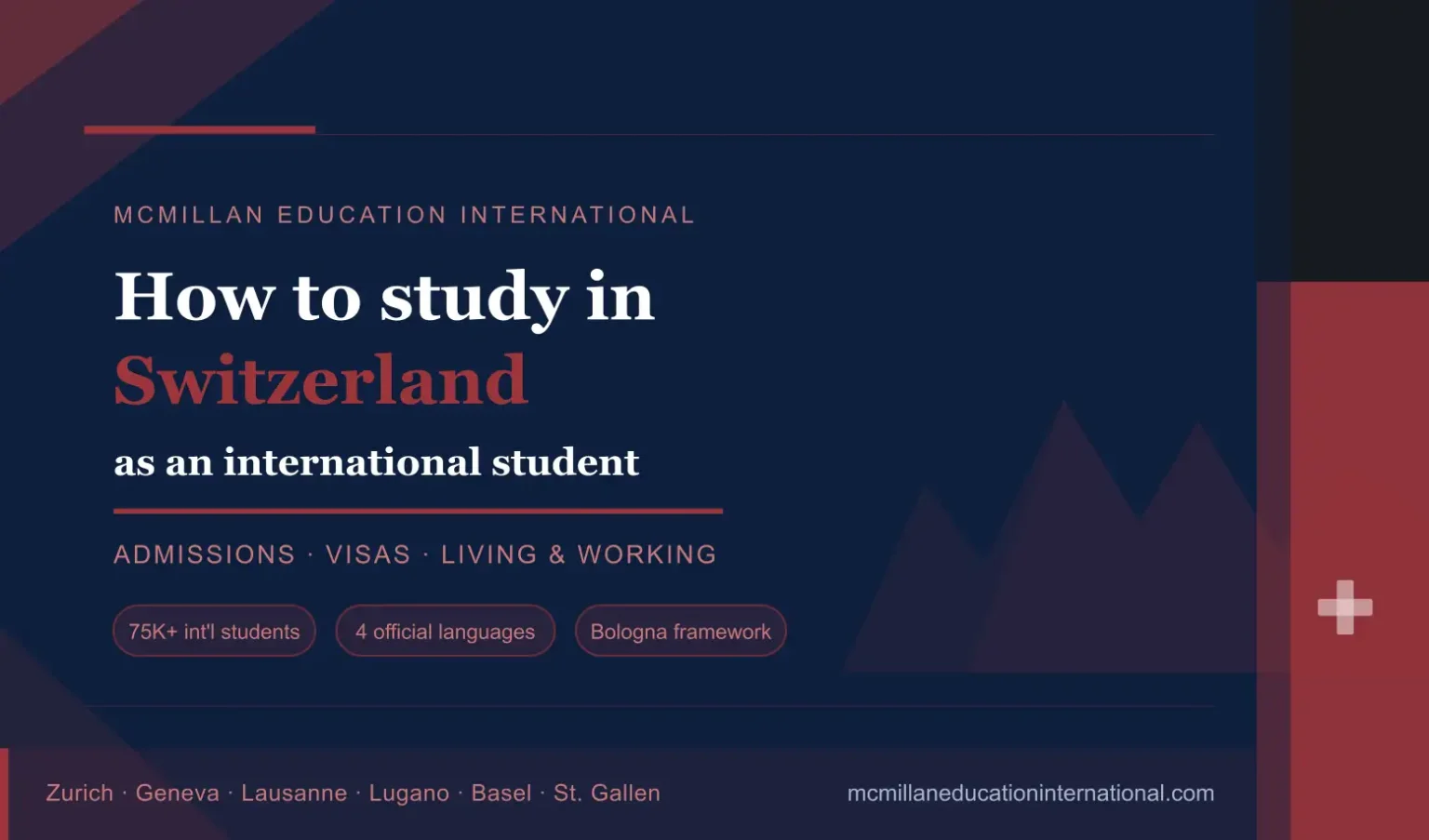
To study in Switzerland as an international student is to navigate a higher education system governed simultaneously at the federal and cantonal levels. Beyond that jurisdictional complexity, admission procedures, entrance examinations, language requirements, and application timelines vary further depending on institution type.
Switzerland nonetheless remains one of the أفضل الدول للطلاب الدوليين; its institutions consistently rank among the continent’s strongest, and its professional environment is difficult to replicate elsewhere.
This article covers how to study in Switzerland as an international student, from admission requirements and the application process to living and working considerations.
For families evaluating English-taught programs specifically, our article on English-speaking universities in Switzerland covers the available institutions in detail.
Benefits of Studying in Switzerland for International Students
1. International by Design
Switzerland enrolls between 75,000 and 80,000 international students annually, a figure that reflects not an open-door admissions policy but sustained demand from applicants across every region of the world. Switzerland has four official languages, German, French, Italian, and Romansh, but the working languages across its academic and professional environments include English as a de facto fourth.
For international students in Switzerland, that environment produces a peer network built across dozens of nationalities and cross-cultural competencies that compound across every dimension of academic and professional life.
2. Academic Quality
Switzerland ranks among the world’s highest investors in research and development as a share of GDP. The return on that investment is visible at the institutional level: Swiss universities generate research output at a scale and density that most national higher education systems do not approach.
Students who want to study in Switzerland should know that the academic environment combines strong research output with comparatively small class sizes, a combination that shapes both instruction quality and access to faculty.
That standing is reflected in the rankings: Swiss institutions place consistently among the best European universities, and degrees from accredited Swiss institutions carry recognition across graduate programs and employer markets globally.
3. Location and Professional Environment
Geneva and Zurich together represent two of Europe’s most distinctive professional environments; one anchored by international organizations and diplomatic institutions, the other by finance, technology, and pharmaceuticals. For students studying in Switzerland, that proximity translates directly into internship access and professional networks. Few countries combine that professional density with the quality of life that Switzerland consistently delivers.
The Swiss Higher Education System Explained
The architecture of Switzerland’s higher education system has direct consequences for how international students apply, where they can study, and which degree levels are open to them. Those consequences vary depending on institution type.
1. Types of Institutions
Switzerland’s higher education system is organized across four distinct institution types, each operating under different regulatory conditions and serving different academic purposes:
- Cantonal universities: ten in total, maintained by their respective cantons, research-intensive, covering law, medicine, humanities, social sciences, and natural sciences
- Federal institutes of technology: two institutions governed directly by the Confederation, outside the cantonal framework entirely
- Universities of applied sciences: professionally oriented, focused on applied research and industry-relevant programs
- Private institutions: predominantly in hospitality, business, and liberal arts, operating under Swiss accreditation requirements but independent of cantonal funding
Institution type determines everything that follows: admission criteria, fee structure, language of instruction, and available programs differ across these four categories.
2. Languages of Instruction
Switzerland has four official languages distributed by region: German in the north and east, French in the west, Italian in the south, and Romansh in the southeast, but the languages of instruction at Swiss institutions are German, French, Italian, and, increasingly, English. Which language dominates at any given institution reflects its location and type
For international students, the practical picture is:
- Cantonal universities in Zurich, Bern, and Basel teach predominantly in German at the undergraduate level
- Cantonal institutions in Geneva, Lausanne, and Fribourg teach predominantly in French
- English-medium undergraduate programs at public universities are limited and concentrated in specific disciplines
- Private institutions deliver most programs in English, regardless of location
- At the master’s level, English-taught options expand considerably across both public and private institutions
- For those planning to study in Switzerland through English-medium programs, availability varies significantly by institution type and degree level. Private institutions deliver most programs in English; public universities do not, with the exception of select master’s programs.
3. Bachelor’s, Master’s, and Doctoral Programs
Switzerland operates within the Bologna framework, standardizing degree structures across participating European countries:
- Bachelor’s – typically three years at public institutions, some four-year programs
- Master’s – one to two years, depending on discipline and institution
- Doctoral – available at cantonal universities and federal institutes of technology only; universities of applied sciences and private institutions do not hold doctorate-awarding rights
Bologna alignment means qualifications from accredited Swiss institutions transfer cleanly across most European graduate programs and employer markets.
Swiss University Admission Requirements for International Applicants
Switzerland’s admission requirements are not administered centrally. Each institution sets and applies its own criteria within the framework established by federal and cantonal regulation, which means the requirements an international applicant faces depend as much on where they are applying as on what qualification they hold.
1. Academic Qualifications
Swiss cantonal universities take the Swiss Matura as their admissions baseline and evaluate international credentials against it. The practical consequence is that not all internationally recognized secondary qualifications are accepted on equivalent terms.
1.1 Qualifications with general recognition across Swiss public universities:
- International Baccalaureate (IB Diploma) – accepted, with a minimum score of 32/42 at most cantonal universities; federal technical institutes require 38/42. Subject combination requirements apply and vary by institution
- German Abitur – recognized, with some institutions requiring specific subject combinations
- French Baccalaureate – recognized, subject to grade thresholds
- مستويات A-Levels – accepted at most institutions, typically requiring a minimum of three subjects
1.2 Qualifications requiring supplementary assessment:
- US high school diploma – completed alongside a minimum of three Advanced Placement classes in mathematics, sciences, and a language, each with a final exam score of 3 or above. Requirements vary by institution
- Other national certificates – evaluated case by case against the Swiss Matura standard
Private institutions apply their own admissions criteria independently of the cantonal framework and generally take a broader view of international qualifications.
2. Language Proficiency Requirements
Language proficiency requirements for international students in Switzerland follow the institution’s language of instruction and are set independently by each institution. The certificates most widely accepted:
2.1 German-medium institutions:
- TestDaF, typically requires TDN 4 across all components
- DSH, Deutsche Sprachprüfung für den Hochschulzugang, level DSH-2 or above
- Goethe-Zertifikat C2
2.2 French-medium institutions:
- DALF C1 or C2
- Some institutions accept DELF B2 for specific programs
2.3 English-medium programs:
- IELTS Academic, typically 6.0 to 7.0, depending on institution and program
- TOEFL iBT, typically 80 to 100
- The Duolingo English Test is accepted at a growing number of institutions
- Private institutions set their own thresholds and publish them independently
Native speakers and applicants who completed secondary education in the relevant language are generally exempt from proficiency requirements. Documentation is required. No uniform exemption policy exists across the system; conditions vary by institution.
3. EU/EEA and EFTA vs Non-EU Applicants
Nationality introduces a further layer of variation in Swiss university admission requirements, one whose consequences extend well beyond the visa stage.
3.1 EU/EEA/EFTA applicants
- Treated comparably to Swiss nationals at cantonal universities for admission purposes
- No student visa required; registration with cantonal authorities required within 14 days of arrival
- Subject to the same qualification recognition standards as other international applicants
3.2 Non-EU/EEA/EFTA applicants
- Face additional procedural steps at several cantonal universities, including entrance examinations where foreign applicant quotas apply
- Some programs cap the proportion of non-Swiss students admitted, making competition among non-EU applicants distinct from the general pool
- Credential recognition may require a formal evaluation through the Swiss ENIC office before an application can proceed
- A Swiss Student Visa Type D is required prior to arrival and cannot be obtained without a confirmed place at an accredited institution
Private institutions generally apply uniform admission procedures regardless of nationality, which is one reason they represent a more straightforward entry point for non-EU applicants unfamiliar with cantonal admission requirements in Switzerland.
How to Study in Switzerland: Application Process
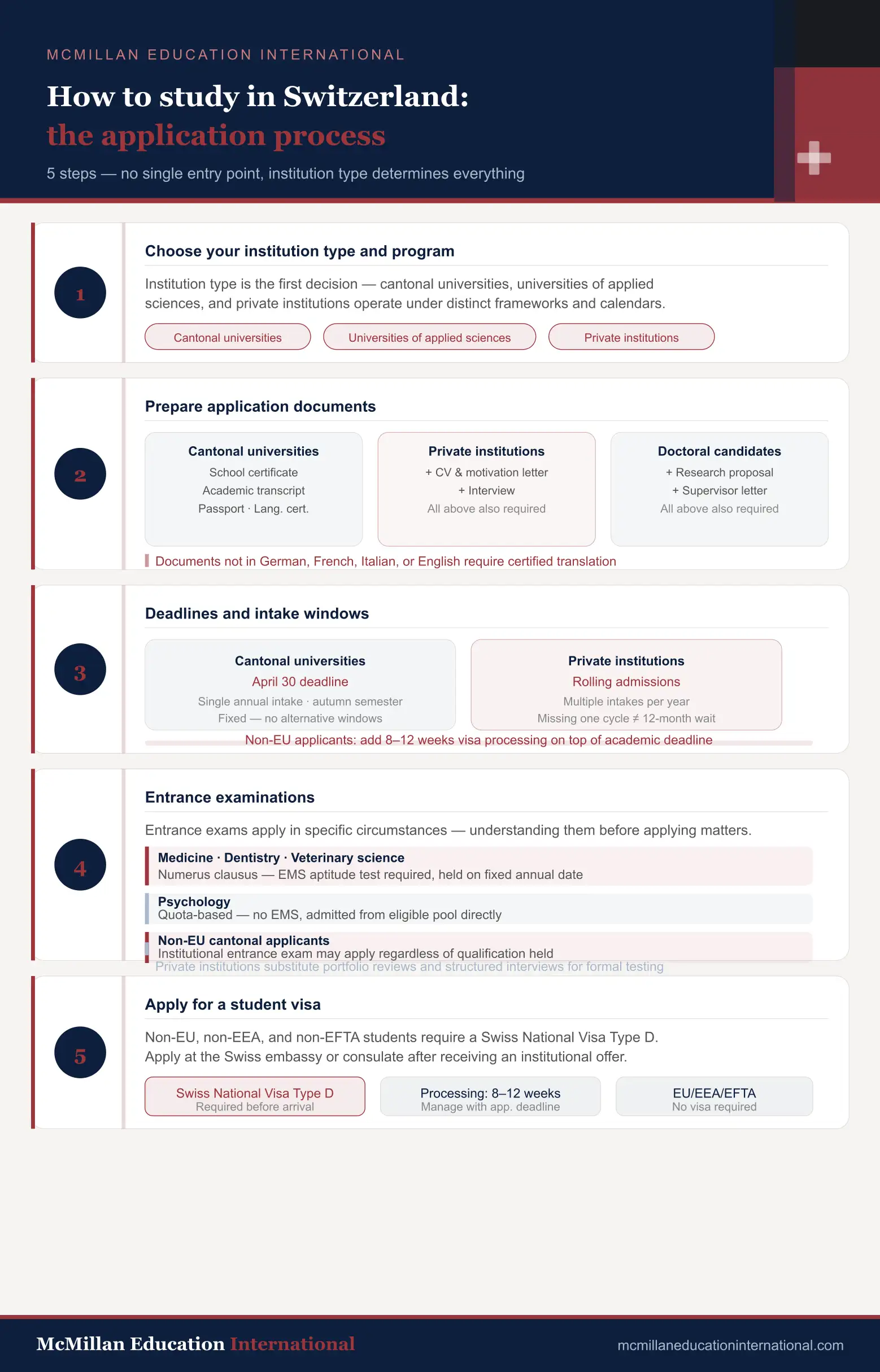
The application process in Switzerland has no single entry point. Where a family begins, and what steps follow, depends entirely on which type of institution they are targeting.
1. Choose Institution Type & Program
To study in Switzerland, the institution type is the first decision. Cantonal universities, universities of applied sciences, and private institutions operate under distinct regulatory frameworks, apply different admission criteria, and run on entirely different calendars.
A family that clarifies institution type before selecting a program arrives at the application stage with the right qualification framework, the right language preparation, and the right timeline already in place.
2. Prepare Application Documents
- Swiss cantonal universities require a secondary school certificate, academic transcript, passport copy, and language proficiency certificate.
- Private institutions layer onto this a CV, motivation letter, and typically an interview.
- Doctoral candidates must additionally provide a research proposal and a letter from a supervising faculty member.
- Documents not in German, French, Italian, or English require certified translation before submission.
3. Deadlines and Intake Windows
Cantonal universities in Switzerland operate a single annual intake, with April 30 as the standard application deadline for the autumn semester. That fixed calendar leaves little room for families whose planning timelines run long.
Private institutions offer a structural alternative: rolling admissions across multiple intake windows per year, which means a family that misses one cycle does not wait twelve months for the next.
Non-EU applicants targeting public institutions must build eight to twelve weeks of visa processing time into their planning on top of the academic deadline. The two timelines do not run in parallel. They must be managed simultaneously.
4. Entrance Examinations
Entrance examinations in the Swiss system apply in specific circumstances that warrant understanding before an application is submitted.
Medicine, dentistry, and veterinary science at cantonal universities are numerus clausus programs: quota-based admissions where a recognized qualification establishes eligibility but does not guarantee a place.
Admission is determined in part by performance on the EMS aptitude test, administered in the language of instruction at the relevant institution and held on a fixed annual date. Psychology operates under the same quota system but does not require the EMS; admission is determined from the eligible applicant pool directly.
Non-EU applicants to certain cantonal universities face institutional entrance examinations as a condition of admission, regardless of the secondary qualification they hold. At the federal technical institutes, applicants presenting non-standard qualifications sit either a reduced or a comprehensive entrance examination, depending on their credential profile. Private institutions substitute portfolio reviews and structured interviews for formal entrance testing.
5. Apply for a Student Visa
International students from outside the EU, EEA, and EFTA require a Swiss National Visa Type D before arriving in the country. Applications are submitted to the Swiss embassy or consulate in the applicant’s home country after an institutional offer has been received. As noted above, visa processing and application deadlines must be managed simultaneously.
Living and Working in Switzerland as an International Student
Studying in Switzerland involves financial and practical variables that differ considerably by institution type, city, and nationality.
1. Tuition Fees and Cost of Living in Switzerland
Tuition at Swiss cantonal universities runs approximately CHF 1,000 to CHF 2,000 per semester for international students, making public institutions among the most cost-competitive accredited options in Europe. Private institutions operate on a different scale entirely:
- Annual tuition ranges from CHF 20,000 to CHF 55,000 depending on the program
- Health insurance is mandatory for all students and must be budgeted separately
- Location produces the sharpest cost variation: Zurich and Geneva rank among the most expensive cities in the world; Lugano and smaller university cities offer materially lower living costs while still providing access to accredited Swiss institutions
The total annual cost, including tuition, accommodation, health insurance, and living expenses, is the figure that determines feasibility for international students. Tuition alone does not tell the story.
2. Scholarships for International Students in Switzerland
The Swiss Confederation awards Government Excellence Scholarships annually to postgraduate researchers and artists from over 180 countries, covering tuition, a monthly stipend, and health insurance. These are competitive, require a confirmed Swiss academic supervisor, and are not available at the undergraduate level.
المصدر: What are Swiss Government Excellence Scholarships? by SBFI SEFRI SERI
Several cantonal universities and private institutions offer merit-based partial scholarships, though availability and value vary considerably and warrant direct verification with each institution. Cantonal grants are awarded primarily to students with established Swiss residency. They are not a reliable funding source for incoming international students in Switzerland.
3. Working During Your Studies
Swiss labor law permits international students to work up to 15 hours per week during term time, but the conditions attached to that permission vary by nationality and require careful planning:
- The 15-hour allowance applies only after six months of continuous residence in Switzerland.
- Full-time work is permitted during official holiday periods.
- For non-EU, non-EEA, and non-EFTA students, the employer must apply for a work permit before employment begins; the student cannot initiate this process independently.
4. Post-Study Work Rights in Switzerland
Switzerland has no dedicated post-study work visa. Graduates of recognized Swiss institutions may apply for a six-month residence permit extension before their student permit expires, during which they may seek qualified employment. The conditions are strict:
- The permit is non-renewable and cannot be extended under any circumstances
- Work during the six-month period is capped at 15 hours per week
- Transitioning to full employment follows the same employer-initiated permit process described above; the graduate cannot apply independently
- Non-EU nationals enter the quota system at that point: 4,000 short-term and 4,500 long-term permits are allocated annually for non-EU nationals across all sectors
In recent years, these quotas have not been fully exhausted, which means the system is competitive rather than categorically closed. Research, technology, and shortage-sector roles offer the most direct pathway into the quota for non-EU graduates.
Start Planning Your Studies in Switzerland
Studying in Switzerland demands early, accurate planning across variables that do not align by default. Families who understand the system’s architecture before applying are consistently better positioned than those who do not.
McMillan Education has placed students from 65 countries into over 450 universities across multiple study destinations, including Switzerland. McMillan’s European university admission consultants apply decades of cross-system admissions expertise to identify the right institutions, in the right countries, for each applicant’s academic profile and objectives.
Families considering Switzerland as a study destination are welcome to schedule a استشارة مجانية with McMillan’s international educational consultant.
الأسئلة المتداولة
1. What are the admission requirements for international students at Swiss universities?
Swiss university admission requirements vary by institution type and are not administered centrally. Cantonal universities evaluate international qualifications against the Swiss Matura standard; private institutions set their own criteria. Language proficiency certificates in the relevant language of instruction are required across all institution types. Numerus clausus programs, medicine, veterinary science, and psychology, operate under quota-based admission regardless of the qualifications held.
2. Which international qualifications are recognized by Swiss universities?
The IB Diploma, German Abitur, French Baccalaureate, and A-Levels carry general recognition at Swiss cantonal universities, subject to minimum score and subject combination requirements. The US high school diploma requires a minimum of three Advanced Placement classes with scores of 3 or above. Other national certificates are evaluated case by case. Private institutions take a broader view of international qualifications than public cantonal universities.
3. Do international students need a visa to study in Switzerland?
EU, EEA, and EFTA nationals do not require a student visa. Nationals from all other countries require a Swiss National Visa Type D, applied for at the Swiss embassy or consulate in their home country after receiving a confirmed institutional offer. Processing runs eight to twelve weeks. On arrival, all students must register with cantonal authorities within 14 days.
4. Which cities in Switzerland are most affordable for students?
Zurich and Geneva rank among the most expensive cities in the world and carry the highest cost of living for students. Lugano, St. Gallen, and Fribourg offer materially lower living costs while still providing access to accredited institutions.
5. What is the difference between public and private universities in Switzerland?
Public cantonal universities are maintained by cantonal governments, charge low tuition fees, teach predominantly in German or French, and evaluate international qualifications against the Swiss Matura standard. Private institutions operate independently of cantonal funding, set their own tuition and admission criteria, deliver most programs in English, and apply more flexible qualification recognition.
6. Can I stay in Switzerland after graduating?
Non-EU, non-EEA, and non-EFTA graduates may apply for a six-month residence permit extension to seek employment after completing their degree. The permit is non-renewable, and work during the period is capped at 15 hours per week. Securing full-time employment requires the employer to apply for a work permit on the graduate’s behalf. Non-EU nationals then enter Switzerland’s annual quota system for non-EU workers, which allocates 4,000 short-term and 4,500 long-term permits per year across all sectors.