
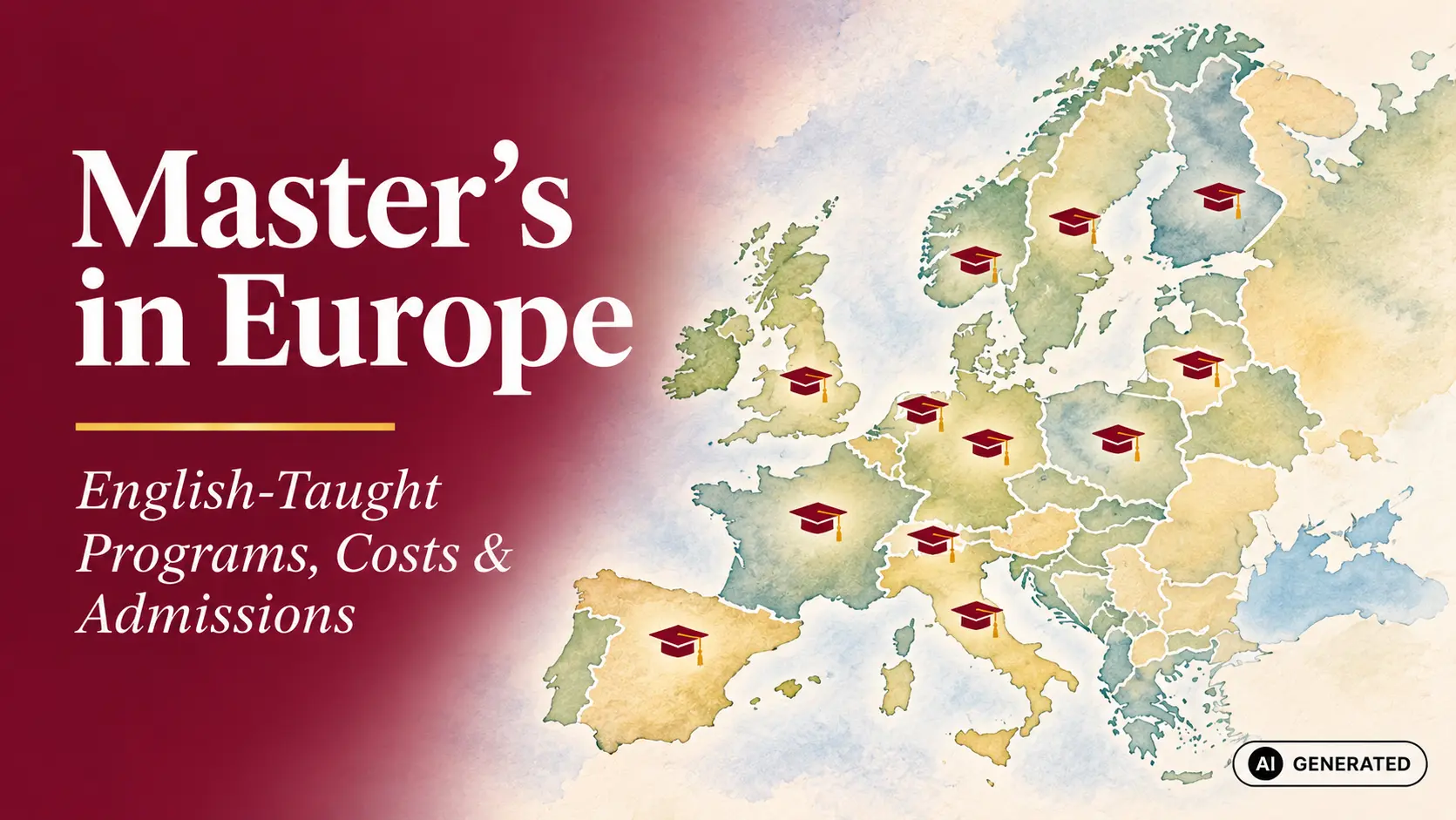
Some applicants begin a master’s in Europe straight from a bachelor’s degree, while others return to study after years of work to specialize or change careers. In both cases, an English-taught master’s in Europe allows them to study at a European university without speaking the local language, as long as their academic background meets the program’s requirements.
This article highlights English-taught master’s programs at universities across Europe, organized by country, and explains how international students apply, from eligibility and language requirements to application timelines.
English-Taught Master’s Programs in Europe: Quick List
The universities below offer English-taught master’s programs across several fields. Each is profiled in the next section.
| University | Country | EU/EEA Fee (annual) | Non-EU Fee (annual) |
|---|---|---|---|
| Ghent University | Belgium | €1,229.70 | €12,557.70 |
| KU Leuven | Belgium | €1,181.40 | €9,493.92 |
| Aarhus University | Denmark | None | €13,000–€17,300 |
| University of Copenhagen | Denmark | None | DKK 100,000–130,000 |
| University of Helsinki | Finland | None | €13,000–€18,000 |
| Université Paris-Saclay | France | €255 | €255–€6,254 |
| Université PSL | France | €255 | €3,950 |
| Heidelberg University | Germany | None | €3,000 |
| LMU Munich | Germany | None | None |
| Trinity College Dublin | Irland | From €3,150 | From €12,330 |
| University College Dublin | Irland | From €3,500 | From €5,635 |
| Sapienza University of Rome | Italy | Up to €2,924 | €300–€1,500 |
| University of Bologna | Italy | Up to €2,550 | Up to €2,550 |
| Maastricht University | Netherlands | €2,771 | €21,800–€32,000 |
| University of Amsterdam | Netherlands | €2,771 | €13,200–€37,200 |
| University of Oslo | Norway | None | NOK 186,000–218,000 |
| Autonomous University of Barcelona | Spain | €1,061–€1,162 | €3,960–€5,520 |
| Pompeu Fabra University | Spain | €1,162 | €5,750 |
| Lund University | Sweden | None | SEK 135,000–270,000 |
| Uppsala University | Sweden | None | SEK 99,000–180,000 |
| University of Basel | Switzerland | CHF 1,700 | CHF 1,700 |
European Master’s Programs Taught in English, by Country
Below is a carefully selected list of universities offering English-taught master’s programs in Europe for international students. This is not a ranking, nor an endorsement of one institution over another. The universities included meet a clear, practical criterion: each appears in the QS World University Rankings: Europe 2026 top 100, excluding the United Kingdom, and offers fully English-taught master’s degrees across several fields of study to international students.
Universities are listed alphabetically by country. Europe has many other quality institutions offering strong master’s programs, including the technical universities covered in our article on engineering universities in Europe.
Belgium
The English-taught master’s programs in Belgium on this list are offered by two universities in Flanders and take one or two years, depending on the program. Applicants apply directly to each university, and students from outside the European Economic Area (EEA) pay a higher fee set by the university.
Ghent University
Ghent University, founded in 1817, is one of Belgium’s largest universities and offers English-taught master’s programs to international students at its campuses in Ghent, Flanders. Its master’s degrees taught in English cover the humanities, business and economics, engineering and architecture, and the sciences, with both MA and MSc programs available. Ghent also offers English-taught advanced master’s programs for students who already hold a master’s degree.
- Standort: Ghent, Belgium
- QS Europe Rank 2026: #42
- English-taught master’s: 67 master’s programs and 14 advanced master’s programs in the university’s 2027/28 catalog
- Fields: Arts and philosophy, economics and business, engineering and architecture, sciences
- Program length: One or two years, depending on the program
- Non-EEA tuition: €12,557.70 per year
- EEA tuition: €1,229.70 per year
KU Leuven
KU Leuven, founded in 1425, is the oldest university in the Low Countries and one of Europe’s largest research universities, offering English-taught master’s programs to international students in Leuven, east of Brussels. Its master’s degrees taught in English span 15 faculties, covering the humanities, law, business and economics, engineering, the sciences and health sciences.
- Standort: Leuven, Belgium
- QS Europe Rank 2026: #30
- English-taught programs: More than 100 across all degree levels, according to the university
- Fields: Humanities, theology, law, business and economics, engineering, sciences, health sciences
- Program length: One or two years, depending on the program
- Non-EEA tuition: €9,493.92 per year
- EEA tuition: €1,181.40 per year
Denmark
A master’s in Denmark normally takes two years (120 ECTS), although universities can also offer one-year programs of 60 ECTS. Students from the EU, the EEA and Switzerland study tuition-free, and applicants apply directly to each university.
Aarhus University
Aarhus University, founded in 1928, is Denmark’s second-oldest university and offers English-taught master’s programs to international students in Aarhus, the country’s second-largest city. Its master’s degrees taught in English span the arts, business and social sciences, natural sciences and technology, with both MA and MSc programs available.
- Standort: Aarhus, Denmark
- QS Europe Rank 2026: #42 (tied)
- English-taught master’s: More than 50, according to the university
- Fields: Arts, business and social sciences, natural sciences, technology
- Program length: Two years for most programs
- Non-EU/EEA tuition: €13,000–€17,300 per year
- EU/EEA tuition: None
University of Copenhagen
The University of Copenhagen, founded in 1479, is Denmark’s oldest university and offers English-taught master’s programs to international students across its campuses in the Danish capital. Its master’s degrees taught in English cover the humanities, social sciences, natural sciences, health and medical sciences, and law.
- Standort: Copenhagen, Denmark
- QS Europe Rank 2026: #45 (tied)
- English-taught master’s: More than 50, according to the university
- Fields: Humanities, social sciences, natural sciences, health and medical sciences, law
- Program length: Two years for most programs
- Non-EU/EEA tuition: DKK 100,000–130,000 per year
- EU/EEA tuition: None
Finland
A master’s in Finland takes two years (120 ECTS) and is applied for through Studyinfo, the national application service, where non-EU/EEA applicants pay a one-time €100 fee. Students from the EU, the EEA and Switzerland study tuition-free.
University of Helsinki
The University of Helsinki, founded in 1640, is Finland’s oldest and largest university and offers English-taught master’s programs to international students across the humanities, social sciences and natural sciences. Admission runs once a year, for studies starting in the autumn.
- Standort: Helsinki, Finland
- QS Europe Rank 2026: #47
- English-taught master’s: More than 30 international master’s programs, according to the university
- Fields: Humanities, social sciences, behavioral sciences, natural sciences, agriculture and forestry
- Program length: Two years (120 ECTS)
- Non-EU/EEA tuition: €13,000, €15,000 or €18,000 per year, depending on the program
- EU/EEA tuition: None
France
In France, English-taught master’s programs usually run as tracks (parcours) within a two-year national master’s degree, and applicants with a bachelor’s degree enter in the first year (M1). Tuition is set by the state at a low rate for EU/EEA students, while universities may charge non-EU/EEA students more or waive the difference.
Université Paris-Saclay
Université Paris-Saclay is a research university south of Paris, offering English-taught master’s tracks to international students in engineering, computer science, the natural and life sciences, health, and economics and business.
- Standort: Paris region, France
- QS Europe Rank 2026: #27
- English-taught master’s: English-taught tracks across several graduate schools. In engineering alone, 12 of 77 master’s tracks are taught fully in English, according to the university
- Fields: Computer science and AI, engineering, physics, chemistry, life sciences, health, economics and business
- Program length: Two years (M1 and M2). Applicants with a bachelor’s degree enter at M1, since M2 entry requires a completed first year of a master’s
- Non-EU/EEA tuition: €255 per year for standard national master’s under the university’s fee waiver; €6,000–€6,254 for some international tracks
- EU/EEA tuition: €255 per year
Université PSL
Université PSL is a collegiate university in central Paris that brings together institutions such as École Normale Supérieure and Université Paris Dauphine, offering English-taught master’s tracks to international students in the sciences, economics, management and the social sciences.
- Standort: Paris, France
- QS Europe Rank 2026: #8
- English-taught master’s: 43 tracks taught in English, according to the university
- Fields: Sciences and engineering, economics, management, social sciences
- Program length: Two years (M1 and M2). Applicants with a bachelor’s degree enter at M1, since M2 entry requires a completed first year of a master’s
- Non-EU/EEA tuition: Varies by school and program. For example, national master’s at Dauphine–PSL cost €3,950 per year, or €255 with the partial fee waiver
- EU/EEA tuition: €255 per year for national master’s
Germany
German universities distinguish between consecutive master’s programs, which build on a related bachelor’s degree, and non-consecutive programs, which admit students from other fields. A master’s in Germany takes one to two years, and studying in Germany means applying directly through each university’s admission process.
Heidelberg University
Heidelberg University, founded in 1386, is Germany’s oldest university and offers English-taught master’s programs to international students in fields ranging from the humanities and economics to the natural and life sciences.
- Standort: Heidelberg, Germany
- QS Europe Rank 2026: #23
- English-taught master’s: Programs across the humanities, sciences and economics, listed in the university’s catalog of English-taught degrees
- Fields: Humanities, anthropology, economics, computer science, mathematics, physics, life sciences, medical research
- Program length: One to two years, depending on the program
- Non-EU/EEA tuition: €3,000 per year (€1,500 per semester) for consecutive master’s programs, plus a semester contribution of €189.80
- EU/EEA tuition: None, plus a semester contribution of €189.80
LMU Munich
LMU Munich, founded in 1472, is one of Germany’s largest universities and offers English-taught master’s programs to international students across the humanities, social sciences, economics and the natural sciences.
- Standort: Munich, Germany
- QS Europe Rank 2026: #17 (tied)
- English-taught master’s: Programs across most faculties, listed in the university’s catalog of international degree programs
- Fields: Humanities, political science, media, economics and management, law, psychology, health, natural sciences, computer science
- Program length: One to two years, depending on the program
- Non-EU/EEA tuition: None for consecutive master’s programs, plus a semester contribution of €97
- EU/EEA tuition: None for consecutive master’s programs, plus a semester contribution of €97
Irland
As an English-speaking country, Ireland teaches every degree in English, from the bachelor’s degree to the master’s, and its taught master’s programs commonly take one year of full-time study (90 ECTS). Both universities on this list are among the universities in Dublin; applicants apply directly to each institution and tuition is set by program, with higher fees for students from outside the EU/EEA.
Trinity College Dublin
Trinity College Dublin, founded in 1592, is Ireland’s oldest university and offers taught master’s programs to international students in the arts, humanities and social sciences, engineering, mathematics and computer science, and health sciences, on a campus in central Dublin.
- Standort: Dublin, Ireland
- QS Europe Rank 2026: #29
- English-taught master’s: All programs are taught in English
- Fields: Arts, humanities and social sciences; engineering, mathematics and science; health sciences
- Program length: One year full-time for most taught master’s
- Non-EU/EEA tuition: From €12,330 per year, depending on the program
- EU/EEA tuition: From €3,150 per year, depending on the program
University College Dublin
University College Dublin is Ireland’s largest university and offers taught master’s programs to international students across business, computing, engineering, science, law, social sciences, agriculture and health sciences, on its campus in south Dublin.
- Standort: Dublin, Ireland
- QS Europe Rank 2026: #38
- English-taught master’s: All programs are taught in English
- Fields: Business, computing, engineering, science, law, social sciences, agriculture, health sciences
- Program length: One year full-time for most taught master’s
- Non-EU/EEA tuition: From €5,635 per year, depending on the program
- EU/EEA tuition: From €3,500 per year, depending on the program
Italy
A master’s in Italy (laurea magistrale) takes two years (120 ECTS), and tuition is calculated on family income, with reduced rates for income earned abroad at both universities below. Applicants from outside the EU who live abroad also complete a pre-enrolment request on Universitaly, the national portal.
Sapienza University of Rome
Sapienza University of Rome, founded in 1303, is one of Europe’s largest universities and offers English-taught master’s programs to international students in engineering, computer science, the natural and life sciences, architecture, the humanities and economics.
- Standort: Rome, Italy
- QS Europe Rank 2026: #77
- English-taught master’s: 45 second-cycle master’s programs, according to the university, 9 of which also offer an Italian curriculum
- Fields: Engineering, computer science, physical and life sciences, architecture, humanities, economics and policy
- Program length: Two years (120 ECTS)
- Non-EU/EEA tuition: €300, €700 or €1,500 per year for students with income earned abroad, depending on their country, plus a €140 regional tax and €16 stamp duty
- EU/EEA tuition: Up to €2,821–€2,924 per year depending on the faculty, reduced according to family income
University of Bologna
The University of Bologna, founded in 1088, is widely regarded as the oldest university in continuous operation in the Western world and offers English-taught master’s programs to international students across nearly every field, from engineering and economics to medicine and the humanities.
- Standort: Bologna, Italy
- QS Europe Rank 2026: #59
- English-taught master’s: 82 second-cycle degree programs in English for 2026/27, according to the university’s catalog
- Fields: Agriculture, business and economics, engineering, humanities, languages, law, medicine, pharmacy, political science, psychology, sciences, statistics, veterinary medicine
- Program length: Two years (120 ECTS)
- Non-EU/EEA tuition: Based on income and program, up to €2,550 per year for most second-cycle programs; €600 or €1,200 under reduced flat rates for applicants from eligible countries, plus a fixed annual charge of €157.04
- EU/EEA tuition: Based on income and program, up to €2,550 per year for most second-cycle programs, with full waivers available
Netherlands
A master’s in the Netherlands starts with an application in Studielink, the national enrollment system, followed by each university’s own portal, and programs take one or two years. Both universities below also run liberal arts and sciences colleges for bachelor’s students, and our article on studying in the Netherlands covers the wider Dutch system.
Maastricht University
Maastricht University, founded in 1976, is one of the Netherlands’ most international universities and offers English-taught master’s programs to international students across business and economics, law, the arts and social sciences, health and life sciences, psychology and neuroscience, and science and engineering, all taught through Problem-Based Learning in small tutorial groups.
- Standort: Maastricht, Netherlands
- QS Europe Rank 2026: #88 (tied)
- English-taught master’s: The majority of programs are taught in English, according to the university
- Fields: Arts and social sciences, business and economics, law, health and life sciences, psychology and neuroscience, science and engineering
- Program length: One or two years, depending on the program
- Non-EU/EEA tuition: €21,800, €25,500 or €32,000 per year, depending on the program
- EU/EEA tuition: €2,771 per year
University of Amsterdam
The University of Amsterdam, founded in 1632, is one of the largest universities in the Netherlands and offers English-taught master’s programs to international students in the humanities, social and behavioral sciences, business and economics, law and the sciences, including research master’s programs for students planning a PhD.
- Standort: Amsterdam, Netherlands
- QS Europe Rank 2026: #24
- English-taught master’s: More than 200 English-taught master’s programs and tracks in the university’s catalog
- Fields: Humanities, social and behavioral sciences, business and economics, law, sciences, medical informatics
- Program length: One or two years, depending on the program
- Non-EU/EEA tuition: €13,200–€37,200 per year, depending on the program, with the highest fees for medicine and dentistry
- EU/EEA tuition: €2,771 per year
Norway
A master’s in Norway takes two years for most programs, and public universities charge tuition only to students from outside the EU/EEA and Switzerland. All students pay a small semester fee for student welfare services.
University of Oslo
The University of Oslo, founded in 1811, is Norway’s oldest university and offers English-taught master’s programs to international students in the humanities, education, social sciences, mathematics and natural sciences, computer science, and health and medicine.
- Standort: Oslo, Norway
- QS Europe Rank 2026: #64
- English-taught master’s: More than 40 programs taught entirely in English, according to the university
- Fields: Humanities, education, social sciences, mathematics and natural sciences, computer science, health and medicine
- Program length: Two years for most programs
- Non-EU/EEA tuition: NOK 186,000–218,000 per year for on-campus programs
- EU/EEA tuition: None
Spain
The English-taught programs in Spain listed here are official master’s degrees (másteres universitarios), recognized across the European Higher Education Area, and many take one year (60 ECTS). Both universities are public, so tuition is set per credit by the regional government, with a higher rate for non-EU students, and remains low compared with many destinations for studying in Spain and elsewhere in Europe.
Autonomous University of Barcelona
The Autonomous University of Barcelona (UAB), founded in 1968, offers English-taught official master’s programs to international students in the sciences and engineering, health, economics and business, education, and politics and law, on its campus in Bellaterra outside Barcelona.
- Standort: Bellaterra (Barcelona area), Spain
- QS Europe Rank 2026: #68
- English-taught master’s: More than 80 English-taught programs across master’s degrees, diplomas and specialization courses, according to the university
- Fields: Sciences and engineering, health, economics and business, English studies, education, politics and law
- Program length: One year (60 ECTS) for most programs
- Non-EU/EEA tuition: €3,960–€5,520 per year (60 ECTS)
- EU/EEA tuition: €1,061.40–€1,162.20 per year (60 ECTS)
Pompeu Fabra University
Pompeu Fabra University (UPF), founded in 1990, is a public university in central Barcelona that offers English-taught official master’s programs to international students in economics and business, law, political science, communication, computing and engineering, biomedicine, and the humanities.
- Standort: Barcelona, Spain
- QS Europe Rank 2026: #99
- English-taught master’s: Programs across most fields, listed in the university’s catalog of official master’s degrees
- Fields: Economics and business, law, political science, communication, computing and engineering, biomedicine, humanities and social sciences
- Program length: One year (60 ECTS) for most programs
- Non-EU/EEA tuition: €5,749.80 per year (60 ECTS), including standard administrative charges
- EU/EEA tuition: €1,162.20 per year (60 ECTS)
Sweden
A master’s in Sweden takes one year (60 ECTS) or two years (120 ECTS) and is applied for through Universityadmissions.se, the national application service, where applicants who pay tuition also pay a SEK 900 application fee.
Lund University
Lund University, founded in 1666, is one of Sweden’s largest universities and offers English-taught master’s programs to international students across its faculties, including economics and management, engineering, humanities, law, medicine, the sciences and the social sciences.
- Standort: Lund, Sweden
- QS Europe Rank 2026: #12 (tied)
- English-taught master’s: More than 130 master’s programs taught in English, according to the university
- Fields: Economics and management, engineering, humanities and theology, law, medicine, sciences, social sciences, fine and performing arts
- Program length: One or two years, depending on the program
- Non-EU/EEA tuition: SEK 135,000–270,000 per year, depending on the program
- EU/EEA tuition: None
Uppsala University
Uppsala University, founded in 1477, is Sweden’s oldest university and offers English-taught master’s programs to international students across the humanities and social sciences, medicine and pharmacy, and science and technology.
- Standort: Uppsala, Sweden
- QS Europe Rank 2026: #22
- English-taught master’s: More than 100 international master’s programs, according to the university
- Fields: Humanities and social sciences, medicine and pharmacy, science and technology
- Program length: One or two years, depending on the program
- Non-EU/EEA tuition: SEK 99,000–180,000 per year, depending on the program
- EU/EEA tuition: None
Switzerland
Swiss universities teach in the language of their region, so a master’s in Switzerland in English means choosing among English-taught programs offered alongside local-language ones. Our articles on how to study in Switzerland und English-speaking universities in Switzerland cover the wider system.
University of Basel
The University of Basel, founded in 1460, is Switzerland’s oldest university and offers English-taught master’s programs to international students in the sciences, biomedical engineering, health, business and economics, the humanities and the social sciences, with the same tuition for Swiss and international students.
- Standort: Basel, Switzerland
- QS Europe Rank 2026: #91
- English-taught master’s: 27 English-taught master’s programs and subject options in the university’s catalog
- Fields: Sciences, biomedical engineering, health, business and economics, humanities, social sciences, sustainability
- Program length: Depending on the program
- Non-EU/EEA tuition: CHF 1,700 per year (CHF 850 per semester)
- EU/EEA tuition: CHF 1,700 per year (CHF 850 per semester)
How to Apply for a Master’s in Europe
Applying to graduate school in Europe follows a different logic from the US process, because each program assesses how closely an applicant’s previous degree matches its subject, a correlation our comparison of American and European education systems explains in more detail. For international students, the application comes down to five steps.
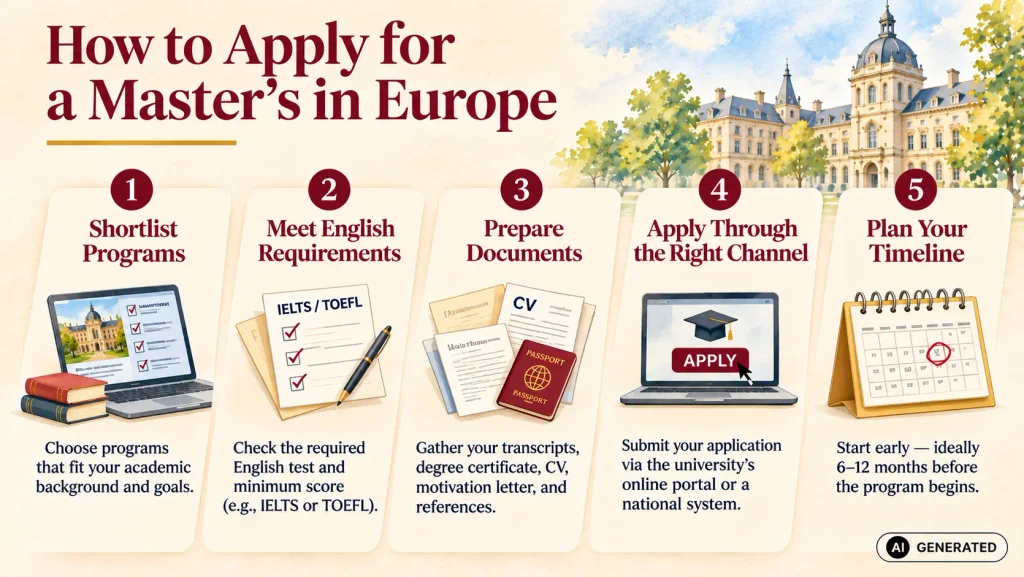
Step 1: Shortlist Programs That Match Your Bachelor’s Degree
European master’s programs admit applicants based on subject match, and each program page lists its required credits in specific subjects, such as mathematics and statistics for an MSc in economics. Applicants should compare their transcript with these requirements before applying, and those who changed fields should look for programs that accept students from other disciplines.
Step 2: Meet the English Language Requirement
English-taught programs require proof of English proficiency, usually through IELTS Academic, TOEFL iBT or Cambridge English (C1 Advanced or C2 Proficiency), with the minimum score set by each program. Some universities do not accept online tests such as the Duolingo English Test, and many exempt native speakers and graduates of English-taught bachelor’s programs. Applicants who need a test should book it early, since scores must usually be available by the application deadline.
Step 3: Prepare the Application Documents
Most graduate programs in Europe ask for:
- Academic transcripts
- The bachelor’s degree certificate, or proof of expected graduation
- A CV
- A motivation letter explaining how previous coursework prepares the applicant for the program
- Reference letters
- Proof of English proficiency
Some programs also ask for a writing sample, portfolio, interview, or GRE or GMAT scores (mainly in business and economics). Documents not issued in English may need certified translations.
Step 4: Apply Through the Right Channel
Each country section above names its application route, and some routes have two stages, such as a national platform followed by the university’s own portal, or a separate national procedure for certain non-EU applicants. Applicants should complete every stage and pay any application fee before the deadline, since an application missing one stage may be treated as incomplete.
Step 5: Plan the Timeline a Year Ahead
For a September start, master’s applications in Europe open in the autumn of the previous year, and many deadlines fall between January and spring, often earlier for non-EU applicants. Planning should begin about twelve months before enrollment, and applicants seeking scholarships should work from the earliest deadline on their list, since funding rounds can close before program applications.
Plan Your Master’s in Europe
McMillan Education International has placed students at 450+ universities worldwide, at both undergraduate and graduate level. Whether an applicant is targeting a single European country or building a list of master’s programs across several countries, the US and the UK at once, our master’s admissions consultants know how these admissions systems work and how they interact.
To plan your master’s in Europe with an educational consultant who works across systems, eine kostenlose Beratung vereinbaren.
Häufig gestellte Fragen
Can Americans get a master’s degree in Europe?
Yes. Universities across Europe accept a US four-year bachelor’s degree for master’s admission, assessing the transcript against each program’s subject requirements, and American students pay non-EU tuition where it applies. Students who prefer a US-style curriculum and accreditation can also consider the American universities in Europe, several of which offer graduate programs.
How much does a master’s in Europe cost?
Tuition for a master’s in Europe depends on the country, the university and the student’s citizenship. Public universities in some countries charge little or no tuition, while others set considerably higher fees for students from outside the EU/EEA, and private universities set their own rates. Because many European master’s programs take one year, the total cost of a degree can also be lower than that of a two-year program.
Can you study a master’s in Europe for free?
In some cases. LMU Munich charges no tuition for consecutive master’s programs, only a semester contribution, and students from the EU/EEA study tuition-free at public universities in Denmark, Finland, Norway, and Sweden. Non-EU students pay tuition in most other cases, although scholarships for non-EU/EEA master’s students can reduce or cover the cost.
Are there scholarships for master’s programs in Europe?
Yes. Scholarships for master’s programs in Europe come from universities, national governments and the European Union, and many target non-EU/EEA students. Erasmus Mundus Joint Master’s programs offer EU-funded scholarships, and individual universities, such as the University of Helsinki, run their own schemes. Scholarship deadlines often fall before program deadlines, so applicants should check funding when they build their shortlist.
Why are some master’s programs in Europe one year and others two?
European master’s programs carry 60, 90 or 120 ECTS credits, equal to one, one and a half, or two years of full-time study, and all lead to the same qualification level. A one-year master’s in Europe is common in Ireland and Spain, while Denmark, Finland and Italy set two years as the standard, and the differences between the types of master’s degrees also affect program length.
Is a European master’s degree recognized in the US?
A master’s degree from an accredited European university is generally recognized in the US. Employers, licensing boards and graduate schools may ask for a credential evaluation to confirm its US equivalent, and the process of establishing foreign degree equivalency in the US depends on the evaluation service and the purpose of the review.
Can US federal student aid be used for a master’s in Europe?
Some European universities participate in the US Federal Direct Loan Program, which allows eligible American students to use federal loans for graduate programs in Europe. Families can check whether a university holds a Federal School Code through the FAFSA school search before applying.