
Summer programs for high school students are often viewed as a quick way to strengthen US college applications. In reality, admissions officers evaluate summer experiences in context, not isolation. What matters is how a student chose to spend their time, how that choice fits into their academic path, and what it signals about readiness for more advanced work.
Timing is another factor families frequently underestimate. Many summer programs for college applications have deadlines that arrive earlier than expected, and some programs fill on a rolling basis well before the posted close date. By the time families begin searching, options may already be limited.
It is also important to understand that not all summer programs carry the same admissions value. Some offer meaningful academic depth, research exposure, or real responsibility, while others function primarily as general enrichment. Because of this, summer programs do not replace strong academic performance. Instead, when chosen carefully, they reinforce a student’s interests, direction, and level of engagement.
When deadlines are approaching, this distinction becomes even more important. While some opportunities may no longer be available, strong and appropriate options often remain.
This guide explains how summer programs are evaluated in US admissions, which types of programs tend to matter most, and how students can make informed, realistic decisions under time pressure.
Principales conclusiones
- Summer programs for high school students are considered part of the overall college application.
- What students do in a program matters more than the program’s name.
- Many summer programs for college applications have earlier deadlines than families expect.
- Academic, research, and internship programs highlight different strengths.
- The best summer programs for teens align with a student’s interests and grade level.
- Missing early deadlines does not eliminate strong summer program options.
- Independent projects can still be a meaningful alternative when planned carefully.
Why Summer Programs Matter for US College Applications
Admissions committees know that the best summer programs for college applications aren’t defined by name or prestige. They evaluate each summer experience in context, alongside a student’s coursework, activities, and overall academic direction.
What admissions officers tend to look for:
- Evidence of initiative and curiosity, shown through structured learning, research, or meaningful work
- Continuity with academic interests or extracurricular involvement, rather than one off experiences
- Depth and outcomes, such as completed projects, research, or skill development, over program name or prestige
Just as important is what summer programs do not do:
- They do not compensate for weak grades or insufficient course rigor
- They do not guarantee admission based on participation alone
Instead, summer programs act as signal amplifiers. When aligned with a strong academic foundation, they reinforce a student’s interests, direction, and readiness for more advanced study, helping admissions committees better understand the full application.
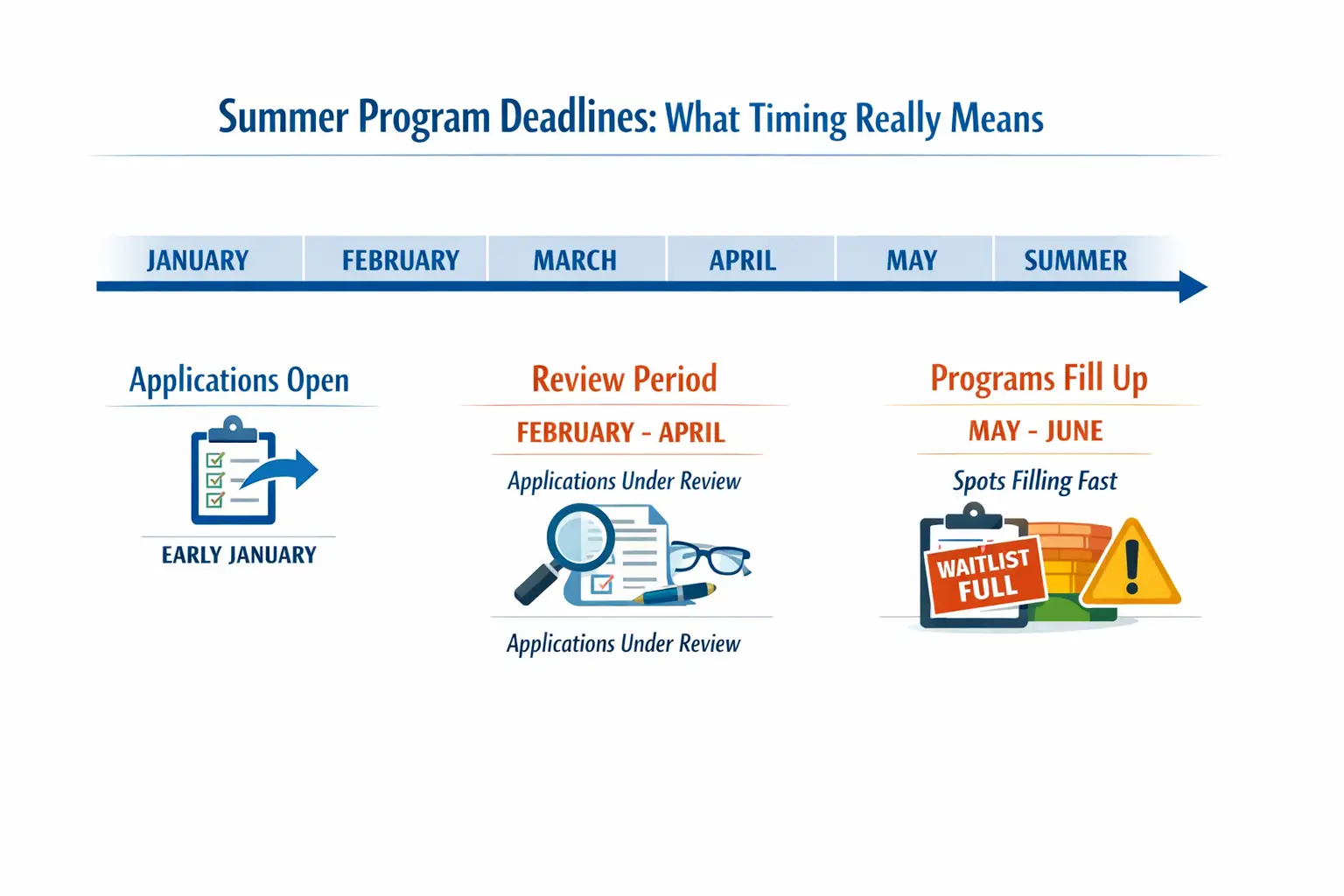
Summer Program Deadlines: What Timing Really Means
Families often assume that summer program deadlines work the same way college application deadlines do. In practice, they usually do not. Many programs begin reviewing applications as soon as they arrive, and decisions are often made long before the published deadline.
Some programs review all applications after a fixed closing date. Others operate on a rolling basis, meaning applications are evaluated as they come in. In those cases, the earlier an application is submitted, the more flexibility the program has. Once spots begin to fill, later applicants may be waitlisted or turned away, even if the deadline has not technically passed.
This is why the early part of the year, often between January and March, tends to matter most. By that point, many of the more structured academic, research, and mentorship summer programs for high school students are already deep into their selection process. Families who start looking in the spring are not necessarily too late, but the landscape looks different than it did a few months earlier.
The practical takeaway is simple. Timing affects not just availability, but choice. When families plan early, they have more room to be selective. When deadlines are approaching, strong options can still exist, but decisions need to be made with a clearer understanding of how programs actually fill.
Types of Summer Programs That Strengthen US College Applications
Not all summer programs are evaluated equally in the US college admissions process. Colleges focus less on program names and more on what the experience requires of the student and what it reveals about academic interests, initiative, and readiness.
The program names below are included as illustrative examples of common program types and are not intended as recommendations.
1. Academic & Pre-College Programs
Academic and pre-college programs are structured summer courses offered by universities or academic institutions. Students typically enroll in one subject and follow a set syllabus, with regular class meetings, assignments, and evaluations over a short period of time, often in campus environments that allow them to explore college with new eyes.
In admissions review, these programs are read as evidence of academic readiness. Colleges look at whether the student was able to handle college-level material, manage the pace of the course, and perform well in a more independent learning environment. Credit status matters less than rigor and performance.
- Harvard Pre-College Program
One of the most competitive summer programs for high school students at colleges, offering residential coursework in a structured campus environment - Stanford Pre-Collegiate Summer Institutes
A subject-focused academic program offering immersive coursework in areas such as science, mathematics, and the humanities through Stanford University. - Summer Science Program (SSP)
A STEM-focused academic program combining classroom instruction, collaborative problem solving, and applied research hosted at university sites.
2. Research & Mentorship Programs
Research summer programs for high school students place students in supervised research environments, often working closely with a faculty member, researcher, or professional mentor. The work may take place in a lab, archive, or structured research setting and usually spans several weeks.
Admissions officers focus on the substance of the work. They look at the student’s role in the project, the length of the engagement, and whether the experience resulted in a paper, presentation, or other documented outcome. These programs are most effective when they align with an existing academic interest.
- Research Science Institute (RSI)
A highly selective summer research program combining advanced coursework and guided research projects in STEM fields. - Stanford Institutes of Medicine Summer Research Program (SIMR)
A biomedical research program where students work in Stanford School of Medicine laboratories under faculty supervision. - NIH High School Summer Internship Program (HS-SIP)
A summer research internship placing students in NIH laboratories to contribute to ongoing biomedical and scientific research.
3. Internships & Professional Experience Programs
Summer internships for high school students involve working within an organization or institution under supervision. Unlike shadowing, these programs assign students defined tasks or projects and expect regular participation and accountability.
For student-athletes, recruiting-focused experiences such as ID camps can serve a similar purpose by providing structured exposure and evaluation within the college athletic recruiting process. These opportunities are most relevant for students pursuing collegiate athletics and should be planned alongside academic priorities and admissions strategy.
In admissions review, internships are evaluated based on responsibility and contribution. Best summer internships for high school students are defined by real work and clear outcomes, not by title alone. Colleges look for evidence that the student was trusted with meaningful tasks and can explain what they did, what they learned, and how the experience connects to their broader interests.
- NASA Office of STEM Engagement (OSTEM) Internships
Structured internships allowing students to work on supervised STEM projects at NASA facilities with professional mentorship. - Bank of America Student Leaders (Internship Component)
An eight-week paid internship placing students in nonprofit organizations, focused on professional skill development and community impact.
4. Leadership, Service, & Impact-Based Programs
Leadership and service programs emphasize civic engagement, leadership development, or community impact through structured activities rather than passive participation.
Admissions officers assess these programs by looking at role and impact. They want to understand what responsibility the student held, how long the involvement lasted, and whether the work led to visible outcomes or sustained engagement.
- National Security Language Initiative for Youth (NSLI-Y)
An intensive language and cultural immersion program supported by the U.S. Department of State, focused on language proficiency and intercultural competency. - Boys State and Girls State
Leadership and citizenship programs that simulate government processes, allowing students to take on defined leadership roles in a structured setting.
5. Independent Projects (When Deadlines Are Missed)
When formal summer program deadlines have passed, independent projects become a practical alternative. The value comes from structure and execution rather than institutional affiliation.
A viable independent project has a defined scope, a clear timeline, and a concrete output. That output might be a research paper, a technical build, a creative portfolio, a presentation, or documented work with a community organization. Projects without a clear end product tend to carry little weight.
The key consideration is whether the project can be completed and documented before applications are submitted. When designed with that constraint in mind, independent projects can provide credible evidence of initiative during a summer with limited program availability.
How to Choose the Right Summer Program for US College Applications
Choosing a summer program often feels harder than it should. Options vary widely in structure, cost, selectivity, and time commitment, and families are rarely comparing like for like. Narrowing choices requires looking closely at what the program actually involves on a day-to-day basis.
The most effective approach is to work through a small set of practical questions. These questions help determine whether a summer program is a good fit for the student, realistic given the timeline, and worth the effort involved. The framework below outlines those considerations.
1. A Practical Evaluation Framework
Selectivity and admissions signal
Some summer programs are more selective than others, but selectivity only helps when the program is a realistic fit. A program that is too advanced or misaligned often creates stress without adding value.
Depth of engagement
Look closely at how the program is structured. Rigorous summer school programs with sustained work over several weeks tend to be more meaningful than brief, loosely defined activities.
Alignment with academic interests
Summer programs work best when they connect to subjects the student already enjoys or wants to explore further. Alignment helps students stay engaged and makes it easier to explain the choice later.
Quality of mentorship or supervision
Programs vary widely in how much guidance students receive. Clear supervision, feedback, and expectations usually lead to better outcomes than programs where students are left to self manage without structure.
Feasibility
Timing, location, cost, and workload all matter. A program that looks strong on paper but creates logistical strain or competes with other priorities is rarely the right choice.
2. Planning by Grade Level
Expectations for summer programs change as students move through high school. What makes sense one year may not make sense the next, and colleges take that progression into account.
Grades 9–10
At this stage, the best summer programs for teens focus on exploration. Some enrichment, such as how to combine exploration, growth, and fun, can be especially appropriate here, alongside trying new subjects, building skills, and gaining confidence in more challenging academic settings.
Grade 11
This is the summer when choices matter most. Programs should reflect a clearer academic direction and involve deeper engagement than earlier years.
Grade 12 (Rising Seniors)
For rising seniors, the priority is balance. Summer activity should support the existing academic path without overwhelming the college application process or pulling focus away from essays and deadlines.
International Students: Special Planning Considerations
International students often face additional constraints when choosing summer programs for US college applications. These constraints affect which options are realistic and how early planning needs to begin.
As many international schools don’t offer the breadth of extracurriculars that American schools do, international students can also engage in service projects or leadership activities, or find a part-time job instead of choosing a summer academic program. That way, they can present a more rounded profile to American universities.
1. Eligibility differences
Some summer programs are open only to U.S. citizens or permanent residents, while others accept international students but limit available spots. Eligibility rules vary by program and are not always obvious at first glance, making early review important.
2. Travel and logistical timelines
Travel requirements can significantly affect planning. Application timelines need to account for travel arrangements, housing, and, in some cases, additional documentation required by the program itself. Programs with early start dates or in-person requirements may narrow options for international students.
3. English language academic demands
Many summer programs assume a high level of academic English proficiency, particularly in reading, writing, and discussion-based coursework. Programs that move at a fast pace can be challenging if language demands are underestimated.
4. Program suitability for international transcripts
Some programs are designed with U.S. high school curricula in mind. International students should consider whether a program’s academic level and expectations align with their current coursework and grading system, especially when transcripts are reviewed alongside U.S. applicants.
If Deadlines Are Approaching: Realistic Paths Forward
When summer program deadlines are close or have already passed, the focus shifts from comparing options to choosing a path that can still be completed well. Some programs continue to review applications on a rolling basis, and shorter, structured opportunities with later start dates may still be available. In these cases, clarity and timing matter more than continued searching.
When formal programs are no longer realistic, a well-defined independent project can be a strong alternative. What matters most is having a clear scope, a manageable timeline, and a concrete outcome that can be completed before applications are submitted. Choosing an option that can be executed fully is more effective than settling for a last-minute program that offers limited substance.
A Final Perspective on Summer Planning
Choosing summer programs works best when decisions are made with a longer view rather than driven by deadlines or program names. The strongest summer choices reflect a student’s academic direction, stage of development, and realistic constraints.
For international families planning US college applications, summer decisions often connect to broader questions about curriculum, academic fit, and timing. McMillan’s international university admission consultants help families think through these choices in context, so summer plans align sensibly with a student’s academic profile and overall admissions goals.
Preguntas frecuentes
1. Do summer programs really help college applications?
Summer school programs can help when they reinforce a student’s academic interests, initiative, or readiness for more advanced work. They do not compensate for weak grades or course rigor, and they are never evaluated on their own.
2. Are pre-college programs worth it?
Pre-college programs can be worthwhile for students who are academically prepared and ready for structured coursework. Their value depends on rigor, engagement, and fit, not on whether the program offers college credit or carries a recognizable name.
3. What if I missed early deadlines?
Missing early deadlines does not mean there are no good options left. Rolling-admission programs, shorter structured opportunities, or a well-planned independent project can still provide meaningful admissions value when executed thoughtfully.
4. Do colleges prefer academic or experiential programs?
Colleges do not have a blanket preference. They look for coherence. Academic programs tend to work well for students with strong classroom interests, while experiential programs are effective when they involve real responsibility and clear outcomes.
5. Are summer programs necessary for top US colleges?
No. Many successful applicants do not attend formal summer programs. What matters is how students use their time and whether their choices reflect initiative, depth, and alignment with their academic path.