For international student-athletes, U.S. college athletics represents one of the most structured pathways to compete at the highest athletic level collegiately abroad while earning the opportunity to fund all or part of the university degree. The administrative complexity of entering it from outside the country is unlike anything domestic recruits face.
This article covers U.S. college sports eligibility requirements, amateurism certification, the recruiting process, and what college coaches evaluate when considering an international prospect.
The U.S. College Athletics Structure: NCAA, NAIA, and NJCAA
No country has developed a collegiate athletics system at the scale of the United States, where competitive sports and higher education operate as a single integrated framework across more than 1,300 institutions. For international student-athletes, it is one of the most administratively complex systems to enter from outside the country.
Three governing bodies structure U.S. collegiate athletics. Which one an international student-athlete targets determines the academic requirements they must meet, the documentation they must submit, the timeline they must follow, and the level at which they will compete.
1. NCAA
En NCAA is the largest governing body in U.S. collegiate sports, overseeing more than 1,100 institutions across three divisions: Division I, Division II, and Division III. Each division operates under different competitive standards, scholarship structures, and recruiting timelines.
For the full breakdown, check our guide to NCAA divisions.
2. NAIA
En NAIA governs approximately 250 smaller, predominantly private institutions across the United States. For international student-athletes encountering the U.S. collegiate athletics system for the first time, the NAIA offers a genuine competitive opportunity with a less complex entry process than the NCAA.
Both full and partial athletic scholarships are available. Institutions tend to be smaller, which means closer relationships with coaching staff and faculty. The eligibility certification process is more straightforward, and the recruiting timeline is generally more flexible.
3. NJCAA
En NJCAA governs more than 500 two-year community colleges across the United States. For international student-athletes, the two-year structure serves a specific and practical purpose: it creates a defined entry point into the U.S. education system before committing to a four-year program. A student-athlete enrolls, competes for up to two seasons under no eligibility clock and no age limit, earns an associate degree, and transfers to an NCAA or NAIA institution with a U.S. academic record, verified competitive footage, and a recruiting profile built on demonstrated performance in the American system.
Which U.S. College Sports Recruit International Athletes Most Actively
U.S. college programs do not recruit internationally at the same rate across all sports. In some disciplines, the global talent pipeline is so established that coaches actively scout overseas competitions, monitor international rankings, and build recruiting classes with international athletes as a primary target. In others, the recruiting infrastructure is built almost entirely around domestic development systems, and international candidates have to work harder to get into the conversation.
What does not change across any sport or division is the administrative complexity of entering the U.S. collegiate sports system from outside the country. Because of those intricacies, many benefit from working with an educational consultant with experience in U.S. college admissions and athletic recruiting.
The sports with the highest concentration of international student-athletes:
- Tennis
- Soccer
- Swimming and diving
- Golf
- Track and field
- Ice hockey
- Field hockey
- Volleyball
- Water polo
Football, baseball, softball, lacrosse, and wrestling recruit internationally at significantly lower rates. The path is not closed, but the work of getting noticed is considerably greater. Basketball sits in a different category: historically a domestic market, but one where international recruitment at the Division I level has accelerated sharply as programs increasingly scout FIBA competitions and European development academies.
Either way, the recruiting mechanics covered in this article apply across all sports.
Eligibility Requirements for International Students
Academic eligibility requirements for international student-athletes differ significantly depending on which governing body oversees the institution. The table below shows where those processes diverge.
|
|
NCAA D1/D2 |
NAIA |
NJCAA |
|
Central clearinghouse |
NCAA Eligibility Center |
NAIA Eligibility Center + InCred |
Honest Game (in transition) |
|
Registration fee |
$170 |
$170 + InCred fee |
None |
|
Transcript requirement |
Original + certified line-by-line English translation |
Original + literal English translation |
Institution-level only |
|
Processing time |
8–12 weeks (longer in summer) |
Submit 2+ months before enrollment |
Varies by institution |
|
External credential evaluation |
Country-specific via Guide to International Academic Standards |
Mandatory InCred evaluation |
None |
|
SAT/ACT for eligibility |
No |
Conditional (if GPA below 2.3) |
No |
1. NCAA
GPA thresholds and core course requirements by division are covered in full in a separate post about general NCAA eligibility requirements. What follows covers what international student-athletes face on top of those baseline requirements.
The NCAA Eligibility Center does not evaluate an international transcript the way it evaluates a domestic one. It runs academic records against country-specific standards published in its Guide to International Academic Standards, a document covering grade conversion scales, recognized qualifications, and required documentation for nearly every national education system. A-Levels and the IB, the French Baccalauréat, the German Abitur, and dozens of other systems are assessed regularly. Families should not assume credentials translate directly. Consult the Guide before submitting anything.
1.1 What international student-athletes must submit
International student-athletes must submit the following to the NCAA Eligibility Center:
- Official academic records from year nine onward, in the original language of issuance
- Certified line-by-line English translation for every non-English document
- Proof of graduation submitted separately: diploma, certificate, or leaving examination record
- All documents must come directly from school officials, not from the student-athlete
Processing takes 8 to 12 weeks under normal conditions and runs longer during peak summer months. A missing translation or a document submitted by the wrong party restarts the clock.
1.2 Standardized tests
The NCAA no longer requires SAT or ACT scores for eligibility. Individual institutions may still require them for admissions or scholarship consideration; verify each school’s policy independently. TOEFL, IELTS, and Duolingo requirements are set by institutions, not the NCAA, but most colleges require English proficiency testing if secondary education was not conducted in English.
2. NAIA
The NAIA adds a step that has no NCAA equivalent: InCred. All international academic records are evaluated through InCred, a credential assessment service integrated into the NAIA eligibility process. This is not optional and cannot be bypassed; transcripts sent directly to the NAIA Eligibility Center are forwarded to InCred automatically. Factor in the InCred fee on top of the $170 registration cost.
2.1 Translation requirements
Records must be submitted in the original language alongside a literal, word-for-word English translation. Certified, notarized, or school-stamped translations are not required, but the translation must be literal. An interpretive translation will trigger a request for new documents or third-party verification. Build in the extra time.
Academic threshold: A GPA of 2.3 or above on graduation qualifies directly. Below 2.3 GPA, meet two of the following three:
- Overall high school GPA of 2.0 or above on a 4.0 scale
- Graduation in the top half of the high school class
- Minimum 18 on the ACT or 970 on the SAT
Unlike the NCAA, standardized test scores remain a qualifying option here. Submit all records at least two months before your enrollment term begins.
3. NJCAA
The NJCAA is the most accessible entry point for international student-athletes on the academic side. There is no central clearinghouse in the traditional sense. A partnership with Honest Game announced in March 2026 is establishing one across the NJCAA’s 500-plus member institutions, but institutional-level determination remains operationally in effect during the transition. Eligibility is assessed by the athletic department at the college the student-athlete plans to attend.
3.1 What this means for international applicants
For international student-athletes, the NJCAA process differs from the NCAA and NAIA in several important ways:
- No external registration fee
- No credential evaluation process comparable to the NCAA’s Eligibility Center or the NAIA’s InCred
- No SAT, ACT, or English proficiency scores required for athletic eligibility (individual institutions may require them for admissions)
- Eligibility documentation is handled directly with the institution
For international student-athletes who need to build a U.S. academic record, accumulate competitive film, or position themselves for transfer to an NCAA or NAIA program, this is a deliberate starting point. Not a fallback.
How Amateurism Certification Works for International Student-Athletes
U.S. college sports are built on the principle that student-athletes compete for educational institutions, not for pay. To protect that status, every governing body requires incoming student-athletes to certify that they have not crossed into professional territory before enrolling. This is amateurism certification: a formal review of a prospective student-athlete’s sports participation and related activities to determine whether they have maintained amateur status under NCAA rules.
Sports systems outside the United States often involve club contracts, federation stipends, prize money, and sponsorship arrangements at ages when domestic athletes are still in high school travel leagues. What is standard practice in one country’s sport structure may constitute a violation under NCAA or NAIA rules. That gap between systems is where international student-athletes face the most unpredictable eligibility risk.
1. NCAA
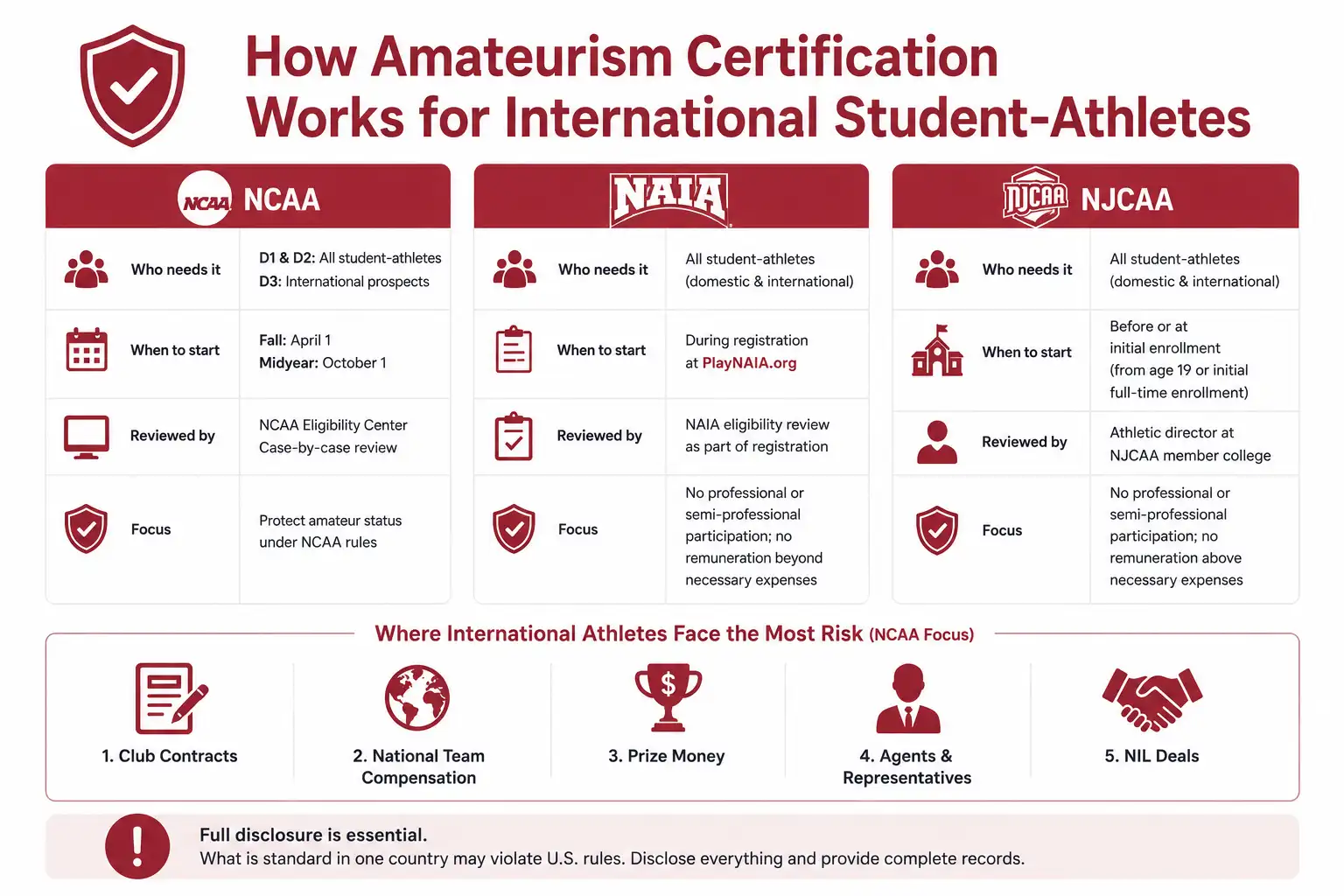
To protect amateur status, the NCAA requires most incoming Division I and II student-athletes, and international prospects for Division III, to complete an amateurism certification process through the NCAA Eligibility Center.
Who needs it: All D1 and D2 student-athletes. D3 student-athletes must also complete amateurism certification through the Eligibility Center, even though D3 does not require academic certification.
When to start:
- Fall enrollment: request opens April 1
- Midyear enrollment: request opens October 1
- Start as early as the dates allow. The review is case by case and follow-up questions from the Eligibility Center are common
1.1 Where international athletes face the most risk
As part of amateurism certification, the NCAA reviews whether a prospect has signed a contract with a professional team, used an agent in ways not permitted by NCAA rules, accepted prize money or salary that exceeds actual and necessary expenses, competed on a professional team, or entered into other arrangements the NCAA deems incompatible with amateur status.
The areas where international athletes face the most scrutiny are:
1.1.1 Club contracts
In some countries, standard youth or development contracts involve salary or guaranteed payments that exceed actual and necessary expenses, and NCAA guidance makes clear that agreements in such leagues can be treated as professional participation even if they are considered normal in that country’s system.
1.1.2 National team compensation
Stipends, bonuses, appearance fees, and expense reimbursements from a national federation are subject to review, and amounts that exceed what the NCAA treats as actual and necessary expenses can negatively affect amateurism certification.
1.1.3 Prize money
NCAA rules historically limited how much prize money prospects could keep before college, but under a 2026 settlement, prospective student‑athletes can now retain unlimited pre‑enrollment prize money without automatically losing NCAA eligibility, while prize money after enrollment still must comply with “actual and necessary expenses” standards.
1.1.4 Agents and representatives
Contracts for professional sports representation or benefits from an agent have long been a central amateurism concern and must be carefully reviewed and disclosed, even if such agreements are common practice in a prospect’s home country.
1.1.5 NIL deals
NCAA rules now allow prospects and student‑athletes to earn compensation for legitimate name, image and likeness activities, and properly structured NIL agreements that are not pay‑for‑play or recruiting inducements do not by themselves jeopardize amateur status.
The Eligibility Center makes these determinations case by case. A clean record in a home country’s sport system does not guarantee a straightforward certification.
2. NAIA
Amateurism questions are completed as part of registration at PlayNAIA.org. The same general principles apply: no prior participation on professional or semi-professional teams, no remuneration beyond necessary expenses directly related to athletic participation. There is no separate certification timeline. The determination is processed as part of the overall eligibility review.
The NAIA’s threshold is generally more flexible than the NCAA’s, but the risk areas are the same. Club contracts, federation payments, and competitive arrangements that are routine in many countries may not align with the NAIA’s definition of amateur status. Disclose everything. Gaps or omissions that surface later create far larger problems than full disclosure upfront.
3. NJCAA
The NJCAA requires amateur status but applies the lightest framework of the three governing bodies. An amateur is someone who has not participated on a professional or semi-professional team or league and has not received remuneration above necessary expenses directly related to athletic participation. Amateur status must be maintained from the point the student-athlete turns 19 or initially enrolls full-time, whichever comes first.
Verification is handled by the athletic director at the NJCAA member college. There is no external certification body. International student-athletes should confirm their amateur standing directly with the institution and be prepared to document their competitive history if questions arise.
The Recruiting Process for International Student-Athletes
The recruiting process for international student-athletes follows the same broad stages as the domestic pathway: build a target list, make contact, get evaluated, visit, and commit. What differs is the context at every stage. Documentation requirements, coach communication across time zones, eligibility certification timelines, and visa considerations all add layers that domestic athletes do not face. The sections below walk through each stage with the international student-athlete specifically in mind.
1. Starting the Recruiting Process
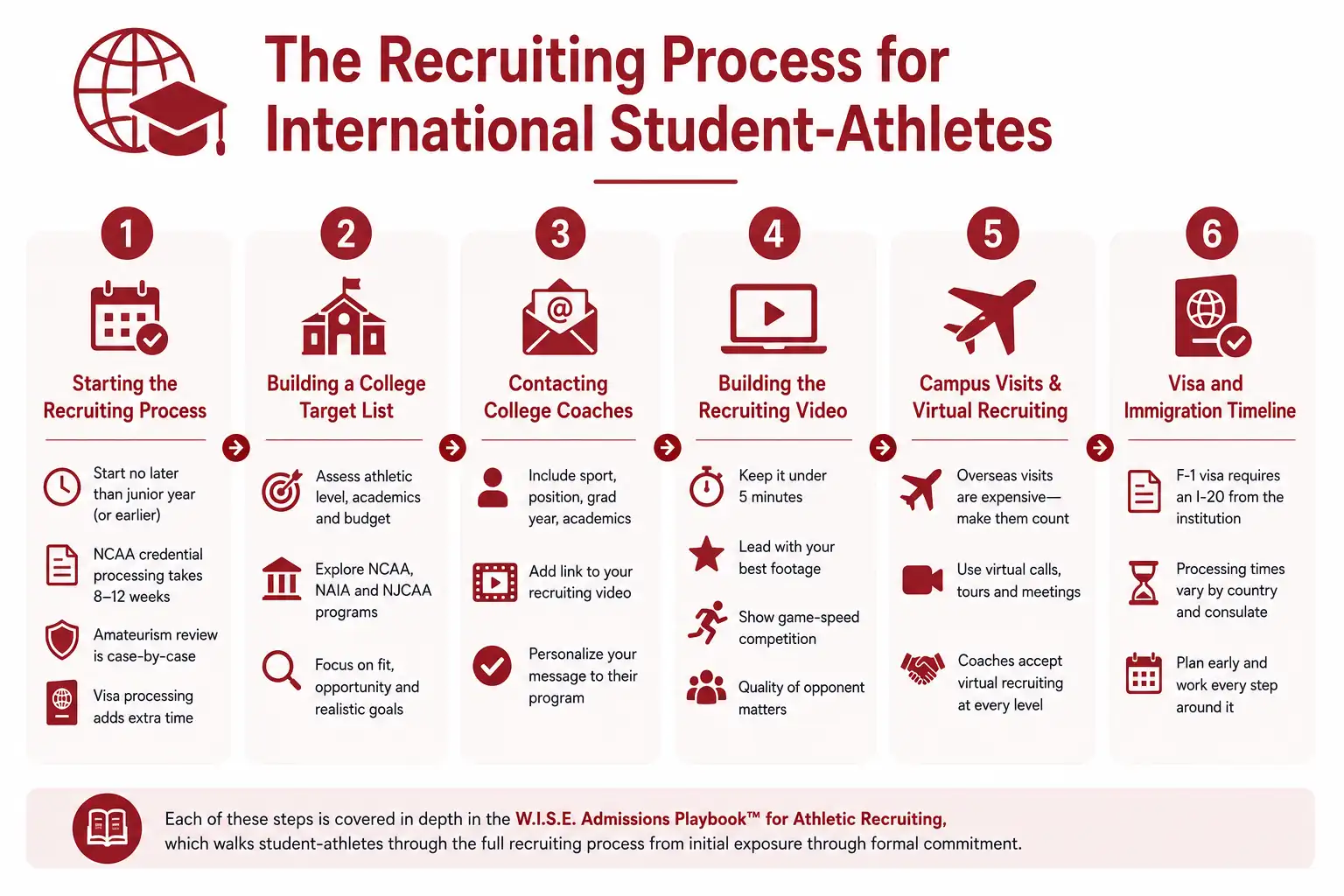
International student-athletes need to start earlier than domestic athletes, and not because of competition. Credential processing through the NCAA Eligibility Center takes 8 to 12 weeks. Amateurism review is case-by-case with no guaranteed timeline. Visa processing adds another layer. Working backward from enrollment, the recruiting process should begin no later than the start of junior year, and earlier in sports where Division I coaches are identifying prospects by sophomore year.
2. Building a College Target List
The default for most international families is to target schools they have heard of. That instinct narrows the search to a handful of Division I programs and ignores the full landscape. A realistic target list starts with an honest assessment of athletic level, academic profile, and budget, then maps those across NCAA, NAIA, and NJCAA programs. Casting wider across governing bodies and divisions produces stronger options than chasing name recognition.
3. Contacting College Coaches
U.S. college coaches receive hundreds of recruiting emails. From overseas, yours has to do more work in fewer words. The first email should include your sport, position, graduation year, academic profile, a link to your recruiting video, and a clear statement of why you are contacting that specific program. Coaches want to see that you have done your research on their program, not that you have sent the same message to 200 schools.
4. Building the Recruiting Video
For international student-athletes, the recruiting video is not supplementary. It is the primary evaluation tool. Coaches cannot fly overseas to watch you compete, and most will not invest time in an athlete they have not seen on film. Keep it under five minutes, lead with your strongest footage, include your name and position on every clip, and show game-speed competition rather than training highlights. Quality of opponent matters as much as quality of play.
5. Campus Visits and Virtual Recruiting
Visiting a U.S. campus from overseas is expensive and logistically demanding, and most international families will only get one or two trips before committing. Make them count by narrowing your list before booking flights and scheduling multiple campus visits in a single trip. Virtual recruiting is not a lesser alternative. Video calls with coaching staff, virtual campus tours, and remote meetings with admissions offices are standard practice and accepted by coaches at every level.
6. Visa and Immigration Timeline
No part of the recruiting process matters if the visa is not secured. The F-1 student visa requires an I-20 form from the institution, which can only be issued after formal admission. Processing times vary by country and U.S. consulate, and delays are common during peak summer months. International student-athletes should treat the visa timeline as a fixed constraint and work every other step around it.
Each of these steps is covered in depth in the W.I.S.E. Admissions Playbook™ for Athletic Recruiting, which walks student-athletes through the full recruiting process from initial exposure through formal commitment.
What College Coaches Look for When Recruiting International Student-Athletes
Coaches at U.S. college sports are building rosters, not collecting talent. Every recruiting decision is a comparative one. A coach evaluates every prospect against every other prospect in the class for what they add as a student, an athlete, a teammate, and a member of the campus community. A strong academic profile from one candidate can move them to the front of the line overnight, creating a ripple effect that shifts the status of every other recruit under consideration.
For international student-athletes, this dynamic carries additional weight. Coaches are evaluating athletic performance produced in a foreign competition system they may not fully understand. They are assessing academic credentials that require external certification. They are weighing eligibility risk that does not exist with a domestic recruit. The international student-athlete who stands out is the one who removes as much of that uncertainty as possible before the coach has to ask.
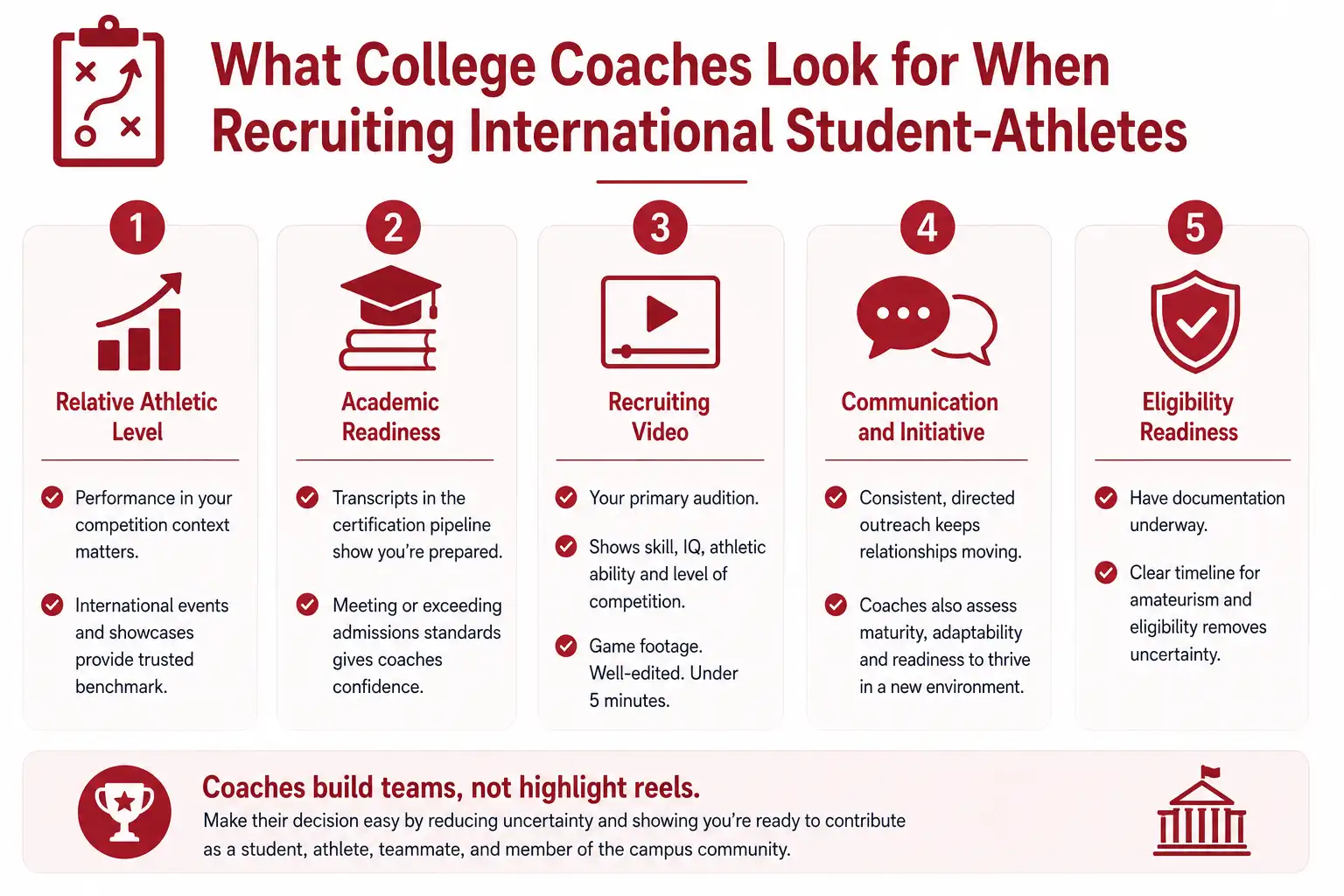
1. Relative Athletic Level
Coaches interpret international performance through the lens of U.S. sports recruiting standards. A strong record in a national league abroad needs context. Competing in internationally recognized tournaments, showcases, or development programs gives coaches a frame of reference they can trust.
2. Academic Readiness
A transcript that is already in the certification pipeline, with translations submitted and eligibility registration underway, signals that the student-athlete is serious and prepared. An academic profile that meets or exceeds the institution’s admissions threshold gives the coach room to advocate internally.
3. Recruiting Video
This is the athlete’s primary audition. Coaches assess sport-specific skill, decision-making speed, physical attributes, and level of competition faced. Poorly edited or training-only footage does not get a second viewing.
4. Communication and Initiative
Coaches vary in recruiting style, responsiveness, and how they engage with prospects. The student-athlete’s job is to keep advancing the relationship with consistent, directed outreach. For international recruits specifically, coaches are also assessing something beyond athletic fit: whether the athlete has the maturity and adaptability to handle a new country, academic system, and culture simultaneously without it affecting performance or team dynamics. How an athlete communicates through the recruiting process is the earliest signal coaches have of that.
5. Eligibility Readiness
A coach who is interested in an international prospect but uncertain about their eligibility timeline or amateurism status will move on to a domestic alternative with fewer unknowns. Having documentation underway and being able to communicate a clear timeline removes that hesitation before the coach has to raise it.
The process is not linear, and the outcome is not guaranteed at any stage. Coaches get paid to win and graduate student-athletes. They decide what formula works for their program. The international student-athlete’s goal is to keep moving through the process with focus and direction, making the coach’s decision easier at every step.
Start Planning for U.S. College Athletics
For international student athletes and families managing the recruiting process independently, the W.I.S.E. Admissions Playbook™, built by experienced athletic recruiting counselors, provides a milestone-by-milestone framework covering target list construction, recruiting video standards, coach outreach strategy, and eligibility preparation built on the same methodology McMillan Education International’s private clients have relied on for decades.
Families who want that depth applied directly to their student-athlete’s sport and academic profile can work with our international admissions consultants specializing in U.S. universities.
Concertar una consulta gratuita to get started.
Preguntas frecuentes
1. Can international students play sports in the USA?
Yes. International students are eligible to compete in college athletics across all three U.S. governing bodies: the NCAA, NAIA, and NJCAA. Each has its own eligibility certification process, and international student-athletes must meet academic, amateurism, and immigration requirements before they are cleared to compete.
2. Can international students play D1 college sports?
Yes. Division I programs actively recruit international student-athletes in many sports. Competing at the D1 level requires academic certification and amateurism certification through the NCAA Eligibility Center, along with meeting the institution’s admissions and English proficiency standards.
3. What are the NCAA eligibility requirements for international students?
International student-athletes must register with the NCAA Eligibility Center and submit official transcripts from year nine onward with certified English translations. The Eligibility Center evaluates credentials against country-specific standards published in its Guide to International Academic Standards. Amateurism certification is required separately. Processing takes 8 to 12 weeks.
4. Which sports recruit the most international athletes?
Tennis, soccer, swimming and diving, golf, track and field, ice hockey, field hockey, volleyball, and water polo have the highest concentrations of international student-athletes in U.S. college programs. Basketball recruitment internationally has accelerated at the Division I level in recent years.
5. Do international student-athletes need SAT or ACT scores?
The NCAA no longer requires standardized test scores for eligibility certification. The NAIA may require them if a student-athlete’s GPA falls below 2.3. The NJCAA does not require them for athletic eligibility. Individual institutions may still require SAT, ACT, TOEFL, or IELTS scores for admissions or scholarship consideration regardless of the governing body.
6. Can international student-athletes get athletic scholarships?
Yes. Athletic scholarships are available to international student-athletes at NCAA Division I and Division II institutions and across the NAIA. Division III does not offer athletic scholarships but provides financial aid through academic and need-based packages. The NJCAA offers both full and partial athletic scholarships at its Division I and Division II levels.