
The United States has no central authority that recognizes foreign academic credentials. For international students applying to US universities, professionals seeking state licensure, and skilled workers entering the US job market, that gap has a direct practical consequence. Foreign degree equivalency must be established through a formal evaluation process before most institutions will review any application.
This article covers how degree equivalency is determined in the US, what evaluation reports assess, and how to navigate equivalency challenges for specific credential types.
What Foreign Degree Equivalency Means in the US System
Foreign degree equivalency, in the American context, is a formal determination that an academic credential earned outside the United States corresponds to a specific level of the US degree framework.
The determination is produced by an independent credential evaluation agency. The agency examines the foreign credential against the educational system that issued it and maps it to the closest US equivalent: associate’s degree, bachelor’s degree, master’s degree, or doctorate. Most US institutions require that the agency be a member of the National Association of Credential Evaluation Services (NACES), the trade association that sets professional standards for the field in the absence of any federal oversight body.
Credential evaluations assess the academic structure of a foreign degree rather than its language of instruction. Documents already in English require the same evaluation as those in any other language. What evaluators examine is the credential itself: years of study completed, curriculum level, grading scale, and whether the degree grants access to the next level of study within the issuing country’s own system.
How International Degrees Map to US Degree Levels
The table below reflects standard equivalency determinations for the most common international credentials.
Disclaimer: Equivalency determinations are indicative. Individual evaluations may differ based on evaluator methodology and institutional requirements.
Evaluators determine equivalency by examining years of study completed, the academic level of the curriculum, the grading scale, institutional accreditation standing in the country of origin, and whether the degree qualifies its holder for graduate study within that same country.
Document-by-Document vs. Course-by-Course Evaluations
There are two types of foreign degree equivalency reports, and understanding the difference before submitting an application saves significant time.
|
Foreign Credential |
Typical US Equivalent |
|
Secondary leaving certificate (Livelli A, Abitur, French BAC, Maturité/Matura, Attestat, IB Diploma) |
High school diploma; may satisfy partial first-year credit |
|
Foundation degree / Higher National Certificate (HNC) |
Partial associate’s credit |
|
Vocational qualification / BTec |
Varies; generally below associate’s degree level |
|
Two-year diploma or Higher National Diploma (HND) |
Associate’s degree or partial bachelor’s credit |
|
Three-year bachelor’s degree (Bologna-compliant, Indian BA/BSc, Licence) |
Varies by evaluator and institution |
|
Ordinary / pass bachelor’s degree (UK, Ireland, Commonwealth) |
Varies by evaluator and institution |
|
Honours bachelor’s degree (UK, Ireland, Australia, Canada) |
Bachelor’s degree |
|
Licenciatura (Latin America, Spain) |
Bachelor’s degree |
|
Four-year bachelor’s degree |
Bachelor’s degree |
|
Specialist degree / Diplom (Germany pre-Bologna, Eastern Europe) |
Master’s degree |
|
Postgraduate diploma (one year post-bachelor’s) |
Post-baccalaureate study |
|
Two-year master’s degree |
Master’s degree |
|
Doctorate |
Doctorate |
1. Document-by-Document
This report confirms the credential, its US degree level equivalent, the year of completion, and the issuing institution. It does not break down individual courses, credit hours, or grades, which is why it is usually sufficient for employment purposes, immigration filings, and licensing boards that only need a general credential assessment.
2. Course-by-Course
This report goes considerably further. It lists every course with its US credit hour equivalent, converts grades to a 4.0 GPA scale, and calculates a cumulative GPA, producing essentially the same academic record a US institution would have for a domestic applicant. Graduate admissions offices almost universally require this report, and some licensing boards require it specifically to verify that prerequisite coursework in a given field has been completed.
3. Which One to Order
If the institution or licensing board specifies a report type, follow that requirement. If no specification is given, course-by-course is usually the safer choice for admissions contexts, since it includes the document-by-document determination as a component. The reverse is not true; a document-by-document report cannot be resubmitted as a course-by-course report. Upgrading after submission is possible with some agencies, but it adds both time and cost, which matters when most standard evaluations already take several weeks to complete.
Which US Institutions Require an Equivalency Determination
Requirements for foreign degree recognition vary by institution type in the US, and the role a credential evaluation plays differs between an admissions office and a licensing board.
1. Graduate and Undergraduate Admissions
Graduate programs require a credential evaluation in almost every case. Admissions offices use the report to establish whether the applicant holds the foreign equivalent of a US bachelor’s degree, the baseline requirement for graduate study, and to assess the academic record behind it. The evaluation does not replace the broader application review, but without it the review does not proceed.
At the undergraduate level, the requirement arises most commonly for transfer applicants. The institution uses the evaluation to determine how many credits from a foreign university apply toward the US degree program. Credits that do not map to recognized US equivalents generally do not transfer.
2. Professional Licensing Boards
Licensing boards in the United States are state-governed, and each sets its own credential requirements independently. The same foreign degree can satisfy a board’s standards in one state and fall short in another.
Healthcare, engineering, and education are the fields most commonly affected. Foreign-trained physicians looking to become licensed doctors in the US, alongside nurses, engineers, and teachers, will almost always encounter a formal evaluation requirement as part of the state licensing process.
How to Get Your Foreign Degree Evaluated in the USA: Step-by-Step
For students planning to work or studio negli Stati Uniti, evaluating a foreign degree follows the same defined process regardless of the credential or country of origin.
Step 1: Confirm the Institution’s Requirements
The starting point is always the receiving institution, not the agency. Some institutions specify a NACES member agency; others name a preferred agency or maintain their own approved list, which is particularly common among state licensing boards. Confirm the required report type at this stage as well, document-by-document or course-by-course, since this determines which application to submit.
Step 2: Select an Agency and Obtain Your Reference Number
Most agencies manage the process through an online account where the report type is selected at the application stage. The agency issues a reference number that your institution will need when sending academic documents. Sharing it with the institution promptly keeps the process moving without gaps.
Step 3: Submit Your Documents
Academic documents: transcripts, mark sheets, and degree certificates, are sent directly from the issuing institution to the agency in a sealed envelope. Non-English documents require certified translations submitted alongside the originals. The processing clock starts when the agency confirms all documents have been received and verified.
Step 4: Plan Around the Full Timeline
Standard processing runs between 5 and 15 business days after documents are verified. The full end-to-end timeline commonly runs 4 to 6 weeks. Students applying to programs with deadlines in peak seasons, December through January and July through August, consistently find that starting two months in advance is the more reliable approach.
McMillan Education International has guided students from over 65 countries through the full admissions process, including the credential evaluation stage. Those planning graduate study in the US are welcome to speak with one of our US university admissions consultants.
Common Foreign Degree Equivalency Challenges in the US
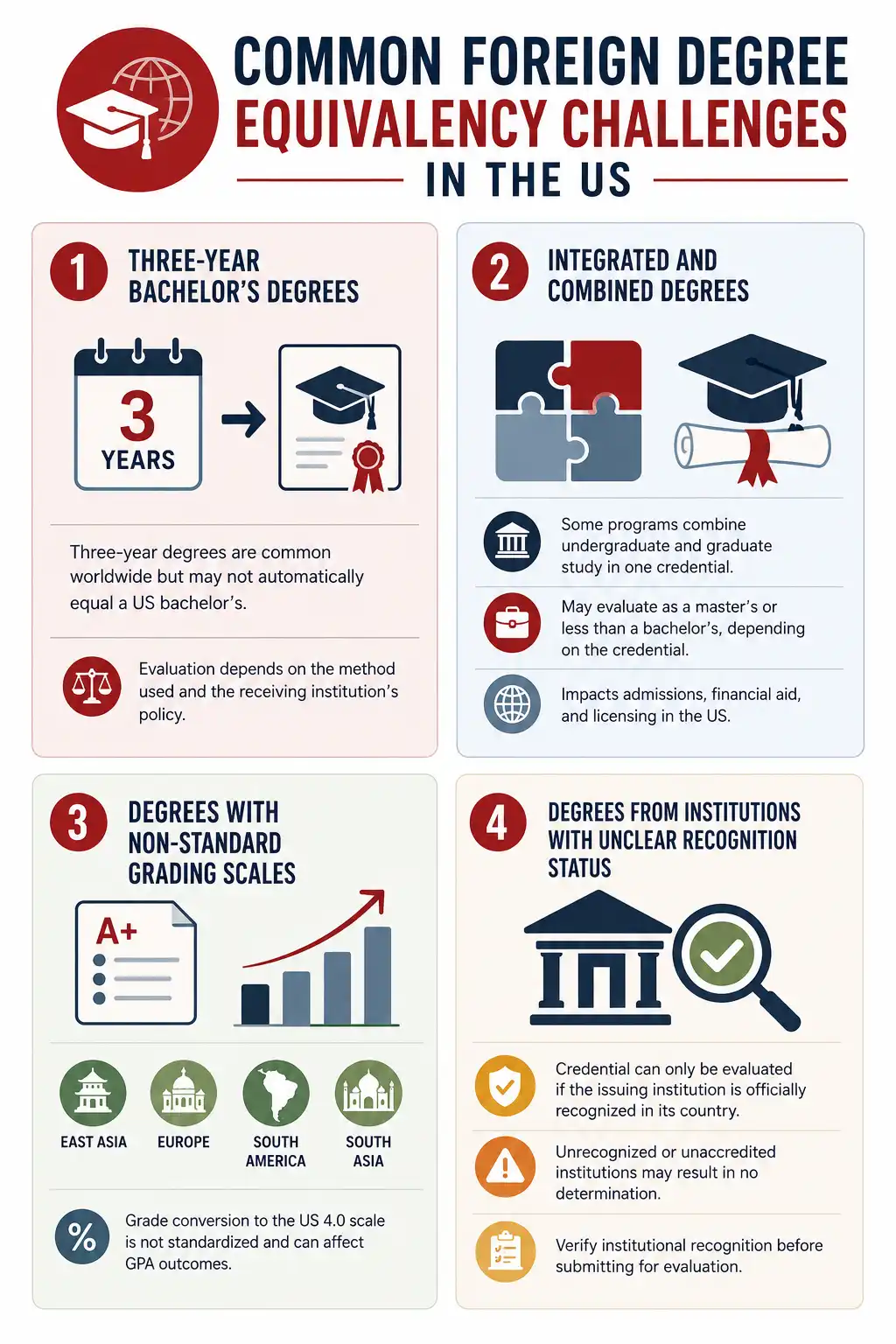
Most foreign credentials map cleanly to US degree levels. The cases that create complications tend to fall into four categories, each defined by the structure of the credential rather than the country of origin.
1. Three-Year Bachelor’s Degrees
The most common equivalency complication involves three-year bachelor’s degrees. US bachelor’s degrees are four years and 120 credit hours, and a three-year degree does not automatically evaluate as the equivalent.
Three-year bachelor’s degrees are common across several regions:
- Bologna-compliant Europe (France, Germany, Italy, Spain, and others): three-year degrees considered complete first degrees within European universities.
- UK and Ireland: three-year honours bachelor’s degrees are the standard undergraduate credential and are routinely evaluated as US bachelor’s equivalents by major NACES members.
- South Asia: three-year general bachelor’s degrees, usually followed by a one-year honours or master’s program for further academic progression.
- Commonwealth countries (Australia, New Zealand, Canada, Sri Lanka, parts of Africa): three-year general bachelor’s degrees that follow different program structures from US four-year degrees and evaluate variably depending on the credential and the receiving institution.
How these credentials evaluate in the US depends on two things: the methodology applied and the receiving institution’s policy. Under a benchmarking approach, a three-year European degree may evaluate as a US bachelor’s equivalent based on its role within the home system. Under a year-and-credit standard, the same degree evaluates as three years of undergraduate credit without bachelor’s equivalence. The same transcript can produce two different results depending on which standard is applied.
For graduate admissions, the receiving university’s policy is what matters most. Some US graduate programs accept three-year degrees with a positive evaluation. Others require four years of undergraduate study regardless. NC State University e Università della Florida Atlantic both have published policies of this kind.
2. Integrated and Combined Degrees
Some credentials combine undergraduate and graduate study into a single program rather than two separate degrees.
Specialist and Diplom degrees (Eastern Europe, Central Asia, Germany before the Bologna reforms) are typically five-year programs covering both undergraduate and graduate-level study. These credentials generally evaluate as equivalent to a US master’s degree. The practical complication is that applicants holding them who apply to US master’s programs may be treated as already holding a master’s equivalent, which can affect admission, financial aid, and program planning.
Higher National Diplomas from polytechnic institutions in parts of West Africa carry professional standing at home but typically evaluate as two to three years of undergraduate study in the US, falling short of a full bachelor’s equivalent.
Professional degrees in regulated fields across parts of Latin America, such as the Título Profesional, are academic credentials that also confer the professional title required to practice in the issuing country. These credentials evaluate variably in the US depending on the field and the evaluator, and the outcome can affect both graduate admissions and the separate professional licensing process required to practice in the United States.
3. Degrees with Non-Standard Grading Scales
A degree can evaluate as a US bachelor’s equivalent and still create complications at the GPA stage. Grade conversion to the US 4.0 scale is not standardized, and the same transcript can produce different GPA results depending on the conversion methodology applied.
This affects credentials from several regions:
- East Asia: percentage-based grades where the threshold for a high grade varies by institution.
- Continental Europe: 20-point or 10-point scales where top grades are rarely awarded, making mid-range grades difficult to convert fairly.
- South America: 10-point scales with similar conversion challenges.
- South Asia: classifications such as First Class or Second Class, where the underlying percentage ranges vary by university.
For programs with minimum GPA requirements or scholarship thresholds, the conversion methodology applied to a transcript can affect the outcome.
4. Degrees from Institutions with Unclear Recognition Status
This category applies across all regions. A credential can only be evaluated when the issuing institution is officially recognized by the national education authority in its country. Credentials from private institutions, newer universities, or institutions whose accreditation has lapsed may produce no determination at all, rather than a negative one. Without confirmed institutional standing, equivalency cannot be established.
This issue is most common in countries where the regulatory framework around private higher education is still developing. The practical step is to verify that the issuing institution holds recognized status before submitting documents for evaluation, particularly for institutions founded in the last twenty years or those without a long accreditation history.
What to Do If Your Degree Evaluates Below the US Bachelor’s Level
A credential evaluating below the US bachelor’s level does not close the door on US study or employment. Several pathways exist depending on the field, the timeline, and how far below the threshold the evaluation falls.
1. Additional Coursework at a US Institution
Some universities allow applicants to complete additional undergraduate credits to bring their academic record to bachelor’s equivalency. The number of credits required depends on the evaluation outcome and the institution’s own standards.
2. Bridge and Degree-Completion Programs
A number of US institutions offer bridge programs specifically designed for international applicants whose credentials fall short of full bachelor’s equivalency. These programs combine academic preparation with formal degree completion, and graduates typically qualify for graduate admissions on the same basis as any other bachelor’s holder.
3. Professional Certifications
In some fields, industry certifications can partially offset an equivalency gap for employment purposes. This option is field-dependent and does not resolve the gap for graduate admissions or professional licensing.
4. Plan Ahead
An equivalency gap identified early is considerably easier to address than one discovered during an active application cycle. Applicants who understand where their credentials stand before applying have more options and more time to act on them. An experienced international educational consultant can assess the credential picture before the application process begins and identify which pathway makes the most sense given the timeline and target institutions.
Planning to Study in the US?
Foreign degree equivalency is one of several admissions variables that experienced planning addresses early. For over 70 years, McMillan Education International has guided students through the full US admissions process. If you need guidance on evaluating your credentials or planning your application, fissare una consulenza gratuita with our educational consultants.
Domande frequenti
1. What counts as a foreign degree equivalent to a US bachelor’s?
A foreign degree is generally considered equivalent to a US bachelor’s degree when it represents four or more years of post-secondary study at a recognized institution and qualifies its holder for graduate study within the home country’s own system. Three-year degrees may also qualify depending on the credential, the methodology applied, and the receiving institution’s policy. The UK is a common example, where the education system is structured differently from the US model.
2. Will US employers accept a foreign degree?
Most US employers accept foreign degrees that have been formally evaluated by a NACES member agency. A document-by-document evaluation is usually sufficient for employment purposes. Some regulated industries such as healthcare and engineering have additional licensing requirements that go beyond a general credential assessment.
3. Does a credential evaluation expire?
Policies vary by agency. Some evaluations carry a five-year validity window; others do not expire. Institutions and licensing boards may also set their own requirements on how recent a report must be, so confirming directly with the receiving institution before submitting an older report is advisable.
4. Do you need a separate evaluation for each institution?
Not necessarily. Most agencies issue reports that can be sent to multiple institutions from a single application. Confirming delivery requirements with each institution before the report is issued is advisable, since some require the report to arrive directly from the agency.
5. Is credential evaluation the same as degree accreditation?
No. Credential evaluation assesses an individual’s foreign academic record for use in admissions, employment, or licensing. Degree accreditation is a quality assurance process applied to institutions and programs. A credential evaluation does not accredit a degree; it determines its US equivalent level.
6. How long does a credential evaluation take?
Standard processing runs between five and fifteen business days once all required documents are received and verified. The full timeline, including document collection and delivery, commonly runs four to six weeks. Applications submitted during peak seasons tend to take longer.
7. Can I use the same evaluation report for multiple purposes?
Yes. A single evaluation report can generally be used for graduate admissions, employment, and professional licensing at the same time. Most agencies send the report directly to multiple recipients from one application. A course-by-course report covers the widest range of purposes since it incorporates the document-by-document determination within it.
8. What happens if my institution is not recognized?
If the issuing institution is not officially recognized by the national education authority in its country, an evaluation agency may be unable to produce any determination at all. This is not a negative result but an absence of one. Options in this situation are limited and typically involve seeking alternative evidence of academic standing or pursuing further study at a recognized institution.