Switzerland is widely regarded as one of the world’s leading education destinations, with institutions that consistently rank among the best in Europe for research quality, academic standards, and graduate outcomes. Enrollment figures reflect this reality: Switzerland enrolls around 75 – 80 thousand international students in its higher education institutions each year. Despite this, it remains underrepresented in international study conversations relative to the UK, US, and Australia. One reason is an assumption that studying in Switzerland requires German, French, or Italian.
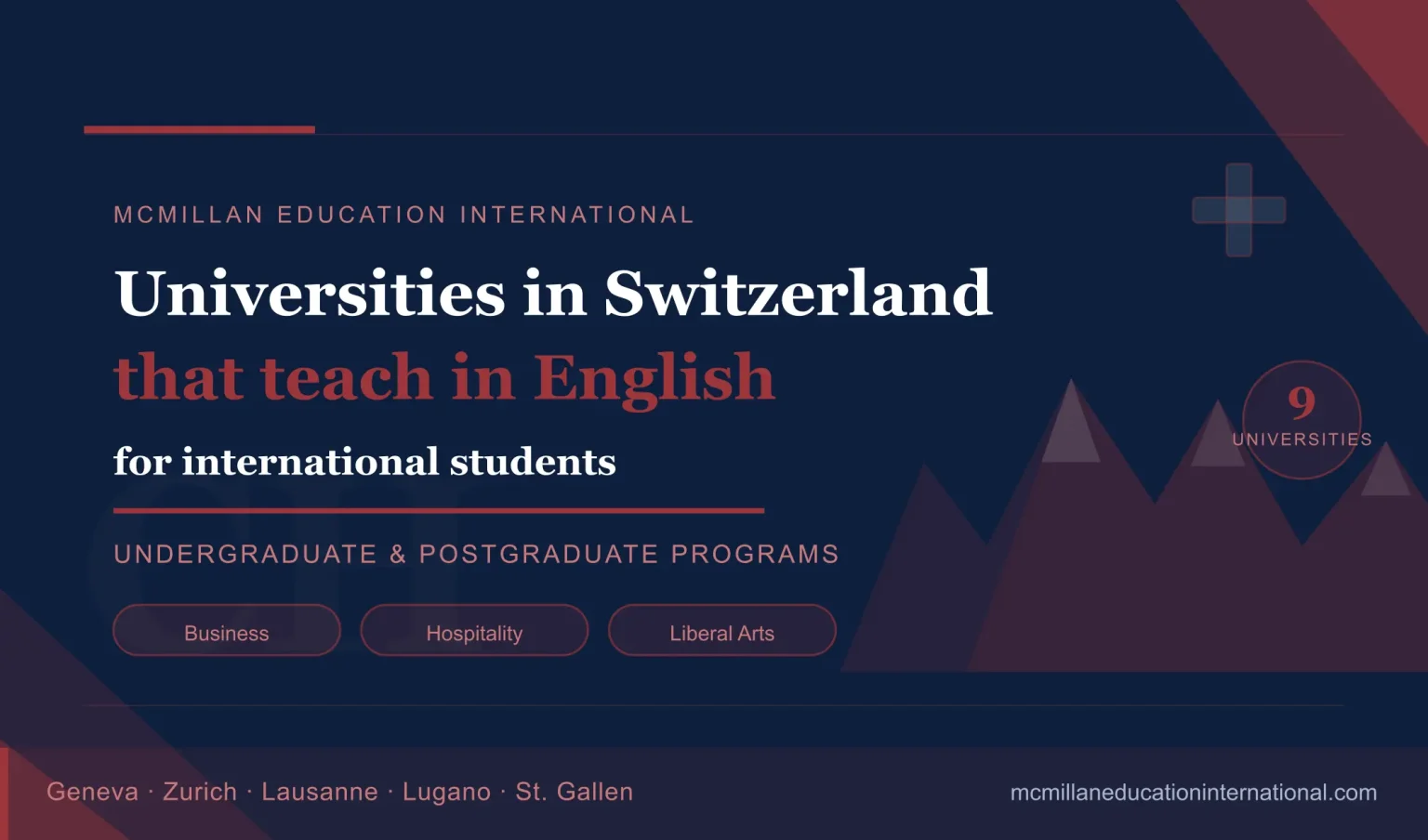
However, a number of English-speaking universities in Switzerland offer programs taught entirely in English. This article covers nine of them in detail, all offering internationally recognized degrees at undergraduate and postgraduate levels and actively enrolling international students.
9 Universities in Switzerland With English-Taught Undergraduate and Postgraduate Programs
- Webster University Geneva
- University of St. Gallen (HSG)
- Franklin University Switzerland
- SBS Swiss Business School
- EHL Hospitality Business School
- Les Roches Global Hospitality Education
- Glion Institute of Higher Education
- César Ritz Colleges Switzerland
- USI — Università della Svizzera italiana
Why Study in Switzerland as an International Student?
Switzerland places multiple institutions in the global top 200 universities, reflecting a research culture and academic standard that runs across the country’s higher education system, including its private institutions. Degrees from accredited Swiss universities are recognized by employers and graduate programs internationally, making Switzerland a credible alternative to the UK and the US for international students evaluating their options.
Beyond academic credibility, Switzerland consistently ranks among the safest and most liveable countries in the world. Its central European location means students are within two hours of major cities, including Milan, Munich, Paris, and Vienna, with one of the most efficient public transport networks on the continent.
The professional environment is equally distinctive. Geneva hosts the United Nations, WHO, WTO, and hundreds of international organizations and NGOs. Zurich is one of Europe’s leading financial centers. For students pursuing careers in business, hospitality, international relations, or technology, proximity to these industries is a practical advantage.
Almost half of the Swiss population speaks English regularly, and campuses are internationally diverse, with students and faculty drawn from across the world, making it a genuinely functional environment for international students who want to study in English.
English-Speaking Universities in Switzerland for International Students
Below is a carefully selected list of universities in Switzerland that offer degree programs taught in English for international students. This is not a ranking, nor an endorsement of one institution over another. The institutions included meet a clear, practical criteria: they offer established English-taught degree programs at both undergraduate and graduate levels, hold recognized accreditation, and actively enroll international students.
Switzerland has many other quality institutions offering strong programs, including those taught in German, French, or Italian, and others with English options available exclusively at master’s level.
1. Webster University Geneva
- Type: Private
- Location: Bellevue, Geneva
- Ranking Performance: #1 private university in Switzerland according to UniRanks
- English-Taught Programs: 17 total: 11 Bachelor, 5 Master, 1 MBA
- International Students: Over 90 nationalities represented each year
- Tuition Fees:
- Bachelor: ~ CHF 35,000/year (CHF 17,500 per semester, flat rate).
- Master: ~ CHF 39,600–54,240
- MA Counseling: ~ CHF 52,800 total
Webster University Geneva is an accredited American university campus that has been operating in Switzerland since 1978. It holds full institutional accreditation from the Higher Learning Commission of the United States, meaning graduates receive the same American degree awarded at the main campus in St. Louis. Around 500 to 600 students from over 90 nationalities study here each year, all programs are taught in English, and class sizes are intentionally small.
The campus is located in Bellevue, eight minutes by train from central Geneva. Geneva’s concentration of international organisations, including the United Nations, WHO, and WTO, gives students direct access to one of the world’s most significant professional environments, with internship and networking opportunities that are genuinely difficult to replicate elsewhere.
Programs span business administration, international relations, media communications, psychology, computer science, and cybersecurity. Tuition is billed per semester rather than upfront, and one in three bachelor’s students receives partial financial aid or scholarship support. For international students seeking an American-accredited degree at a university in Switzerland that teaches in English, Webster Geneva is one of the most established options available.
2. University of St. Gallen (HSG)
- Type: Public
- Location: St. Gallen
- Ranking Performance: #436 — QS World University Rankings
- English-Taught Programs: 11 total: 2 Bachelor, 9 Master.
*Both bachelor’s programs can be studied mainly in English, though students are required to complete 9–12 ECTS credits in German. - International Students: 25%
- Tuition Fees:
- Bachelor: ~ CHF 6,258/year
- Master: ~ CHF 6,658/year
The University of St. Gallen is Switzerland’s leading public business university and one of Europe’s most respected institutions for management, economics, law, and international affairs. It holds triple accreditation from EQUIS, AACSB, and AMBA, a distinction shared by fewer than 1% of business schools globally, and its Master’s in Management program ranks first in the Financial Times European Business Schools ranking. Around 10,000 students from over 100 nationalities are enrolled across bachelor’s and master’s programs.
For international applicants, the English-track bachelor’s programs in Business Administration and International Affairs are the primary entry point. Both can be studied mainly in English, though students are required to complete 9 to 12 ECTS credits in German before graduation. Admission is competitive, requiring a two-stage selection procedure, with places for foreign applicants limited by Swiss law.
Tuition fees are exceptionally low compared to private institutions, at approximately CHF 6,258 per year for international students, making HSG one of the most cost-effective routes to a world-class European business education. The city of St. Gallen offers a focused academic environment and a lower cost of living than Zurich or Geneva. Graduates are heavily recruited by consulting firms, banks, and multinationals, with McKinsey, BCG, and Goldman Sachs among the leading employers of HSG alumni.
3. Franklin University Switzerland

- Type: Private
- Location: Lugano
- Ranking Performance: #24 in the WURI Ranking for Most Innovative Universities
- English-Taught Programs: 17 total: 16 Bachelor, 1 Master
- International Students: Students from over 50 countries
- Tuition Fees:
- Bachelor: ~ CHF 54,750/year.
- Master: ~ CHF 25,500 total
Franklin University Switzerland is a small private liberal arts university in Lugano, dually accredited in both the United States and Switzerland. It is the only institution in the world to hold both recognitions simultaneously, and one of the very few universities in Switzerland where all instruction is delivered entirely in English. With around 400 students from over 50 countries, class sizes average 15 students, giving undergraduates direct and consistent access to faculty.
What distinguishes Franklin most clearly is its Academic Travel program, embedded into the curriculum as a credit-bearing requirement. Every semester, students travel to a location relevant to their coursework and study on-site alongside their professors, meaning international exposure is a formal academic component rather than an optional addition.
Lugano sits in the Italian-speaking canton of Ticino, close to the Italian border and well-connected by rail to Milan and Zurich. The small campus size creates a strong sense of community, and Franklin’s dual accreditation makes its degrees recognised by both American and Swiss graduate programs and employers. Approximately 70% of the student body receives some form of financial aid or scholarship support.
4. SBS Swiss Business School
- Type: Private
- Location: Kloten (Zurich)
- Ranking Performance: #4 Global EMBA Rankings 2026
- English-Taught Programs: 6 total: 1 Bachelor, 2 Master, 3 MBA
- International Students: Students from 58+ nationalities
- Tuition Fees:
- Bachelor: ~ CHF 20,000/year.
- Master: ~ CHF 18,000 total program
SBS Swiss Business School is a state-accredited private business school located in Kloten, Zurich, offering undergraduate, postgraduate, and doctoral programs entirely in English. It holds Swiss accreditation as a University of Applied Sciences Institute and has been recognised in the QS Online MBA Rankings for its graduate programs. The student body draws from 58 or more nationalities, and the school’s relatively small size creates a personalised learning environment within one of Europe’s major financial centres.
The bachelor’s program covers core management disciplines alongside specialisations in international business, marketing, finance, and entrepreneurship. At the master’s level, programs in International Business and Digital Marketing are available on campus, alongside online and executive MBA formats designed for working professionals. The curriculum is internationally oriented throughout, with cross-cultural business competency treated as a core graduate outcome.
Zurich consistently ranks among the world’s top cities for quality of life and is Switzerland’s leading business and financial hub. For international students considering a business-focused English-taught university in Switzerland outside the hospitality or liberal arts track, SBS offers Swiss accreditation, competitive tuition fees relative to other private institutions, merit-based scholarships, and instalment payment options.
5. EHL Hospitality Business School

- Type: Private
- Location: Lausanne
- Ranking Performance: #1 – QS World University Rankings by Subject: Hospitality & Leisure Management (2026)
- English-Taught Programs: 6 total: 2 Bachelor, 3 Master, 1 MBA
- International Students: 59%
- Tuition Fees:
- Bachelor: ~ CHF 177,050 total for 4 years
- Master: ~ CHF 27,500 – 50,000 total
EHL is one of the most prestigious English-speaking European universities, holding the number one position in the QS World University Rankings by Subject for eight consecutive years. Its bachelor’s program is built around a preparatory year of hands-on practical training, followed by three years of academic and business coursework. Two mandatory six-month internships are built into the degree, and students can spend a semester at EHL’s campus in Singapore.
The student body draws from over 120 nationalities, English is the working language throughout, and class sizes are small relative to the program’s prestige. The curriculum is structured around live business projects and industry partnerships across hospitality, luxury, and finance.
EHL’s alumni network spans 30,000 professionals across 150 countries, with direct recruiting relationships with companies including LVMH, Nestlé, and major international hotel groups. Nearly half of alumni work outside hospitality, reflecting the school’s positioning as a broad business education with a service-industry lens. The Lausanne location offers proximity to Geneva and Zurich and one of the highest quality-of-life environments in the world.
6. Les Roches Global Hospitality Education

- Type: Private
- Location: Crans-Montana
- Ranking Performance: #2 — QS World University Rankings by Subject: Hospitality & Leisure Management (2026)
- English-Taught Programs: 16 total: 2 Bachelor, 12 Master, 2 MBA
- International Students: Students from over 100 nationalities
- Tuition Fees:
- Bachelor: ~ CHF 164,800 across 5 semesters.
- Master: ~ CHF 28,950–36,760 total depending on program;
- MBA: ~ CHF 57,600 total.
Les Roches is a private Swiss hospitality school ranked second globally by QS, with its flagship campus in the Alps near Crans-Montana. Programs span hospitality management, luxury tourism, sports business, and events management at both undergraduate and postgraduate. The curriculum follows the Swiss model of experiential learning, with significant practical components built into every program alongside academic coursework.
Students from over 100 nationalities study on campus each intake, and English is the language of instruction throughout. The campus is fully residential and self-contained, which creates a close-knit community that many students cite as a defining part of the experience.
Career outcomes are a central focus, with dedicated career services, a global alumni network, and a 98% employment rate for job-seeking graduates reported at graduation. The school also has campuses in Marbella and Abu Dhabi, and some programs include cross-campus study options. For international students considering English-taught programs in Switzerland, the Crans-Montana campus offers an Alpine setting that is well-connected to the rest of Europe via the Swiss rail network.
7. Glion Institute of Higher Education
- Type: Private
- Location: Glion-sur-Montreux and Bulle
- Ranking Performance: #3 — QS World University Rankings by Subject: Hospitality & Leisure Management (2026)
- English-Taught Programs: 6 total: 2 Bachelor, 4 Master
- International Students: Around 100 nationalities represented on campus
- Tuition Fees:
- Bachelor: ~ CHF 190,050 over 4 years
- Master: ~ CHF 52,100–61,750 total program
Glion is a private Swiss hospitality and luxury business school ranked third globally by QS, with campuses in Glion-sur-Montreux, Bulle, and London. Its bachelor’s programs in International Hospitality Business and Luxury Business are four-year degrees incorporating two professional internships, with options to study in London. Programs are accredited by both NECHE in the United States and the Swiss Accreditation Council.
With around 1,600 students from 98 nationalities, Glion maintains a deliberately small and international student body. First-year bachelor’s students complete a practical semester focused on operational hospitality skills before moving into academic study, ensuring graduates arrive in the workforce with both theoretical grounding and hands-on experience.
Graduate outcomes are strong, with 98% of job-seeking students reporting at least one employment offer at graduation. Alumni move into roles across hospitality, luxury brand management, real estate, and finance. The Glion campus sits above Lake Geneva with views of the Alps, and the London campus, located within the University of Roehampton, is the only UK campus established by a Swiss hospitality institution.
8. César Ritz Colleges Switzerland
- Type: Private
- Location: Le Bouveret and Brig
- Ranking Performance: #5 — QS World University Rankings by Subject: Hospitality & Leisure Management (2026)
- English-Taught Programs: 3 total: 2 Bachelor, 1 Master
- International Students: Students from over 60 nationalities
- Tuition Fees:
- Bachelor: ~ CHF 119,000 tuition total; CHF 194,000 grand total including accommodation and meals
- Master: ~ CHF 35,500 tuition total; CHF 61,900 grand total
César Ritz Colleges is a Swiss hospitality business school ranked fifth globally by QS, with campuses in Le Bouveret on the shores of Lake Geneva and Brig in the Valais Alps. The bachelor’s degree is delivered in partnership with Washington State University, meaning graduates receive dual credentials recognised in both Switzerland and the United States. The master’s program is similarly structured as a dual award with the University of Derby in the UK.
Classes are small, with 90% of lecturers holding a PhD, and the school places significant emphasis on practical learning environments, including training restaurants, working kitchens, and front office facilities.
Within five years of graduation, 92% of alumni report holding management positions or having launched their own businesses. Students from over 60 nationalities study on campus, and the school’s dual-accreditation model makes its degrees straightforwardly recognised by employers and graduate programs internationally. The Le Bouveret campus sits close to Geneva, while Brig offers access to some of Switzerland’s most iconic Alpine terrain.
9. USI — Università della Svizzera italiana
- Type: Public
- Location: Lugano and Mendrisio
- Ranking Performance: #473 — QS World University Rankings (2026)
- English-Taught Programs: 25 total: 2 Bachelor (Informatics; Data Science), 23 Master
- International Students: 69%
- Tuition Fees:
- Bachelor: ~ CHF 8,000/year
- Master: ~ CHF 8,000/year
USI is the only public university in Switzerland where Italian is the official language, though a substantial share of its programs, particularly at master’s level, are taught in English. Founded in 1996 and based across campuses in Lugano and Mendrisio, it enrolls around 4,000 students, which means genuinely small class sizes and direct access to faculty. Over 69% of its student body comes from outside Switzerland, making it the most internationally diverse public university in the country.
At bachelor’s level, English-taught programs are limited to Informatics and Data Science, both fully English-medium with no Italian requirement. At the master’s level, 23 programs are taught in English, spanning informatics, economics, finance, communication, management, data science, and biomedical sciences, making USI particularly relevant for international postgraduate applicants.
Lugano sits close to the Italian border, well-connected by rail to Milan in under an hour, and has a warmer and more Mediterranean character than German-speaking Swiss cities. Tuition fees for international students are CHF 8,000 per year, among the lowest at any accredited university in Switzerland. For postgraduate applicants, USI offers English-medium instruction, Swiss public university standards, strong research output, and an affordable fee structure in a distinctive southern Swiss setting.
Is Switzerland the Right Study Destination for You?
Switzerland is a credible study destination for international students. It is not, however, the right choice for every applicant. Tuition structures, program availability, and post-study work rights differ from those in the UK, US, and Canada in ways that matter at the planning stage. Students pursuing technology-related degrees should also compare Swiss institutions with the top universities for computer science in Europe for international students, as program selection, teaching language, research opportunities, and costs vary considerably across countries.For families weighing Switzerland against other destinations, our international university admission consultants apply decades of cross-system admissions expertise to identify which institutions, in which countries, suit a given applicant’s academic profile and objectives.
Tuition fees at English-speaking universities in Switzerland range from CHF 6,000 to 8,000 per year at public institutions to CHF 35,000 or more at private ones. Living costs add CHF 1,500 to 2,500 per month, depending on location. Total annual cost, tuition plus living expenses, is the figure that matters for planning purposes.
Switzerland does not offer a post-study work route comparable to the UK Graduate Route or Canada’s Post-Graduation Work Permit. Non-EU and non-EEA graduates who wish to remain after completing their degree must secure a job offer and navigate a quota-based permit system. For students whose plan includes working in Switzerland after graduation, this is a substantive constraint. Degrees from accredited English-speaking universities in Switzerland are recognized by employers and graduate programs across most international markets, making the destination viable for students returning home or pursuing opportunities elsewhere.
Start Planning Your Swiss University Application
Whether you are weighing Switzerland against other destinations, planning for an upcoming intake, or thinking ahead for the years to come, McMillan’s international educational consultants work across multiple study destinations and specialize in English-taught university placements across Europe and beyond.
Schedule a free consultation to begin planning.
Frequently Asked Questions
1. Can I study in Switzerland entirely in English?
Yes. A number of universities in Switzerland offer degree programs taught entirely in English at undergraduate and graduate levels. These are predominantly private institutions specializing in hospitality, business, and liberal arts, alongside select public universities where English-medium programs have expanded significantly at master’s level. At bachelor’s level, fully English-taught options are more limited and concentrated in private institutions, with the exception of a small number of public programs at HSG and USI.
2. Are degrees from English-taught Swiss universities recognized internationally?
Degrees from accredited Swiss universities are recognized by employers and graduate programs across most international markets. Switzerland has a formal accreditation system administered by the Swiss Accreditation Council, and several institutions additionally hold US regional accreditation or programmatic accreditation from bodies such as AACSB, NECHE, and IACBE. Families should verify recognition requirements in their home country, particularly for regulated professions or government employment, where additional credential evaluation may apply.
3. Do I need to speak German or French to study in Switzerland?
Not at universities where English is the language of instruction. Switzerland has four official languages (German, French, Italian, and Romansh) distributed by region. Universities that deliver programs in English do not require proficiency in a local language to complete a degree, though some public institutions incorporate limited language requirements as part of their curriculum. Familiarity with the local language of a given city improves day-to-day experience but is not an academic requirement at English-medium institutions.
4. How much does it cost to study in Switzerland as an international student?
Tuition fees vary significantly by institution type. Public universities charge international students approximately CHF 6,000 to 8,000 per year, making them among the most cost-competitive accredited options in Europe. Private institutions range from CHF 20,000 to CHF 55,000 or more per year depending on the program. Living costs are among the highest in Europe, with students typically budgeting CHF 1,500 to 2,500 per month depending on location. Total annual cost, tuition combined with living expenses, is the figure that matters for planning purposes.
5. Can international students work while studying in Switzerland?
International students enrolled at Swiss universities are generally permitted to work up to 15 hours per week during term time after six months of residence. The specific conditions depend on the student’s nationality, their permit category, and the canton in which they are based. Students from outside the EU and EEA face additional permit requirements and should verify current work authorization conditions with the relevant cantonal migration authority before making financial plans that depend on part-time income.