
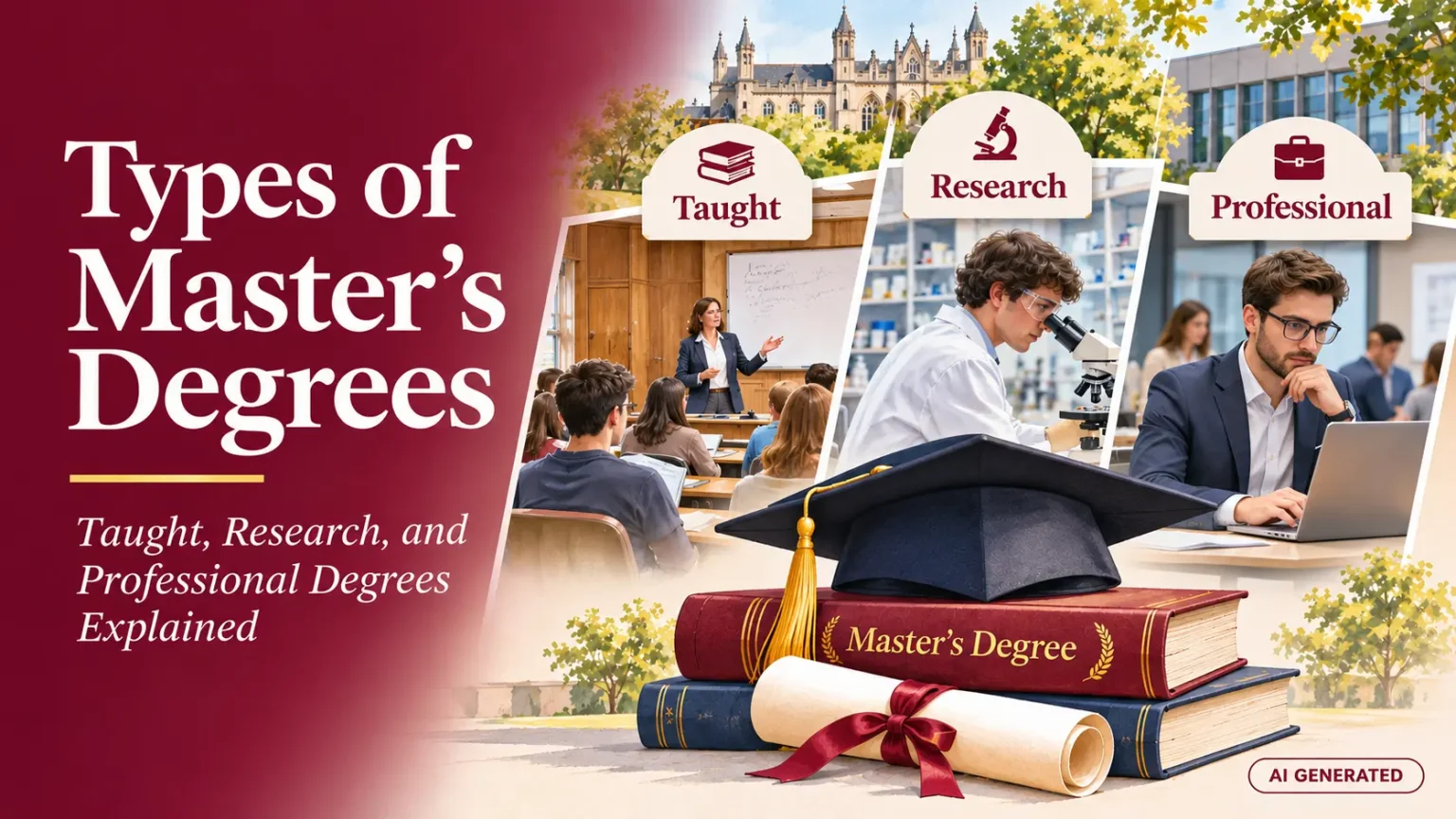
A master’s degree is a graduate qualification between a bachelor’s degree and a doctorate, built on advanced coursework, an independent research project, or both. Master’s degrees can be offered full-time, part-time, and in many fields online. The types of master’s degrees differ in format, purpose, and entry route, and the same degree can be structured differently from one higher education system to the next.
This article explains the different types and titles of master’s degrees, what each requires, and how they differ across the US, the UK, Canada, continental Europe, and Australia.
Principales conclusiones
- There are three main types of master’s degrees: taught, research, and professional. Integrated and conversion programs are variations on the taught format.
- A degree title usually signals the broad discipline or format, although some titles, the MPhil in particular, mean different things at different universities.
- MS and MSc both stand for master of science and are the same level of degree. The US uses MS, while the UK, many Canadian universities, and much of Europe use MSc.
- Most programs ask for a bachelor’s degree, transcripts, a statement of purpose, references, and English proficiency scores for non-native speakers. MBA, creative, and research programs add work experience, a portfolio, or a research proposal.
- A full-time master’s usually takes one year in the UK and one to two years in the US, Canada, continental Europe, and Australia.
What Are the Different Types of Master’s Degrees?
Different master’s degrees fall into three main types:
- Taught master’s degrees are built around structured coursework and usually end with a dissertation.
- Research master’s degrees center on an independent project supervised by an academic, with little or no coursework.
- Professional master’s degrees prepare students for a specific profession, and their titles name that field directly.
Integrated and conversion master’s degrees are variations on the taught format, each with its own entry route.
Taught, Research, and Professional Master’s Degrees at a Glance
The three types differ in how students spend their time, how they are assessed, and where the degree usually leads.
Type |
Core activity |
Assessed mainly through |
Usually leads to |
Common titles |
Taught |
Structured modules: lectures, seminars, assessed coursework |
Exams, essays, a dissertation or capstone |
Employment, further specialization, in some cases doctoral study |
MA, MS/MSc, MSt |
Research |
Independent project under an academic supervisor, few or no classes |
A thesis or dissertation |
Doctoral study or research roles |
MRes, MPhil (in many cases), master’s by research |
Professional |
Training for a specific profession, often with practical components |
Coursework, projects, and in some fields supervised placements |
Entry to or advancement in a named profession |
MBA, MiM, LLM, MPH, MSW, MArch, MEd, MFA |
Master’s Degree Titles and What They Mean
Degree |
Full Title |
Type |
Typical Subjects |
MA |
Master of Arts |
Taught |
Humanities, social sciences |
MS / MSc |
Master of Science |
Taught |
Sciences, engineering, mathematics, quantitative fields |
MSt |
Master of Studies |
Taught |
Humanities and professional fields (Oxford, Cambridge) |
MLitt |
Master of Letters |
Taught or research |
Humanities |
MRes |
Master of Research |
Research |
All fields |
MPhil |
Master of Philosophy |
Taught or research |
All fields |
MEng, MSci, MMath (UK) |
Master of Engineering / Science / Mathematics |
Integrated |
Engineering, sciences, mathematics |
MEng (US) |
Master of Engineering |
Professional |
Engineering |
MBA, MiM |
Master of Business Administration / Master in Management |
Professional |
Business, management |
LLM |
Master of Laws |
Professional |
Law |
MPH, MSW |
Master of Public Health / Social Work |
Professional |
Public health, social work |
MEd, MAT |
Master of Education / Master of Arts in Teaching |
Professional |
Education, teaching |
MArch, MFA, MM |
Master of Architecture / Fine Arts / Music |
Professional |
Architecture, visual art, creative writing, music |
Taught Master’s Degrees
Taught master’s degrees are usually the most common format on university course lists. Students complete structured modules through lectures, seminars, exams, and assessed coursework, and in most cases finish with a dissertation, so the program follows the shape of a bachelor’s degree at a more advanced level. UK universities refer to these programs as postgraduate taught (PGT), a term that appears throughout their course listings.
Master of Arts (MA)
A Master of Arts is a master’s degree usually awarded in the humanities and social sciences, including history, literature, languages, education, and communications. In most systems, the title marks a postgraduate degree earned through coursework and a dissertation. Two traditions in the UK and Ireland use it differently:
- Scotland: at the ancient universities of St Andrews, Glasgow, Aberdeen, and Edinburgh, as well as Dundee, the MA is a four-year undergraduate degree, equivalent to a BA elsewhere in the UK. The postgraduate degree that other universities would call an MA is usually awarded there as an MLitt or MSc.
- Oxford, Cambridge, and Trinity College Dublin: BA graduates are promoted to MA after a set period as a mark of seniority within the university, without further study or examination. At Oxford, this happens 21 terms after matriculation, and the degree is often written as “MA (Oxon).”
In the US, a related title, the Master of Arts in Liberal Studies (MALS), describes an interdisciplinary graduate program drawing on courses across the humanities and social sciences.
Master of Science (MS / MSc)
A Master of Science is a master’s degree usually awarded in the sciences, technology, engineering, mathematics, and quantitatively oriented social sciences. On the MS vs MSc question, the two abbreviations describe the same level of degree: MS is the standard form in the US, while MSc is used in the UK, at many Canadian universities, and across much of Europe. Subjects such as economics and psychology sit on the boundary between the two titles, and depending on the university, the same field can lead to either an MA or an MS.
MA vs MS: What’s the Difference?
The difference between a Master of Arts and a Master of Science in the same subject is sometimes substantive and sometimes a matter of institutional habit.
- Where it is real: an MS usually weights quantitative methods, laboratory or technical work, and research design more heavily, and in some fields it carries a larger thesis. An MA in the same area usually leans toward qualitative, theoretical, or interpretive work.
- Where it is habit: one university awards an MA in economics while another awards an MS for comparable coursework. In those cases, the required courses and the final project show where a program sits.
MA |
MS / MSc |
|
Typical subjects |
Humanities, social sciences, education |
Sciences, engineering, mathematics, quantitative social sciences |
Coursework emphasis |
Qualitative, theoretical, interpretive |
Quantitative, technical, methodological |
Research component |
Dissertation or final paper, varies by program |
Thesis or project, in some fields more research-intensive |
Common next steps |
Teaching, policy, cultural sectors, doctoral study in the humanities |
Technical and research roles, doctoral study in the sciences |
The same question arises at the undergraduate level, in comparing a BA and a BS, and the same approach of reading the curriculum behind each label applies.
Master of Studies (MSt) and Master of Letters (MLitt)
Two less common titles appear mainly at UK universities, and both are easier to read once their institutional context is clear.
En Master of Studies is offered mainly at Oxford and Cambridge and is comparable to an MA or MSc, with coursework and a dissertation. At Cambridge, every MSt is a part-time program designed for students who are working full-time, while Oxford offers both full-time and part-time MSt programs, and the mix of taught and research content varies by course.
En Master of Letters is, in Scotland, usually a one-year taught degree in the humanities. It is the postgraduate qualification Scottish universities award where others would award an MA, which follows from the Scottish MA being an undergraduate degree. Where English universities offer the MLitt, it is in many cases a research degree.
Integrated Master’s Degrees
An integrated master’s degree, often described as a four-year master’s degree, combines undergraduate and master’s study in a single program. It is mainly a UK format, common in engineering and the sciences under titles such as MEng, MSci, and MMath. Students apply straight from secondary school, and the final year is taught at master’s level. In England, Wales, and Northern Ireland, integrated master’s programs usually run for four years, or five with a placement year. In Scotland, where bachelor’s degrees take four years, they usually run for five, as with the MEng at the University of Glasgow.
The closest US equivalent is the accelerated bachelor’s/master’s program, often called a 4+1 or 3+2. Students take graduate courses during their senior year that count toward both degrees, then complete the master’s in a fifth year, which leads to two separate degrees where the UK model awards one. The US MEng is a different degree altogether: a graduate program that at universities such as Cornell takes one year and replaces the traditional thesis with a design project.
Conversion Master’s Degrees
A common question is whether a graduate can get a master’s in anything. In many fields, the answer is yes, through conversion master’s degrees, which are designed for graduates moving into a subject different from their bachelor’s degree. These programs condense the core knowledge of an undergraduate degree in the new field into an intensive course, usually one year full-time or two years part-time.
In the UK, conversion programs exist in fields such as psychology and computer science. Psychology conversion programs accredited by the British Psychological Society, for example, typically take one year full-time and open the route toward professional psychology. Other fields, particularly in the sciences and engineering, usually expect a related bachelor’s degree, since the master’s coursework builds directly on undergraduate foundations.
Research Master’s Degrees
Research master’s degrees are built around an independent project on a single topic, completed under an academic supervisor with few or no classes. UK universities refer to these programs as postgraduate research (PGR). A research master’s program is in many cases the step before a PhD, either as preparation for doctoral study or as a way to test an interest in research before committing to it. The titles in this category reflect how universities structure that preparation.
Master of Research (MRes)
The MRes is research training at master’s level. It combines projects, seminars, and classes in research methods, usually over one year, and is common in the UK as preparation for doctoral study in a specific field.
Master of Philosophy (MPhil)
The MPhil varies more by university than any other master’s title:
- Cambridge: most MPhils are one-year programs with taught elements, called “MPhil by Advanced Study.” A smaller number are research-only, called “MPhil by Thesis.”
- Oxford: the MPhil is usually a 21-month taught degree with a substantial thesis, designed in many cases as preparation for doctoral study.
- Elsewhere: the MPhil is in many cases a research degree.
For any MPhil, the program structure gives a more reliable picture than the title. For applicants planning a doctorate, the difference also affects timing. On a one-year program, doctoral applications are in many cases prepared within the first few months of the master’s itself, while a two-year program allows a full year of graduate work to inform them.
Master’s by Research (MSc by Research, MA by Research)
Some UK universities award a master’s degree by research under familiar titles, such as “MSc by Research” or “MA by Research.” The title resembles a taught degree, but the program is almost entirely independent research. The University of Edinburgh, for example, describes its MSc by Research as a pure research degree with no taught elements, usually completed in one year full-time, which many students use as a stepping stone to a PhD.
Professional Master’s Degrees
Professional master’s degrees prepare students for a specific profession, and the title names the field itself. Some function as entry routes into a profession; others deepen expertise for people already working in it.
Common Professional Master’s Degrees
- MBA (Master of Business Administration): advanced training in business and management, usually for applicants with several years of work experience.
- MiM (Master in Management): a business and management degree designed for recent graduates with little or no work experience.
- LLM (Master of Laws): specialized legal study for students who already hold a first degree in law.
- MPH (Master of Public Health): public health training, with specializations such as epidemiology, global health, and health policy.
- MSW (Master of Social Work): professional preparation for social work practice.
- MPA and MPP (Master of Public Administration / Public Policy): management and policy training for government, nonprofit, and international organizations.
- MLS or MLIS (Master of Library and Information Science): in the US and Canada, often required for professional librarian positions.
- MArch (Master of Architecture): architectural design and practice, in many countries part of the route to registration as an architect.
- MEd and MAT (Master of Education / Master of Arts in Teaching): the MEd usually serves educators developing expertise in areas such as curriculum or leadership, while the MAT prepares graduates, including those without an education degree, for teacher certification.
- MFA (Master of Fine Arts): advanced study in visual art, creative writing, or performance.
- MM or MMus (Master of Music): advanced study in performance, composition, or conducting.
Several of these degrees, including those in social work, architecture, and teaching, connect to professional licensing, which is regulated country by country, so the country where a graduate plans to practice shapes which programs qualify.
Executive Master’s Degrees
Executive master’s degrees are designed for experienced professionals, usually mid-career, and run part-time or in short intensive blocks so students can continue working. The Executive MBA is the best-known example, but executive formats also exist in fields such as management, public policy, and healthcare leadership. Entry usually requires more professional experience than a standard MBA.
Master’s Degree Requirements
Master’s degree requirements are set program by program, but most applications are built from the same core elements, and the differences between degree types follow a clear pattern. Grade thresholds, deadlines, and application platforms vary more widely, by country and by university.
What Most Master’s Programs Require
Most master’s applications include:
- A bachelor’s degree or its equivalent, often with a minimum grade (in the US, commonly around 3.0 on a 4.0 scale)
- Transcripts from every institution attended
- A statement of purpose
- Two or three letters of recommendation
- A CV or resume
- English proficiency scores, such as TOEFL or IELTS, for applicants whose first language is not English
- GRE or GMAT scores at some programs, though many make them optional
For US programs, applicants with a degree from another country may also need a foreign degree evaluation to show how their qualification compares with a US bachelor’s.
Additional Requirements by Degree Type
Beyond that baseline, each type of master’s degree adds requirements of its own.
Taught Master’s Degrees
- MA, MSt, and MLitt: in most cases, nothing beyond the standard application.
- MS and MSc: usually a bachelor’s in a related field, with prerequisite coursework such as calculus or statistics at some programs.
- Integrated master’s degrees: secondary school qualifications in place of a bachelor’s, since students enter straight from school.
- Conversion master’s degrees: a bachelor’s in any subject, often with a minimum grade.
Research Master’s Degrees
- MRes, research MPhil, and master’s by research: a strong academic record in the field, usually a related bachelor’s, and in many cases a research proposal outlining the intended project.
Professional Master’s Degrees
- MBA: usually several years of professional work experience.
- Executive master’s degrees: substantial mid-career experience, typically more than a standard MBA expects.
- MiM: designed for recent graduates, so little or no work experience is expected.
- MPA, MPP, and MEd: prior professional experience is preferred at some programs.
- MAT: open to graduates without an education degree.
- LLM: a first degree in law.
- US MEng: a bachelor’s in engineering or a related field.
- MFA, MM/MMus, and MArch: a portfolio, audition, or writing sample.
- MPH, MSW, and MLS: usually nothing beyond the standard application, with related coursework required at some programs.
Work experience requirements also shape timing. In fields such as business, programs expect professional experience first, which is why timing a graduate application is part of the same decision as the degree itself.
How Master’s Degrees Differ by Country
The same degree title can describe programs of different lengths, credit structures, and final requirements depending on where it is awarded.
Country |
Typical Full-Time Length |
Credit Measure |
Thesis Expectations |
Common Master of Science Abbreviation |
Estados Unidos |
1 to 2 years |
At least 30 semester credit hours is common |
Thesis and non-thesis options |
MS |
Reino Unido |
1 year (taught) |
180 UK credits (90 ECTS) |
Dissertation or substantial project usually required in taught programs |
MSc |
Canadá |
1 to 2 years; thesis-based programs commonly take about 2 years |
Varies by university |
Course-based or thesis-based |
MSc |
Continental Europe |
1 to 2 years |
60 to 120 ECTS, typically 90 to 120 |
Required in many countries, including Germany |
MSc |
Australia |
1 to 2 years (coursework or research); typically 3 to 4 years (extended) |
Credit points vary by university |
Required for research degrees |
Varies by university |
Estados Unidos
US master’s programs may offer thesis and non-thesis options, depending on the university and department. A thesis involves supervised research, while non-thesis options may involve additional coursework, a comprehensive exam, or a capstone. For students considering a research PhD, a thesis track can provide useful research experience, a substantial writing sample, and a closer working relationship with a supervisor.
Reino Unido
A UK taught master’s usually takes one year full-time, commonly includes a dissertation or substantial project, and is graded differently from a US degree. UK universities usually award it with a Pass, Merit, or Distinction, with Distinction commonly set at 70 percent and above. The one-year format is a core difference between the American and UK education systems. Students planning to move straight into a PhD or employment should check deadlines early, as some applications close before the dissertation is complete.
Canadá
Canadian universities offer course-based and thesis-based master’s programs, with some also offering a major research paper, project, or practicum. A thesis-based master’s centers on supervised research and can provide preparation for students considering a research PhD. The options available differ between universities in Canada and between departments within the same university.
Europa
Most of continental Europe follows the Bologna system, with degrees measured in ECTS credits, but national systems still shape the degree. Germany divides master’s programs into consecutive degrees, which build on previous undergraduate study, and continuing education degrees, which generally require at least one year of relevant professional experience. Every German master’s also ends with a thesis. In the Netherlands, research universities offer selective two-year research master’s programs as preparation for a PhD. Other master’s commonly take one or two years, depending on the subject.
Australia
Within the Australian education system, every master’s degree sits at Level 9 of the Australian Qualifications Framework (AQF), in one of three forms: coursework, research, or extended. The AQF permits the title Juris Doctor for extended master’s qualifications in legal practice, and certain “Doctor of” titles for extended master’s in medicine, dentistry, physiotherapy, optometry, and veterinary practice.
Choosing a Master’s Degree Type
The first question is what the degree should lead to. Students planning a PhD should look for substantial research training, a supervised thesis, and faculty working in their area of interest, the hallmarks of a research university. For a licensed profession, the program should meet the relevant regulator’s educational requirements where the student intends to practice. For other career goals, the skills taught, practical projects, and graduate destinations are a better guide than the degree title alone.
Background then narrows the options. A conversion master’s offers a way into a new field, while an advanced specialist program may require related undergraduate study. A MiM typically suits recent graduates seeking management training, an MBA generally suits applicants with professional experience, and executive programs often expect leadership experience. Part-time and online options may make it easier to study alongside work.
Before committing, students should weigh the total cost, funding, and time away from employment against the opportunities the program opens. It also pays to check whether graduates enter the careers or doctoral programs being targeted, whether the qualification is recognized where it will be used, and whether the study schedule works with the next step.
Plan Master’s Admissions Across Countries
Planning a master’s in one country, or comparing programs across several? McMillan Education International plans graduate applications for a single chosen destination or across the US, the UK, Canada, continental Europe, and Australia.
Our master’s admissions consultants, many of them former admissions officers and educators, know what each system’s admissions committees look for and build every application to compete in that pool. That expertise has placed students across 15 countries and secured admission at 450+ universities worldwide.
Concertar una consulta gratuita to plan a master’s application with a consultant who knows the systems involved.
Preguntas frecuentes
1. Why get a master’s degree?
A master’s degree can deepen your subject knowledge, strengthen your research and problem-solving skills, and help you build connections with specialists in your field. It can also support a career change, prepare you for doctoral study, or qualify you for roles that require advanced training. There may be financial benefits too: US Bureau of Labor Statistics data show that master’s degree holders earned about 19% more in median weekly pay than bachelor’s degree holders in 2025, although outcomes vary by field, experience, and program cost.
2. What are the main types of master’s degrees?
Master’s degrees include taught, research-focused, and professional programs, with considerable overlap between these categories. Common titles include MA, MS/MSc, MBA, MEd, and MEng. The title alone does not establish how much coursework, research, or practical training a program includes.
3. Is a master’s degree a graduate or postgraduate degree?
Both terms apply. A master’s is generally described as a graduate degree in the US and Canada and a postgraduate degree in the UK, Ireland, and Australia. These terms also cover other qualifications beyond a bachelor’s, including doctorates.
4. Do you need a bachelor’s degree to get a master’s?
In most cases, yes. Integrated master’s degrees are one exception, since students typically enter them directly from secondary school and complete undergraduate and master’s study within one program. Some standalone programs, particularly executive and professional ones, may consider applicants without a bachelor’s based on substantial relevant experience or alternative qualifications.
5. What is the difference between a master’s and a PhD?
A master’s typically takes one to two years and involves advanced coursework, research, or both. A PhD usually takes several years and requires an original contribution to knowledge, normally presented in a doctoral thesis or equivalent research submission. A master’s with substantial research can prepare students for doctoral study, although some PhD programs admit applicants directly from a bachelor’s degree.
6. Is a one-year master’s degree recognized in other countries?
A one-year master’s can be recognized internationally, but acceptance depends on the qualification and its intended use. A typical UK taught master’s comprises 180 UK credits, equivalent to 90 ECTS, which falls within the typical master’s credit range in the European Higher Education Area. For further study, employment, or professional licensing abroad, check the receiving institution’s or authority’s requirements. In the US, these may include a foreign credential evaluation.
7. Can you get a master’s without a thesis?
Yes. Many US and Canadian programs offer non-thesis or course-based options, which may require additional coursework, a comprehensive exam, or a capstone project. UK taught master’s commonly include a dissertation or substantial project. German master’s programs require a final thesis.
8. Is an integrated master’s the same level as a standard master’s?
Yes. In the UK, an integrated master’s leads to a qualification at the same academic level as a standalone master’s. The difference is structure: an integrated master’s combines undergraduate and master’s-level study in one program, while a standalone master’s normally follows a completed bachelor’s degree.
9. What is a joint master’s degree?
A joint master’s is developed and delivered collaboratively by two or more higher education institutions, often across different countries. Award arrangements vary: graduates may receive a single jointly awarded degree or separate degrees from participating institutions. Erasmus Mundus Joint Masters involve at least three higher education institutions in three different countries. Students complete study periods in at least two countries different from their country of residence and receive either a joint degree or multiple degrees.