
International enrollment in Irish higher education has grown for four consecutive years, and more than 44,000 students from outside Ireland now study at Irish institutions, according to Higher Education Authority data. For students considering a bachelor’s degree in Ireland, the choice between universities comes down to differences in course range, tuition, and entry requirements, all of which are set separately for international applicants.
This article covers eight of the top universities in Ireland for international students, comparing undergraduate programs, tuition, and entry requirements, along with what the application process looks like for non-EU applicants.
8 Universities in Ireland for International Bachelor’s Students
Below is a carefully selected list of some of the best universities in Ireland for international students that offer bachelor’s degrees taught in English. This is neither a ranking nor an endorsement of one institution over another, and there are many other good universities in Ireland beyond those covered here. The universities included are all in the Republic of Ireland and are chosen on the basis of a clear, practical criterion: they offer established bachelor’s degree programs that non-EU applicants can apply to directly.
|
University |
City |
EU Fee (Free Fees) |
Non-EU Tuition per Year |
|
Trinity College Dublin |
Dublin |
€2,500 |
€20,630–€60,000 |
|
University College Dublin |
Dublin |
€2,754 |
From €23,050 |
|
Dublin City University |
Dublin |
€2,543 |
€16,900–€23,000 |
|
Maynooth University |
Maynooth |
€2,500 |
€16,500–€18,000 |
|
TU Dublin |
Dublin |
€2,500 |
€13,500–€21,886 |
|
University College Cork |
Cork |
€2,714 |
€19,514–€54,414 |
|
University of Galway |
Galway |
€2,640 |
€19,390–€55,000 |
|
University of Limerick |
Limerick |
€2,604 |
€17,500–€29,000 |
1. Trinity College Dublin
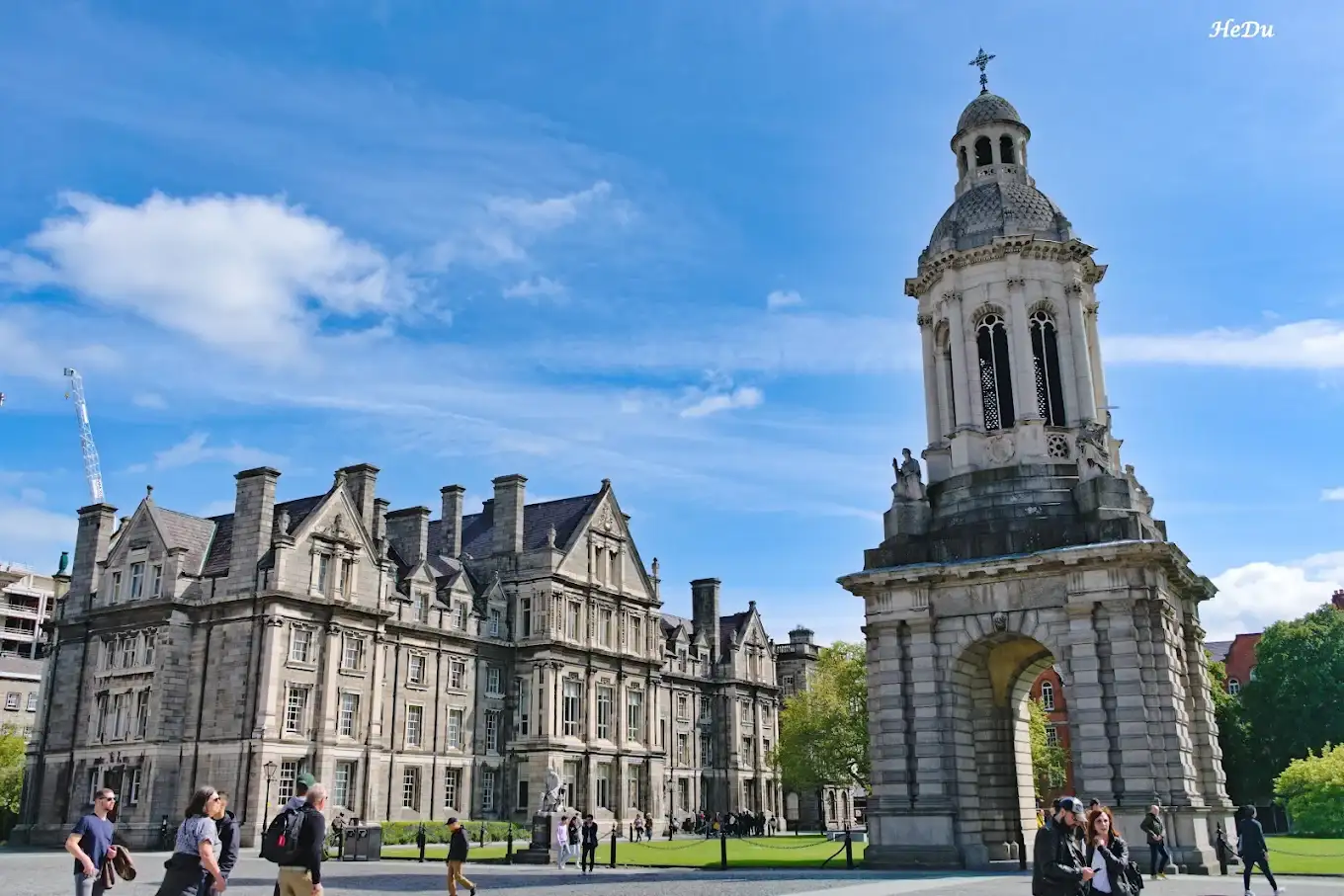
Trinity College Dublin was founded in 1592 and is the oldest of the universities in Ireland. Its campus at College Green in Dublin city center places students within walking distance of the city’s business, cultural, and government districts, and the Book of Kells, housed on campus since the 17th century, is on display in its Old Library. Trinity’s alumni include Oscar Wilde, Jonathan Swift, Samuel Beckett, and Bram Stoker, and the university is the only Irish member of the League of European Research Universities, a network of research-intensive universities across Europe. Trinity Business School, on the same campus, holds accreditation from all three major global business school accrediting bodies: AACSB, AMBA, and EQUIS.
- Undergraduate programs: arts and humanities, business, law, science, engineering, computer science, health sciences
- Tuition (EU), 2026/27: €2,500 student contribution for students eligible for Free Fees
- Tuition (non-EU), 2026/27, first year:
- Global Business: €20,630
- Most arts, humanities, business, and law: €22,580
- Most science, engineering, and mathematics: €29,570
- Medicine and Dental Science: up to €60,000
- English proficiency:
- IELTS: 6.5 (6.0 per band)
- TOEFL iBT: 90 (21 per section); from January 2026, 4.5 (4.0 per section)
- Duolingo: 120 (100 per subscore)
- Entry requirements:
- Unweighted GPA: 3.2 or higher
- SAT/ACT optional for 2027; published benchmarks: SAT 1250–1400 or ACT 27–32
- 2027 entry: individual assessment of GPA, transcripts, references, and personal statement; AP results considered where relevant
- IB: 30–40 points including bonus points, depending on course
- Application:
- Route: direct, through the course page
- Opens: by 1 November for September 2027 entry
Fees and English requirements vary by course; see Trinity’s undergraduate fee schedule and course pages.
2. University College Dublin
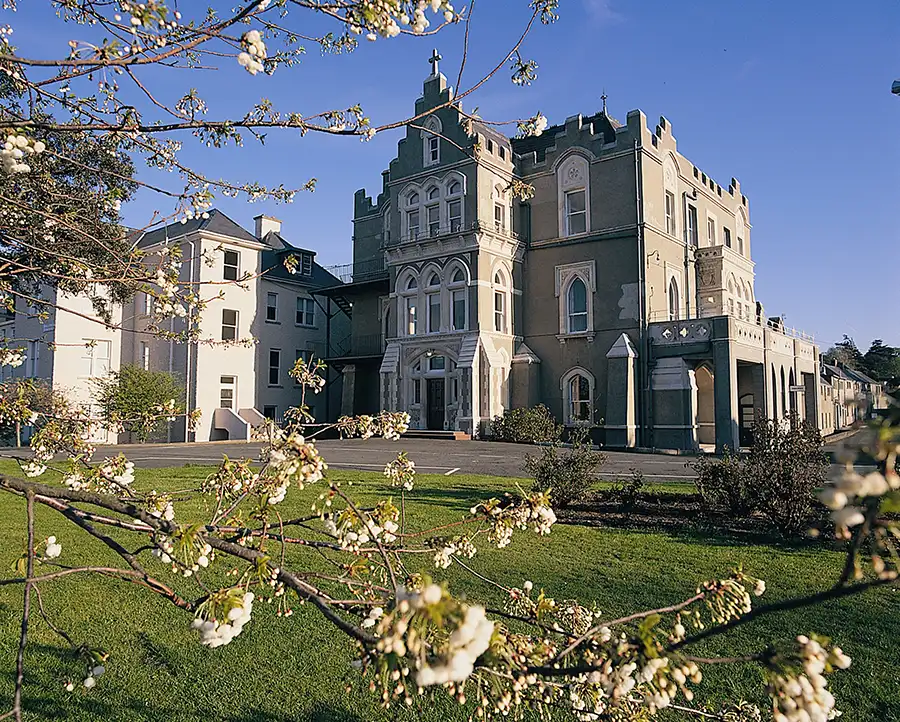
University College Dublin is located at Belfield, Dublin 4, on a self-contained campus a short distance south of the city center. It is one of the largest Irish universities by enrollment, with students from over 140 countries, and it leads or hosts several national research centers, including the Insight Centre for Data Analytics, CeADAR, iCRAG, and Food for Health Ireland. Alongside subject-specific degrees, UCD offers broader entry routes such as Liberal Arts and Sciences, where students begin across several subjects before choosing a focus.
- Undergraduate programs: arts and humanities, agricultural science, architecture and planning, business, engineering, law, science, social sciences, health sciences, sport, veterinary medicine
- Tuition (EU), 2026/27: €2,754 for students eligible for Free Fees (€2,500 student contribution plus €254Student Centre Levy)
- Tuition (non-EU), 2027/28, per year:
- Law: €23,050
- Arts (BA): €23,250
- Commerce: €23,635
- English proficiency:
- US high school graduates: grade C or higher in English in grade 11 or 12
- IELTS: 6.5 (6.0 per band)
- TOEFL iBT: 90 (writing 21, other sections 19)
- Duolingo: 120 (110 per subscore)
- Entry requirements:
- GPA requirements vary; some routes accept 3.0
- Arts and humanities: 3.2 GPA, or 3.0 with SAT 1000 / ACT 20
- Law, Commerce, Computer Science, Engineering: 3.5 GPA, SAT 1200 / ACT 25, one AP score of 3+
- Economics & Finance: 3.8 GPA, SAT 1400 / ACT 30, three AP scores of 3+
- IB: 24+ points and the award of the IB Diploma
- Examples (2026 entry): History 24, Law 33, Medicine 39
- Application:
- Route: direct to UCD; €70 fee covers several programs
- Opens: 1 October
- Recommended deadline for visa-required students: 1 July
Fees and subject requirements vary by course; see UCD’s non-EU undergraduate fee schedule e US curriculum entry requirements.
3. Dublin City University

Dublin City University was founded in 1975 and is based in Glasnevin, on the north side of Dublin. Through its INTRA program, many DCU courses include a paid work placement as part of the degree. For international students comparing universities in Ireland, DCU has a career-focused model and one of the lower non-EU fee levels among Dublin universities.
- Undergraduate programs: business, computing, engineering, science, health, communications and journalism, humanities, law, education
- Tuition (EU), 2026/27: €2,543 student contribution for students eligible for Free Fees
- Tuition (non-EU), 2026/27, per year:
- Most science courses: €16,900
- Business: €17,000
- Humanities, communications, and law: €17,300
- Computing and engineering: €17,900
- Nursing: €23,000
- English proficiency:
- IELTS: 6.5 (6.0 per component)
- TOEFL iBT: 92; on the newer scale, 4.5 (4.5 per section)
- Duolingo: 120 (110 per subscore)
- Entry requirements:
- US diploma: unweighted GPA of 3.0, plus two honors subjects or two AP subjects at grade 4+
- SAT 1200 (600 Math, 600 EBRW) or ACT 24
- School profile required with the application
- IB: general minimum 24 points; course-specific totals and subject requirements apply
- Application:
- Route: direct, through the DCU application portal
- Deadline: 1 July
- Up to three course preferences at no extra cost
Fees, GPA, and subject requirements vary by course; see DCU’s undergraduate fee schedule e international undergraduate admissions.
4. Maynooth University
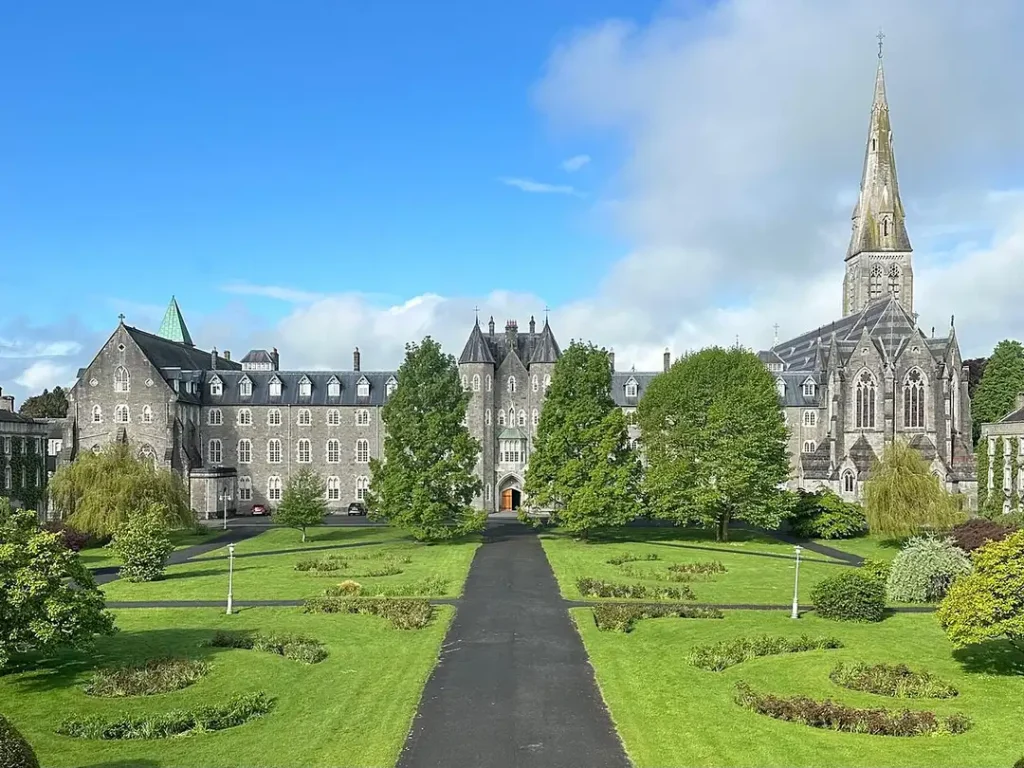
Maynooth University is in the town of Maynooth, County Kildare, west of Dublin. Its origins go back to 1795, and it became an independent university in 1997. Many of its degrees, including the Bachelor of Arts, let students combine subjects in first year before choosing a focus. For US students, Maynooth is approved to certify William D. Ford Federal Direct Loans. That makes it one of the universities in Ireland where American families can use US federal student aid.
- Undergraduate programs: arts and humanities, social sciences, business, law, science, engineering, computer science, psychology, education
- Tuition (EU), 2026/27: €2,500 for students eligible for Free Fees (€2,350 student contribution plus €150 student levy)
- Tuition (non-EU), 2026/27, per year:
- Arts, social science, psychology (BA), media studies: €16,500
- Business and law: €17,000
- Science, engineering, and computer science: €18,000
- English proficiency:
- IELTS: 6.5 (6.0 per band)
- TOEFL iBT: 90 (21 in writing, 19 in other sections); on the 1–6 scale, 5 (4.5 per section)
- Duolingo: 120 (110 per subscore)
- Entry requirements:
- US diploma (2027 entry): GPA 3.0 with SAT 1090 / ACT 21 for Arts and Social Science, up to GPA 3.4 withSAT 1350 / ACT 29 for Psychology
- A language other than English or Irish is required; high-school, AP or college evidence is accepted
- IB: 28 points minimum, with three subjects at Higher Level and three at Standard Level
- Application:
- Route: direct, through Maynooth’s online application portal
Fees, entry bands, and subject requirements vary by course; see Maynooth’s international undergraduate fee schedule e US entry requirements.
5. Technological University Dublin

Technological University Dublin was founded in 2019 as one of Ireland’s first technological universities. It has more than 27,000 students from over 100 countries across five campuses: Grangegorman, Aungier Street, and Bolton Street in Dublin city, plus Blanchardstown and Tallaght. Its degrees are career-focused, with labs, industry projects, and work placements built into many courses. TU Dublin also offers shorter higher certificates and ordinary degrees; the details below cover its honours bachelor’s degrees.
- Undergraduate programs: business, computing and data, engineering, architecture and built environment, science and health, creative arts and media, law, culinary arts and hospitality, social sciences
- Tuition (EU), 2026/27: €2,500 student contribution for students eligible for Free Fees
- Tuition (non-EU), 2026/27, per year, honours degrees:
- Most courses: €13,500
- Engineering, architecture, and built environment: €14,500
- Human Nutrition and Dietetics: €21,886
- English proficiency:
- IELTS: 6.0 (6.0 per component)
- Some courses, including Law, Journalism, and Film: 6.5–7.0
- Entry requirements:
- US diploma: GPA 3.0 with SAT 1090 (EBRW 560, Math 530) or ACT 21
- IB: 24 points and the award of the Diploma
- Some courses require a portfolio or audition
- Application:
- Route: direct, through the course page
- Fee: €50
Fees and requirements vary by course; see TU Dublin’s international undergraduate brochure e US entry requirements.
6. University College Cork
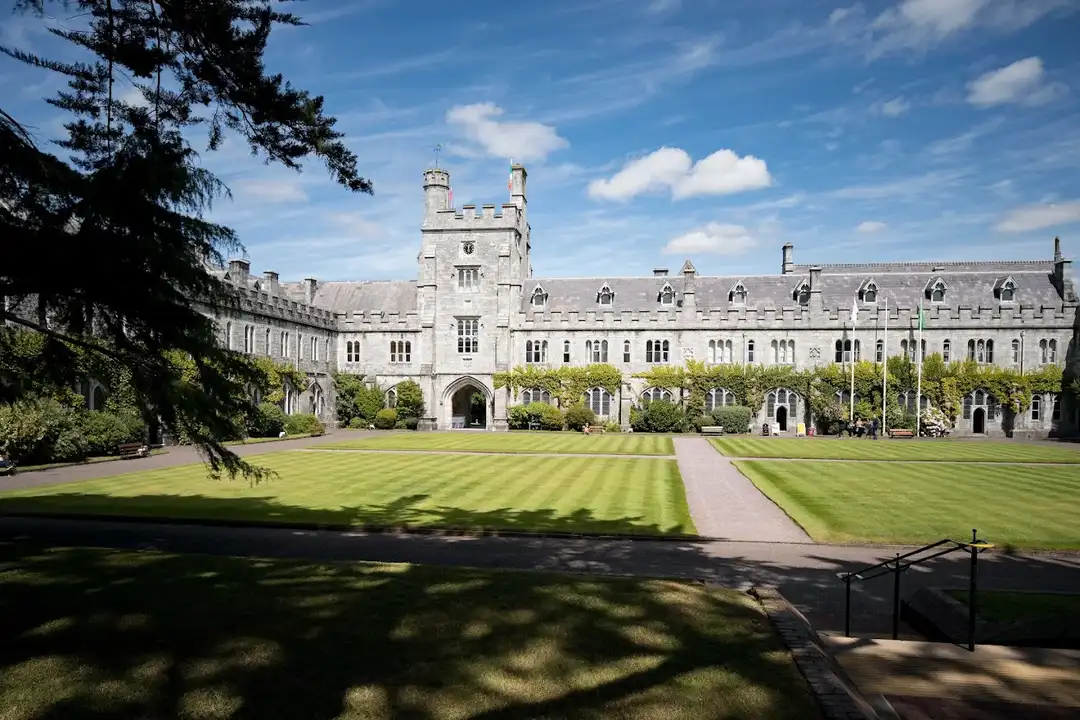
University College Cork is in Cork, Ireland’s second-largest city, on a campus a short walk from the city center. It was established in 1845 and has more than 20,000 students. UCC was the first university in the world to receive a Green Flag for environmental management, and sustainability runs through its teaching and research. Among universities in Ireland, it offers one of the broadest undergraduate catalogs, from arts and law to medicine, food science, and engineering.
- Undergraduate programs: arts and humanities, social sciences, business, law, science, engineering, computer science, food science, medicine and health
- Tuition (EU), 2027/28: €2,714 for students eligible for Free Fees (€2,500 student contribution plus €214 capitation fee)
- Tuition (non-EU), 2027/28, per year:
- Arts and social sciences: €19,514, with an automatic €2,000 scholarship for international students
- Business and law: €22,814
- Science, engineering, and computer science: €28,314
- Medicine: €54,414
- English proficiency:
- IELTS: 6.5 (6.0 per band)
- Medicine and health courses: 6.5 in every band
- Entry requirements:
- US diploma: GPA 3.0 with SAT 1140 / ACT 23, up to GPA 3.7 with SAT 1470 / ACT 32 for the most competitive courses
- Courses requiring math: SAT Math 640, ACT Math 28, or AP 3
- IB: six subjects, at least three at Higher Level; minimum points vary by course
- Application:
- Route: direct, through UCC’s online application for non-EU applicants
Fees and entry bands vary by course; see UCC’s international undergraduate fees e US entry requirements.
7. University of Galway
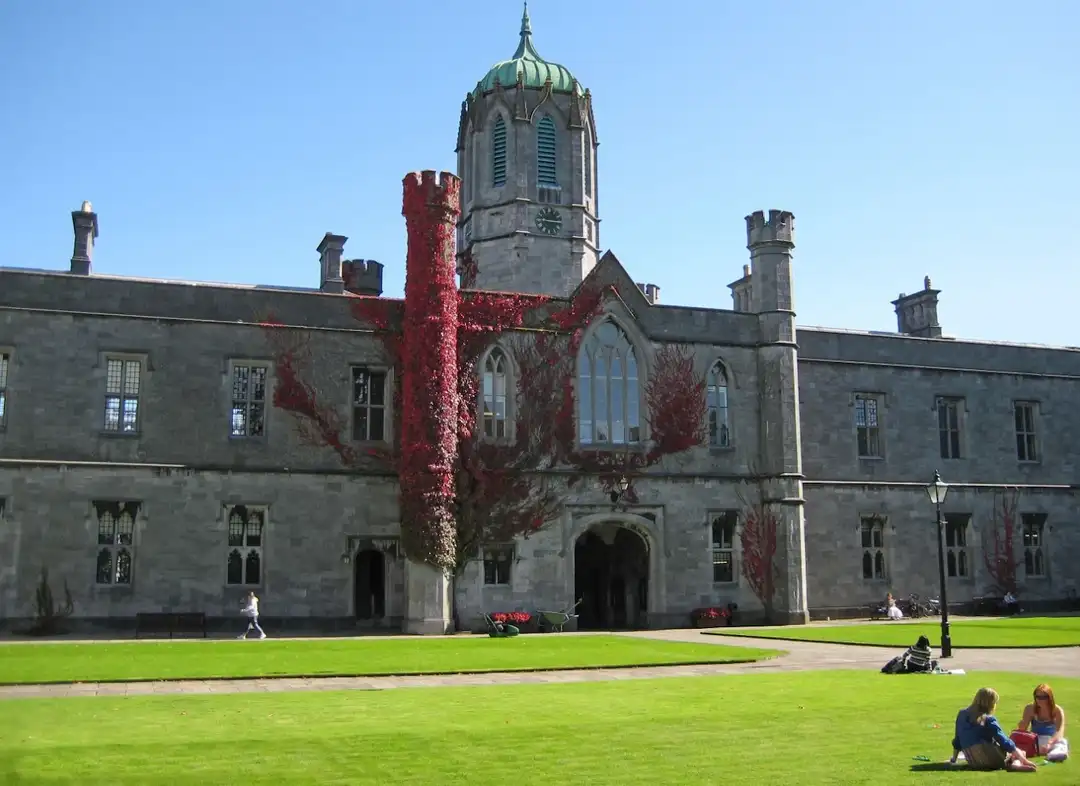
The University of Galway was founded in 1845 and sits on a 105-hectare campus along the River Corrib in Galway city, on Ireland’s west coast. It has more than 4,000 international students. The region is a European hub for medical technology, and the university has strong research links with the sector. For US students, Galway takes a test-flexible approach to admissions, although some courses require AP or honors-level preparation.
- Undergraduate programs: arts and humanities, commerce and business, law, science, engineering, computer science, medicine, nursing and health sciences
- Tuition (EU), 2026/27: €2,640 for students eligible for Free Fees (€2,500 student contribution plus €140 student levy)
- Tuition (non-EU), 2026/27, per year:
- Arts, commerce, and law: €19,390–€20,890
- Science, engineering, and computer science: €27,640
- Nursing and health sciences: €28,140–€28,340
- Medicine: €55,000
- English proficiency:
- IELTS: 6.5 (6.0 per component)
- Entry requirements:
- US diploma: GPA 3.0–3.75; published SAT/ACT benchmarks apply when scores are submitted
- Test-flexible: high school transcript required; SAT/ACT considered where available
- AP: grade 3 or above in at least two tests, if available
- Application:
- Route: direct, through University of Galway’s online application for non-EU applicants
Fees and entry bands vary by course; see University of Galway’s undergraduate fees e US entry requirements.
8. University of Limerick
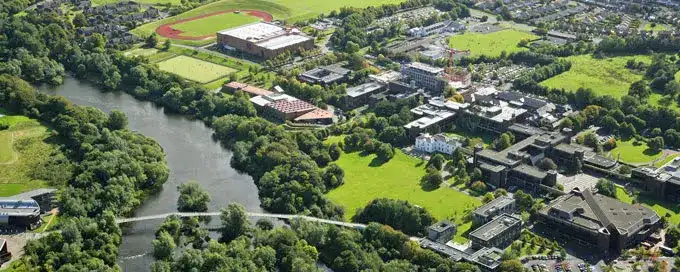
The University of Limerick is on a riverside campus along the River Shannon, a few kilometers from Limerick city on Ireland’s west coast. Founded in 1972, it introduced cooperative education to Ireland, and most of its degrees include a paid work placement, some of them abroad. UL is approved to certify William D. Ford Federal Direct Loans. It also accepts the Common App, which makes it one of the more straightforward universities in Ireland for American applicants.
- Undergraduate programs: arts and humanities, business, law, engineering, computer science, science, sport and exercise science, psychology, music and dance, nursing and health sciences
- Tuition (EU), 2026/27: €2,604 for students eligible for Free Fees (€2,500 student contribution plus €104 student levy)
- Tuition (non-EU), 2026/27, per year:
- Arts, business, and law: €17,500
- Science, engineering, computer science, and psychology: €22,700
- Health sciences and nursing: €26,300–€29,000
- English proficiency:
- IELTS: 6.5 (6.0 per band)
- Entry requirements:
- US diploma; SAT/ACT requirements depend on the course under UL’s test-flexible policy
- GPA 3.0 with SAT 1090 / ACT 22, up to GPA 3.3 with SAT 1350 / ACT 28 for the most competitive courses
- Science, engineering, and health courses: SAT Math 600 or ACT Math 25
- Application:
- Route: Common App or direct to UL
Fees and requirements vary by course; see UL’s undergraduate fees e US applicant page.
Why Study in Ireland
Ireland has become an established destination for international students who want an English-taught bachelor’s degree inside the European Union, and the main reasons are:
- English-taught degrees inside the EU. Ireland is the largest English-speaking country in the European Union, so students earn an EU degree without studying in a second language.
- High graduate employment. In the most recent Higher Education Authority (HEA) survey, 80.2% of graduates were working or due to start work nine months after graduating.
- Work experience built into degrees. Many global technology, pharmaceutical, and financial companies run their European operations from Ireland, and several of the universities above build paid work placements into their degrees, so course choice can shape professional experience before graduation.
- Work rights during study. Non-EU students can work up to 20 hours a week during term and 40 hours during holidays.
- A route to work after graduation. Honours bachelor’s graduates can apply for 12 months of post-study work permission under the Third Level Graduate Programme (Stamp 1G). Students planning to work in Ireland benefit from building employer connections before final year.
Tuition and Costs for International Students
Tuition at Irish universities depends on fee status and course rather than on the university alone. The Free Fees Initiative is the government scheme under which the state pays tuition for eligible full-time undergraduates, who pay only a student contribution. To qualify, a student must be a first-time undergraduate with EU, EEA, or Swiss nationality and must have lived in the EU, EEA, Switzerland, or UK for at least three of the five years before entry. Everyone else pays a fee set by the university, either an EU rate or an international rate that varies by course.
A fee assessment before applying avoids an unexpected bill at registration, and an educational consultant with experience in Irish admissions can review fee status alongside course choice at the planning stage.
For non-EU students, fees follow a consistent pattern across Irish universities. Arts, business, and law programs sit in the lowest band, science, engineering, and computing cost more, and health sciences and medicine carry the highest fees. Several universities raise fees in each year of a course, so the first-year figure understates the cost of the full degree. Most universities also offer merit-based fee reductions for non-EU students, which can lower the first-year cost.
Living costs vary mainly by city. University estimates put Dublin at €1,500 to €1,800 a month for a student living away from home, or roughly €18,000 to €21,600 a year, with rent as the largest expense. Costs in Cork, Galway, and Limerick are generally lower. Non-EU students must also hold private health insurance for the length of their studies. For budgeting purposes, families should plan for tuition and living costs together, since in Dublin living costs can approach the tuition fee itself.
How to Apply to Irish Universities as an International Student
Irish universities run two admissions routes. EU applicants apply through the Central Applications Office (CAO), which closes on 1 February each year. Non-EU applicants, including students with a US high school diploma, apply directly to each university. The steps below cover the non-EU route.
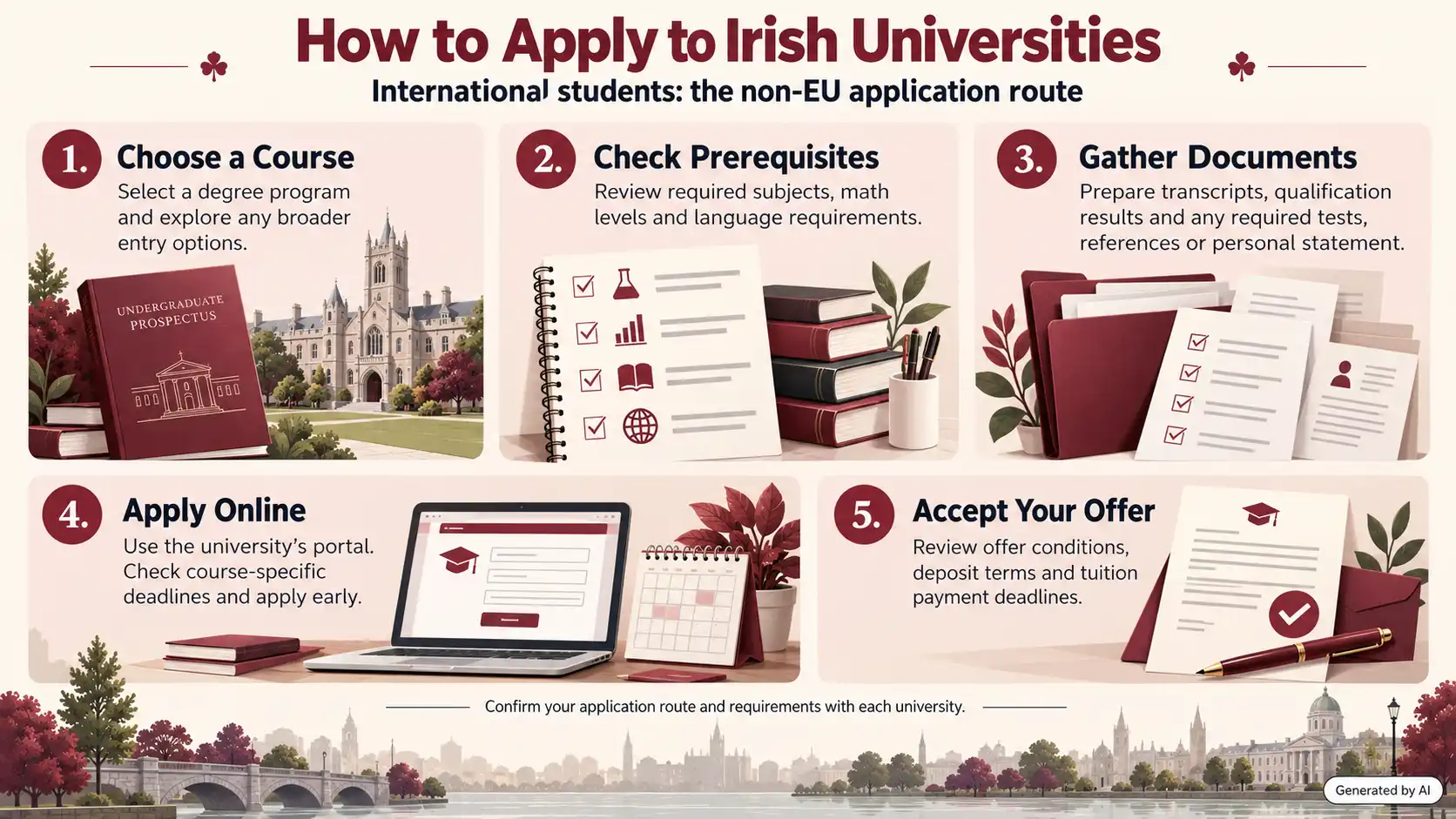
- Choose a course. Applications go to a specific degree course, and specialized study starts in first year. Some universities offer broader entry routes, such as common entry to engineering or general arts and science.
- Check subject prerequisites. Many science, engineering, and computing courses set minimum math requirements, and some universities require a language other than English. These belong in high school course choices well before senior year.
- Gather documents. High school transcript, school profile, and SAT or ACT scores, though a few universities are test-flexible. AP results can satisfy subject requirements, and IB Diploma holders apply with predicted or final scores. Some universities add references and a personal statement.
- Apply through the university’s portal. Applications open in October or November for September entry. Most non-EU deadlines fall in June or July, but medicine and other competitive courses close earlier, and some universities assess on a rolling basis. Applying in the fall or winter keeps more courses open and leaves time for scholarships.
- Accept the offer. A deposit confirms the place and is often non-refundable. Part or all of first-year tuition is due before registration.
Irish deadlines fall later than US and UK cycles, so students applying across several countries need the timelines planned together. McMillan Education International’s consulenti didattici structure course selection, subject requirements, testing, and application timing across Irish, US, UK, and European admissions as a single strategy.
Admissions Planning for Irish Universities
Planning to study in Ireland? Or considering Ireland among other options? McMillan Education International has placed students from over 65 countries into universities in 15+ countries, including Ireland. Our Irish university admissions consultants know how each university evaluates US and international applicants and build admissions strategies around each student’s academic and career goals.
Prenota una consulenza gratuita to plan an application backed by this expertise.
Domande frequenti
1. Are universities in Ireland free for international students?
No. Free tuition under the Free Fees Initiative applies only to eligible EU students, who pay a capped student contribution instead. Non-EU international students pay a course-specific fee, which at the universities in this article ranges from about €13,500 to €29,500 a year for most programs, with medicine above €54,000.
2. Is it cheaper to study in Ireland or the US?
For most courses, yes. The College Board puts the average 2025–26 published tuition at $31,880 for out-of-state public universities and $45,000 for private nonprofit colleges. Non-EU tuition for arts, business, and law at Irish universities falls below both, while science, health, and medicine fees can approach or exceed the out-of-state public average. Living costs in Dublin are comparable to many large US cities, so families should compare total cost, not tuition alone.
3. Can a US citizen go to college in Ireland?
Yes. US students apply to Irish universities as non-EU applicants, directly through each university’s portal or, at some universities, through the Common App. Most colleges in Ireland for American students assess the US high school diploma using unweighted GPA, SAT or ACT scores, and AP results, with requirements set by course.
4. Do Irish universities require the SAT or ACT?
Most Irish universities ask US diploma applicants for SAT or ACT scores, with minimum scores that rise for more competitive courses. Some take a test-flexible approach and assess the transcript first, and science and engineering courses often set separate math score minimums. Applicants choosing between the two tests can compare them in our article on the ACT vs SAT.
5. Is an Irish bachelor’s degree recognized in the US?
Irish honours bachelor’s degrees from recognized universities are widely accepted by US employers and graduate schools. Some institutions and licensing bodies ask for a credential evaluation from a NACES-member agency, which confirms the degree’s US equivalence. Our article on foreign degree equivalency in the USA explains how that process works.
6. Can international students work while studying in Ireland?
Yes. Non-EU students on a student immigration permission can work up to 20 hours a week during term and up to 40 hours a week during holiday periods. Work hours are limited by immigration rules, not by the university.
7. Can international students stay in Ireland after graduation?
Yes. Graduates of an Irish honours bachelor’s degree can apply for 12 months of post-study work permission under the Third Level Graduate Programme (Stamp 1G), which allows full-time work without an employer sponsor. Graduates who secure qualifying employment during that period can then move on to an employment permit.