
Families often come to us curious about New Zealand, drawn by its strong reputation for education but unsure how its system compares to more familiar North American or European models. That uncertainty usually stems from not knowing how the New Zealand education system is structured and what qualities define it.
We notice that confidence tends to grow once the system’s structure and values become clear, and often, families discover that New Zealand’s approach has been underrated in their initial consideration, despite the fact that international education is well established there and supported both publicly and institutionally. Public opinion consistently shows strong support for international students, and the majority report positive academic and personal experiences during their time here.
This article offers a deep dive into New Zealand’s education system, explaining how the system is organised and how it supports international students over time, so families can assess whether it aligns with their child’s learning style, academic strengths, and long-term aspirations.
Principaux enseignements
- New Zealand’s education system is nationally regulated, ensuring consistent quality standards across all institutions and regions.
- New Zealand universities rank highly globally (5 in the top 250 worldwide).
- 86% of international students rate their New Zealand experience positively, with 41% describing it as “excellent.”
- International students are broadly welcomed in New Zealand, with 77% of the public supporting the same or increased international student numbers.
- Bachelor’s degrees typically take 3 years to complete, while master’s programmes usually range from 1 to 2 years.
- Postgraduate degrees cost less than in Australia, making New Zealand an affordable option.
- NCEA qualifications are recognised globally by universities in the UK, US, Canada, and Australia, supporting students pursuing international careers or further study.
- Eligible international graduates can stay and work in New Zealand for up to 3 years after completing a degree.
Overview of the New Zealand Education System
New Zealand’s international education sector has developed steadily over time and is treated as a long-term national priority rather than a short-term initiative. It contributes more than $2.6 billion annually to the economy and represents approximately 13.6% of the country’s total services exports, which signals how seriously education is taken at a national level and why it receives sustained attention rather than periodic focus.
The decision to set out a strategy to double the sector’s value by 2034, while maintaining public support for international students, further reflects a long-term commitment to education that is meant to endure and remain credible over time.
To understand what sits behind this commitment, let’s explore how the education system itself is structured.
How the New Zealand Education System Is Structured
New Zealand’s education system is organised into three main stages:
- Primary Education (Years 0/1–6 or 8, ages 5–12): Foundation years focused on literacy, numeracy, and core skills. Some schools include Year 7–8, while others have separate intermediate schools for these years.
- Secondary Education (Years 9–13, ages 12–18): Students enter Year 9 around age 12–14 and progress through to Year 13 by age 16–18. From Year 11 onward, students pursue the National Certificate of Educational Achievement (NCEA), progressing through Levels 1, 2, and 3. Advancement is based on achieving credits rather than age alone.
- Tertiary Education (ages 18+): Universities, polytechnics, and private training institutions offering qualifications from certificates through doctoral degrees.
The system is nationally regulated, ensuring consistent quality standards across institutions and regions. This unified New Zealand Qualifications Framework allows qualifications to be recognised internationally, regardless of where they’re earned in the country.
Key Features of Education in New Zealand
One defining feature of education in New Zealand is that institutions operate within a shared framework, which means quality and expectations are consistent regardless of location. For families, this matters because it creates clarity around what qualifications represent and helps explain why public confidence in the system remains steady.
Another key feature is the credit-based progression system. Rather than advancing students by age alone, the NCEA framework requires demonstrated achievement. Students earn credits by meeting specific competency standards, so progress depends on mastery rather than calendar years. We often see this make a meaningful difference for students who develop at different rates.
The system also maintains parallel academic and vocational pathways throughout secondary and tertiary education. These routes are designed to remain open alongside one another, rather than forcing early decisions. Students can explore different directions through secondary education, then choose their trajectory at the tertiary level without having foreclosed options.
Finally, the system emphasises independent thinking and practical application. Students are expected to think critically and apply knowledge to real contexts, which develops the intellectual adaptability that international employers and universities value.
Primary and Secondary Education in New Zealand
Primary Education
Primary education in New Zealand is intentionally calm and developmental. Children typically start school at age five and move through Years 1 to 6, or through Year 8 in schools that include intermediate levels. The focus at this stage is on building strong literacy and numeracy skills while helping students become confident, independent learners.
What stands out to us is how little pressure there is to define a child academically too early. Students are not separated into rigid tracks, and progress is viewed as something that unfolds over time.
Secondary Education
Secondary education in New Zealand unfolds across two distinct phases, each serving a different purpose in a student’s academic journey. Years 9 and 10 function as exploration years, where students encounter a breadth of subjects before narrowing their focus. This deliberate design means students aren’t forced to specialise early; instead, they sample different disciplines and discover where their genuine interests lie.
By Years 11 through 13, that exploration gives way to formal qualifications through the NCEA, where students commit to specific pathways while still maintaining the flexibility the system provides.
In practice, this secondary education model delivers strong academic results, a point reinforced by international assessments such as PISA, where New Zealand students perform above OECD averages in reading, science, and mathematics.
What This Means for International Students and Families
International students typically enter in Year 9 or 10, depending on academic readiness. Most schools accept students at term starts, and entry timing depends on how prior education compares to New Zealand standards.
Schools with international students provide transition support, though the scope varies. We recommend asking directly what’s available, since this shapes adjustment success.
Prior qualifications are assessed individually to determine placement and whether credits transfer. This process takes time, so start conversations early.
The system offers real flexibility. If a student struggles, they can take additional time at a level or adjust their course load, rather than being forced forward by age. This provides genuine reassurance for families uncertain about transition.
NCEA qualifications are recognised by universities globally. If students later apply to étudier au Royaume-Uni, the US, Canada, or Australia, NCEA is understood and accepted. Learn more about NCEA with the video below:
Tertiary Education in New Zealand
For many families, study abroad programs in New Zealand at the tertiary level offer the most practical and straightforward transition path. Universities and other post-secondary options are used to working with students from different systems, and the transition from school into higher education is generally straightforward and well understood.
1. Types of Tertiary Institutions
New Zealand colleges and universities form part of a broader tertiary sector that also includes institutes of applied learning and private training providers, each serving different academic and career goals. Universities focus on research and academic depth. Institutes of applied learning emphasise practical skills tied to industry needs. Private providers offer specialised training in fields ranging from hospitality to creative industries.
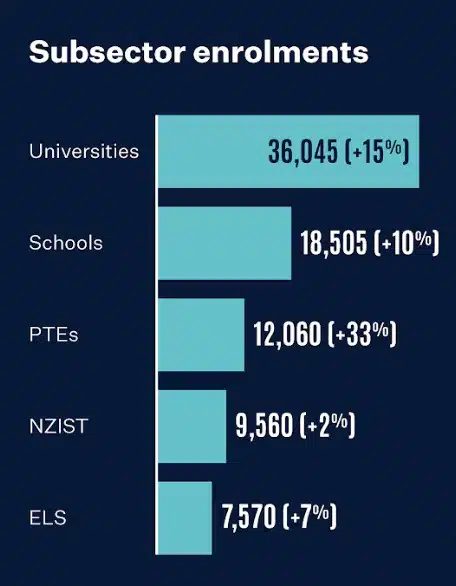
International students distribute across these institutions, with universities enrolling the largest share at 36,045 students. This number reflects where international demand tends to sit, but it also shows that universities in New Zealand have long experience supporting international students academically and administratively.
2. Academic Quality and Global Standing
New Zealand’s universities are well regarded internationally, offering a broad range of programmes across disciplines. New Zealand colleges and universities demonstrate strong global standing, with five institutions ranked in the top 250 worldwide, reflecting consistent academic standards rather than concentration in a single institution.
Tertiary education in New Zealand for international students combines institutional strength with a genuine welcome. For example, the University of Auckland, ranked 65 globally, illustrates this clearly, with international students making up approximately 39% of its student body and contributing to a diverse classroom experience.
Taken together, these indicators help explain why New Zealand is often included among the les meilleurs pays pour les étudiants étrangers. Academic quality, international recognition, and a strong track record of welcoming students from around the world come together in a way that is both credible and sustainable.
3. Student Experience and Support
Beyond rankings and reputation, what often matters most to families is how students actually feel once they arrive. From our experience working with international students in New Zealand, day-to-day support and overall well-being tend to be strong considerations at the tertiary level. In recent surveys, 86% of international students rated their experience positively, with 41% describing it as excellent.
Of course, individual experiences vary by institution and programme, but these responses reflect a pattern we hear regularly from students. For families, this can be reassuring, particularly when a student is living and studying far from home and adjusting to a new academic and cultural environment.
4. Outcomes After Graduation
The New Zealand education system places clear emphasis on preparing students for work and further study. At the tertiary level, academic learning is often paired with practical skill development, and many programmes are shaped with input from industry. For students, this means theory is regularly connected to how knowledge is applied in real professional settings.
Among key English-speaking study destinations, New Zealand ranks highest globally for employment outcomes, reflecting a system that keeps graduate readiness in view through curriculum design and employer engagement.
Eligible international graduates may also access post-study work options that allow them to stay and work in New Zealand for up to 3 years, giving students time to gain professional experience before making longer-term career or location decisions.
H2: Entry and Placement for International Students in New Zealand
International students enter New Zealand’s education system with different academic backgrounds, qualifications, and goals. Understanding how the system evaluates students’ preparation and where they fit ensures they start at the right level.
Entry requirements vary by institution and level. A student from the UK with GCSEs or Niveaux A will be assessed differently from one from a North American system with AP credits or an IB diploma. Schools evaluate prior qualifications individually to determine appropriate placement and whether credits transfer.
This assessment takes time. Prior academic records are reviewed, sometimes alongside entrance exams or interviews, to match students accurately to their entry level. Starting conversations early with institutions gives families clarity on timelines and what documentation is needed.
Practical Considerations for International Students
Before committing to study in New Zealand, families need clarity on logistics: when the year starts, what it costs, and what compliance means. These practical details shape the feasibility of a decision.
1. Academic Calendar and Study Duration
New Zealand’s academic year typically runs from February or March through November, organised into two main semesters. Some programmes offer trimester options, giving flexibility in how students structure their study. This calendar differs from North American and European systems, which matters for planning transitions and coordinating with family timelines.
Study duration is shorter than in some countries. Bachelor’s degrees typically take three years, while master’s degrees often complete in one to two years. This compressed timeline reflects both the intensity of the programmes and the system’s efficiency, which affects overall planning and cost.
2. Costs and Planning
Tuition and living costs vary significantly by institution, programme, and location. Postgraduate study in New Zealand costs approximately 26% less than studying in Australian universities, which positions the country as more affordable than some comparable destinations. Major cities like Auckland and Wellington carry higher living costs than regional centres, though accommodation, food, and transport remain factors families should budget for.
Planning should account for tuition, housing, health insurance, and daily expenses. Families benefit from understanding the full picture rather than tuition alone, since living costs often exceed what families expect.
3. Visas and Compliance
International students require a student visa to study in New Zealand, and visa conditions are tied to active enrolment and academic progress. While requirements can change, maintaining compliance is an essential part of a smooth study experience.
Earlier, we noted that post-study work options are available for eligible graduates. At the study stage, the key takeaway is that visa planning should be handled carefully and early, with up-to-date guidance, to ensure continuity throughout a student’s time in New Zealand.
Ready to Explore New Zealand?
New Zealand’s education system offers something different: structure without rigidity, academic depth without forcing early specialisation, and genuine support for international students finding their way. For families drawn to this approach but uncertain how it fits their child, understanding the system’s architecture is the first step toward clarity.
At McMillan Education, our international educational consultants help families make this assessment with clarity. If you’d like to discuss your child’s specific situation and explore whether New Zealand is the right fit, we invite you to prendre rendez-vous pour une consultation gratuite.
Questions fréquemment posées
1. Is education in New Zealand compulsory?
Education in New Zealand is compulsory for domestic students between certain ages, but for international students, participation depends on visa status and enrolment.
2. How does NCEA compare internationally?
NCEA is a nationally recognised secondary qualification that is well understood by universities in New Zealand and abroad. Its credit-based structure allows universities to assess both subject depth and academic achievement, and it is commonly accepted for entry to universities in the United States, Australia, Canada, and the UK.
3. Can international students move from secondary to tertiary education in New Zealand?
Yes. International students can progress from secondary education into tertiary study in New Zealand, provided they meet academic and English language requirements. The system is designed with continuity in mind, so qualifications earned at the school level are clearly linked to post-secondary options.
4. Are New Zealand qualifications recognised globally?
New Zealand qualifications are widely recognised internationally. They are issued within a nationally regulated framework, which helps universities and employers abroad understand their level, content, and academic rigour, making them suitable for further study or employment in many countries.