
The education system in Australia covers the same broad stages as the American and British models, but the structural details matter when an international family is evaluating it as a study destination. This article covers the Australian education system level by level, from the first year of compulsory school through university.
Principaux enseignements
- Australia doesn’t have one national school system. Each state and territory runs its own, with different grade names and certificates
- School runs from age 5 to around 17, split into primary, secondary, and senior secondary
- At the end of school, students earn a state-specific certificate
- After school, students can choose university or VET, Australia’s vocational training system, and both are treated as equal tertiary pathways.
- A bachelor’s degree usually takes 3 to 4 years in Australia
- Australian universities grade with HD, D, C, P, F instead of letter grades, and use a WAM instead of a GPA
- Australian universities admit international students based on their home country qualifications
- The academic year in Australia runs from February to March through November
How the Australian Education System Works
Australia organizes education into three stages: primary, secondary, and tertiary. Unlike countries with a single national school system, each of Australia’s eight states and territories runs its own, which means grade names, school starting ages, and senior secondary certificates can differ depending on where a student is enrolled. Across all three stages, qualifications are regulated through the Australian Qualifications Framework, a 10-level system that establishes what each certificate, diploma, and degree represents nationally.
Primary Education in Australia: Ages, Grades, and Curriculum
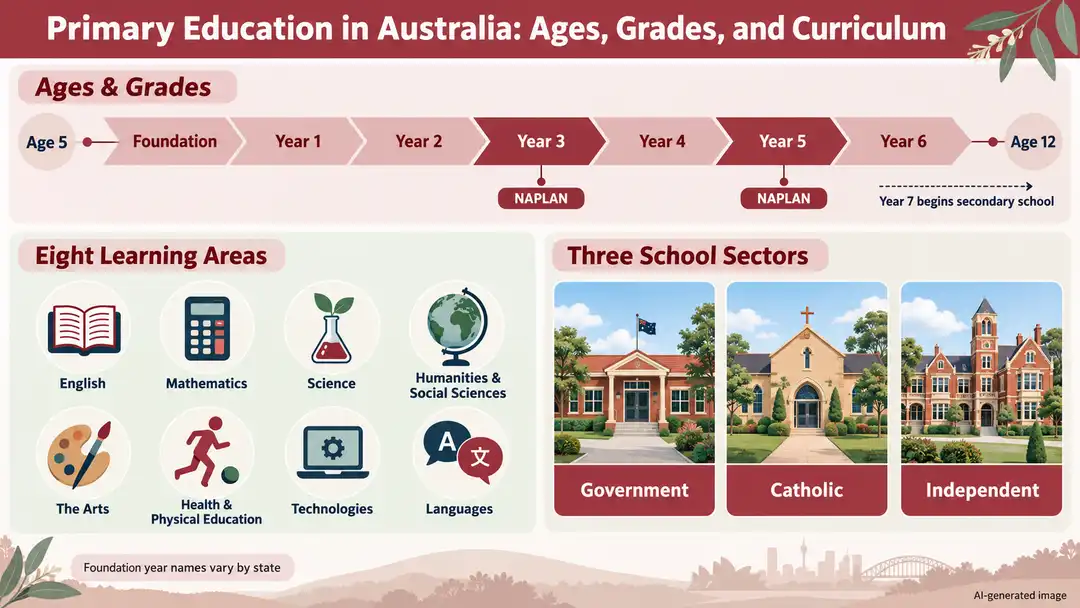
Primary education is the first stage of compulsory schooling in Australia, generally covering children aged 5 to 12.
1. What Ages and Grades Does Primary School Cover?
Primary school runs from a foundation year through Year 6, with students typically aged 5 to 12. The foundation year is known by different names across Australian states:
- Kindergarten – New South Wales, ACT
- Prep – Victoria, Queensland, Tasmania
- Reception – South Australia
- Pre-primary – Western Australia
- Transition – Northern Territory
Year 7 sits in secondary school across all states and territories, completing a transition that Queensland and Western Australia made before 2015 and South Australia completed in 2022.
2. What Do Primary Students Learn?
The Australian Curriculum covers eight learning areas across primary school, a structure broader than many comparable systems at this level.
- English
- Mathematics
- Science
- Humanities and Social Sciences
- The Arts
- Health and Physical Education
- Technologies
- Languages other than English
English and mathematics anchor the program, but the inclusion of Technologies and a dedicated Arts learning area from the earliest years reflects a deliberate emphasis on practical and creative development alongside academic foundations. Languages other than English is part of the national framework, though availability varies by school and state.
Students in Years 3 and 5 sit NAPLAN, the National Assessment Program for Literacy and Numeracy. NAPLAN tests reading, writing, language conventions, and numeracy, and results are published publicly on the My School website, giving families a basis for comparing school performance across the country.
3. Types of Primary Schools in Australia
Australia’s school system operates across three sectors, which differ in funding, character, and cost.
- Government schools are state-funded and free of tuition for citizens and permanent residents, accounting for around two-thirds of all enrollments nationally. Enrollment is generally tied to a catchment zone, meaning families are assigned to the school serving their residential address. Enrolling outside a zone is possible but depends on available capacity.
- Catholic schools form the largest non-government sector, receiving partial government funding and charging moderate fees. They follow the same national curriculum as government schools but operate within a Catholic ethos.
- Independent schools are the most varied of the three, covering secular private schools, faith-based schools of other denominations, and alternative-philosophy schools such as Montessori and Steiner. Fees range widely, and academic and extracurricular offerings tend to be more extensive at the higher fee end of the sector.
For international families, all three sectors can enroll international students, though tuition fees for visa holders apply regardless of sector. Only schools registered under CRICOS, the Commonwealth Register of Institutions and Courses for Overseas Students, are authorized to enroll international students, and this registration is worth confirming before applying anywhere.
Secondary Education in Australia: High School Years and Structure
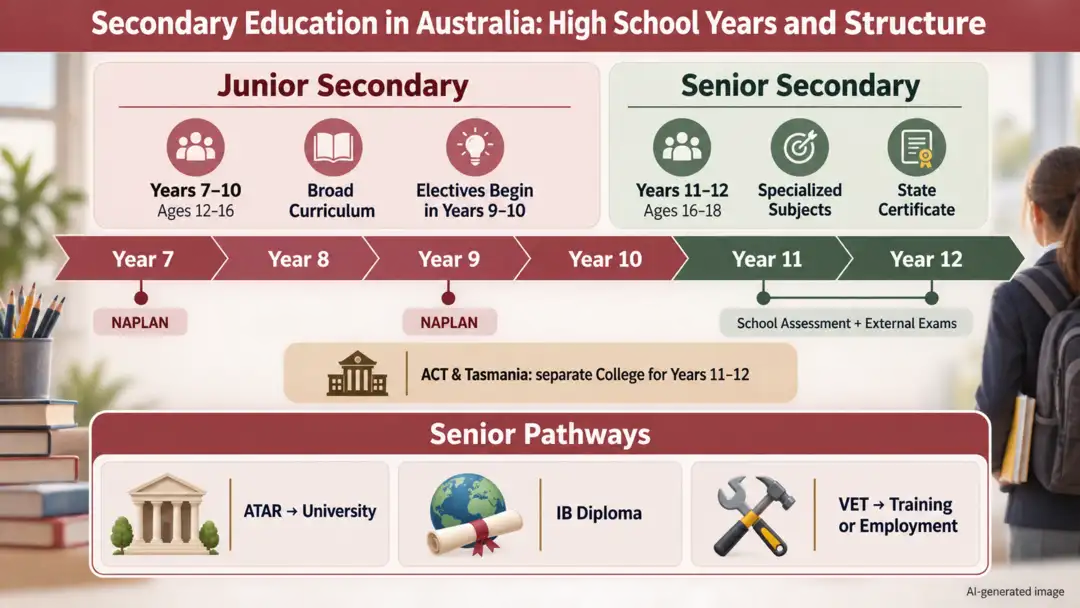
Secondary school begins at Year 7 across all states and territories. In most of Australia, students attend a single secondary school for the full six-year sequence. The ACT and Tasmania are an exception: their public school systems physically separate the two phases, with students attending a high school for Years 7 to 10 before moving to a separate senior campus referred to as “College” for Years 11 and 12.
Across all jurisdictions, students may leave school after completing Year 10, provided they move directly into approved full-time employment, an apprenticeship, or vocational training.
Academically, the six years of Australian secondary education divide into two phases:
- Junior secondary (Years 7 to 10): Students aged 12 to 16 follow a broad general curriculum across all major academic disciplines
- Senior secondary (Years 11 and 12): Students aged 16 to 18 move into specialized, goal-driven study oriented toward university entry, vocational qualifications, or direct employment
1. What Subjects Are Taught in Australian High Schools?
The curriculum shifts between the junior and senior years, both in what students study and how much choice they have over what they take.
1.1 Junior Secondary
In Years 7 to 10, schools follow the Australian Curriculum as adapted by state educational authorities. Students study a core set of subjects: English, mathematics, science, humanities and social sciences, and health and physical education. They also cycle through arts, technologies, and languages. Elective options open in Years 9 and 10, allowing students to begin focusing on areas they plan to pursue further.
1.2 Senior Secondary
In Years 11 and 12, mandatory core subjects give way almost entirely to student choice. Most states require at least one English subject; the remaining four to five subjects are elective. Students select courses based on university entry prerequisites, career direction, or trade pathways, with options ranging from advanced extension streams in mathematics and sciences to creative arts and humanities.
2. NAPLAN and How Students Are Assessed
Secondary school assessment combines national standardized testing with ongoing school-based evaluation and, in senior years, high-stakes state examinations.
2.1 Junior Secondary
Students sit NAPLAN again in Years 7 and 9. The tests cover reading, writing, language conventions, and numeracy. NAPLAN results do not affect a student’s grades or graduation standing; they produce nationally comparable data published on the government’s My School website, which families can use to assess individual school performance.
2.2 Senior Secondary
In Years 11 and 12, assessment is managed by state authorities and typically combines school-based internal assessment, including assignments, practical work, and unit tests, with centralized external examinations at the end of the year.
3. Senior Secondary Certificates by State
Students who complete Year 12 earn a state-specific Senior Secondary Certificate of Education. Each state and territory issues its own credential, all of which are nationally recognized as equivalent.
|
State / Territory |
Certificate Name |
Abbreviation |
|
New South Wales |
Higher School Certificate |
HSC |
|
Victoria |
Victorian Certificate of Education |
VCE |
|
Queensland |
Queensland Certificate of Education |
QCE |
|
Western Australia |
Western Australian Certificate of Education |
WACE |
|
South Australia |
South Australian Certificate of Education |
SACE |
|
Northern Territory |
Northern Territory Certificate of Education and Training |
NTCET |
|
Tasmania |
Tasmanian Certificate of Education |
TCE |
|
Australian Capital Territory |
ACT Senior Secondary Certificate |
ACT SSC |
The Australian HSC is the best-known of these internationally, but it is specific to New South Wales. Families researching Australian secondary education in other states will encounter a different certificate name and administering authority.
4. What Is the ATAR and How Does It Work?
The ATAR, or Australian Tertiary Admission Rank, is the primary metric Australian universities use to select school leavers for undergraduate programs. It is a percentile rank, not a score or percentage, measured on a scale up to 99.95. An ATAR of 85.00 means the student performed better than 85 percent of their entire age cohort statewide, including peers who left school early or did not pursue an academic pathway. Ranks below 30.00 are not published to avoid stigma; results in that range are officially reported as 30.00 or below.
Raw subject marks from Year 12 are mathematically adjusted before the ATAR is calculated, a process called scaling. Scaling accounts for differences in the difficulty and competitive composition of individual subject cohorts, ensuring students are neither penalized for choosing rigorous subjects nor boosted by less demanding ones.
5. Alternative Pathways: IB and VET in Schools
Not all secondary students follow the standard ATAR route. Two structured alternatives exist within the Australian education system.
The International Baccalaureate Diploma is offered at many independent private schools and some selective public schools as an alternative to the state Year 12 certificate. IB scores, which run out of 45, are converted into a notional ATAR by state tertiary admissions centers, allowing students to apply to Australian universities while holding a globally portable qualification.
VET in Schools programs allow students to complete vocational certificates, from Certificate I through Certificate III, alongside or within their high school certificate. Students pursuing apprenticeships, TAFE entry, or direct employment can graduate through non-scored vocational pathways without sitting ATAR exams. Victoria’s VCE Vocational Major is one example of a formally structured non-ATAR graduation pathway.
Tertiary Education in Australia: Vocational Training and University
Tertiary education in Australia refers to all formal study after secondary school. It splits into two pathways: vocational education and training, which covers practical, industry-linked qualifications, and university education, which covers academic degrees from bachelor’s through doctoral level.
1. Vocational Education and Training: VET and TAFE
Not every school leaver in Australia is headed to university, and the vocational system exists because a degree isn’t the right preparation for every career. Electricians, early childhood educators, chefs, and IT technicians typically train through VET, short for Vocational Education and Training, which is assessed against what a graduate can actually do on the job rather than through written examination.
TAFE, or Technical and Further Education, is the government-funded network that delivers most VET training across the country. Registered Training Organizations, or RTOs, run alongside TAFE and are typically privately operated, often specializing in a single trade or industry.
A VET qualification does not close the door to university. Diploma and Advanced Diploma graduates commonly receive credit toward a related bachelor’s degree through articulation agreements between TAFE and universities, often entering in the second year rather than starting from the beginning.
2. University Education in Australia
Australian universities are regulated nationally by the Tertiary Education Quality and Standards Agency, which sets the standards a degree must meet regardless of which institution issues it. The Group of Eight represents the country’s most research-intensive universities and functions as a rough equivalent to the UK’s Russell Group:
- Australian National University
- Adelaide University
- Université de Monash
- Université de Melbourne
- UNSW Sydney
- University of Queensland
- Université de Sydney
- University of Western Australia
Australian universities run on a calendar that will feel unfamiliar to families from the Northern Hemisphere. The main intake is February to March, with a mid-year intake in July available at most institutions.
One term worth clarifying for international families: in Australia, “college” does not mean a university. It typically refers to a residential college attached to a university campus, or in the ACT and Tasmania, to the senior secondary campus students attend for Years 11 and 12.
Degree length depends on the qualification:
- Bachelor’s degree: 3 to 4 years, with an additional honours year for students pursuing research
- Master’s degree (coursework): 1 to 2 years
- Doctorate: 3 to 4 years
- Medical schools: 5 to 6 years, or entered as a postgraduate program after a related bachelor’s
- Law: 4 years as a standalone degree, or 5 to 6 years as a combined degree
Australian universities admit international students on the basis of their home country qualifications, whether A-Levels, the IB, a US high school transcript, or an equivalent credential, alongside an English proficiency test such as IELTS or TOEFL. Students who need to bridge a gap in academic preparation can complete a foundation or pathway program before entering their degree, an option most major universities offer directly or through a partner provider.
2.1 The Australian University Grading System
Australian university results don’t use letter grades or a GPA. Instead, most institutions grade on this scale:
|
Grade |
Full Name |
Typical Percentage Range |
|
HD |
High Distinction |
85% and above |
|
D |
Distinction |
75 to 84% |
|
C |
Credit |
65 to 74% |
|
P |
Pass |
50 to 64% |
|
F |
Fail |
Below 50% |
A Pass means the student met the course requirements. A Credit and above is considered strong academic performance. Instead of a GPA, Australian universities calculate a WAM, or Weighted Average Mark, a numerical average across all subjects in a degree. A WAM above 70 is broadly equivalent to what a competitive GPA signals in the US system, and some graduate programs and employers set a minimum WAM as part of their entry requirements, a distinction worth understanding for families weighing foreign degree equivalency when applying abroad.
Considering Australia?
Australia is one of the leading study destinations in the world, and its education system is different enough from most others that getting it right takes more than a general understanding. McMillan Education International’s Australian university admissions consultants bring decades of experience guiding families through exactly these decisions.
Schedule a free consultation to get started.
Questions fréquemment posées
1. What age do children start school in Australia?
Most children start their foundation year, known locally as Kindergarten, Prep, Reception, Pre-primary, or Transition depending on the state, at age 5 or 6.
2. Is education free in Australia?
Government schools are free of tuition for citizens and permanent residents, though families still cover uniforms, excursions, and school levies. Catholic and independent schools charge fees. International students pay tuition regardless of sector.
3. What is a good ATAR score?
There’s no fixed threshold since it depends entirely on the course and university. Competitive programs like law or medicine at leading universities often require an ATAR above 90, while many bachelor’s degrees accept students well below that.
4. Is the Australian HSC recognized internationally?
Yes, the HSC and every other state senior certificate are recognized by universities abroad, though international admissions offices typically request a credential evaluation to assess how the result compares to their own system.
5. What is the difference between TAFE and university?
TAFE delivers practical, competency-based vocational qualifications like certificates and diplomas, while university delivers academic degrees from bachelor’s through doctoral level. Both sit within the same national qualifications framework.
6. Do Australian degrees transfer internationally?
Generally yes. Australian degrees are recognized by employers and universities in most countries, and the AQF gives them a standardized national basis for that recognition.
7. From what educational system does Australia pattern its own?
Australia’s formal schooling system developed from the British model, established during the colonial period. Over time, the states retained authority over schooling rather than centralizing it under one national body, and the Australian Qualifications Framework later introduced a level of national standardization that the British system does not have in the same form.