

For international students, studying at a university in Canada is not a single, isolated decision. Study permit rules, tuition and living costs, and post-study options are closely linked. Choices made early, such as the program or province you select, can affect both your ability to study in Canada and your opportunities after graduation.
Over the past several years, more international families we work with have been looking to Canada as a strong and realistic university option. This growing interest is reflected more broadly as well, with recent research ranking Canada as the second most preferred study abroad destination.
This guide brings those pieces together. It explains how the Canadian university system works for international students and how admissions, study permits, costs, and post-study options connect in practice. The goal, as always, is to help you plan thoughtfully, understand what matters at each stage, and make university choices in Canada with clarity and confidence.
Wichtigste Erkenntnisse
- Canada remains one of the world’s most preferred study destinations for international students, but increased demand means competition and policy complexity have grown.
- University admission requirements in Canada are program-specific, not standardized, and must always be confirmed directly with each institution.
- Post-study work options, including the PGWP, are not automatic or guaranteed and depend on program, institution, and compliance with current rules.
- Program choice and length influence total cost, study permit planning, and the range of post-graduation options available.
- English or French language requirements vary by university and program, including accepted tests, minimum scores, and validity periods.
- A Canadian study permit requires enrollment at a Designated Learning Institution and clear proof of sufficient financial support.
- City and province choice can affect total costs as much as tuition and should be considered early.
Why Study at a University in Canada as an International Student
The benefits of studying in Canada for international students are shaped by more than one factor. Looking more closely at these considerations can provide helpful context when evaluating Canadian universities.
1. Academic Reputation and Recognition
One of the main reasons why studying in Canada continues to attract international students is the quality and recognition of its universities. Several Canadian institutions are consistently ranked among the world’s leading universities, including McGill University, the University of Toronto, and the University of British Columbia, all placed in the global top 50. Canadian university degrees are widely respected by employers and graduate schools worldwide, making them a solid foundation for long-term academic and professional goals.
2. English and French Programs Within One Education System
Canada offers both English- and French-language university programs, with many institutions also providing bilingual options. This allows international students to study in their preferred language while developing additional language skills that can be valuable academically and professionally. For students seeking flexibility and international exposure, this linguistic diversity is a key benefit of studying in Canada for international students.
3. Post-Study Work and Immigration Planning Opportunities
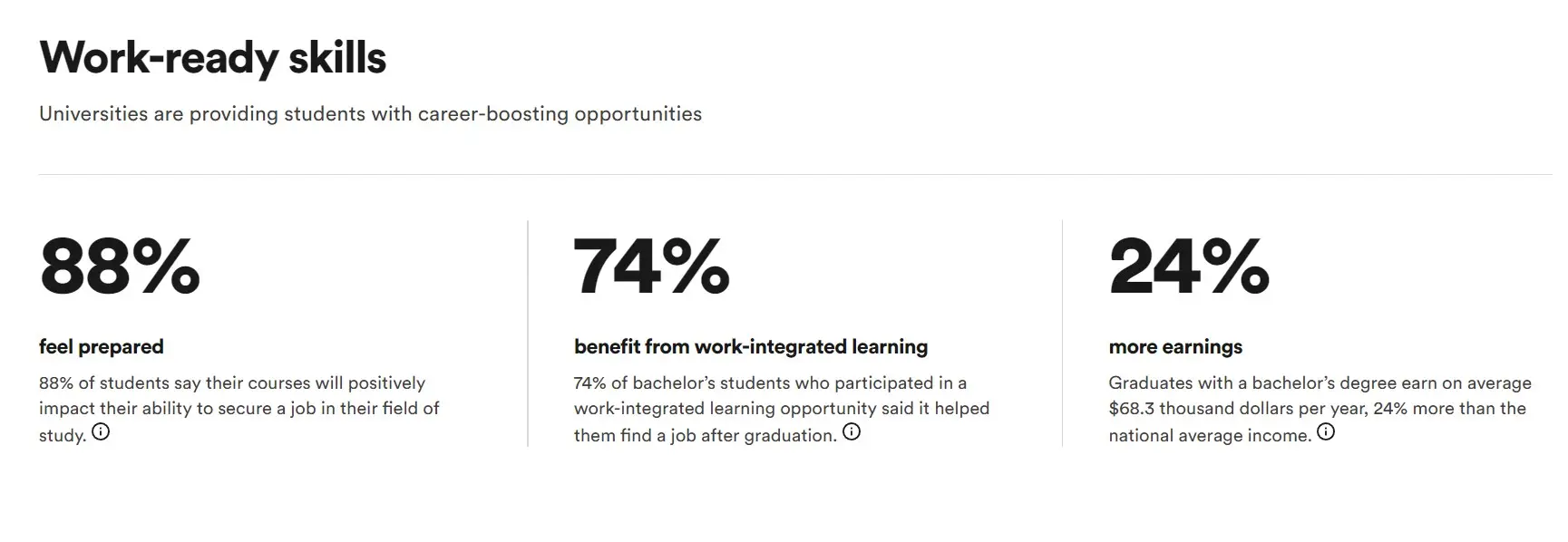
Canada’s university system is closely linked to post-study planning. Eligible graduates of Canadian universities may apply for the Post-Graduation Work Permit (PGWP), which allows them to remain in Canada and work for up to three years after completing their studies.
This period can provide valuable professional experience and time to assess longer-term options. Canadian university graduates also tend to see strong economic outcomes, earning on average 24% more than the national income average, reflecting the value placed on higher education in Canada.
4. A Safe and Internationally Oriented Environment
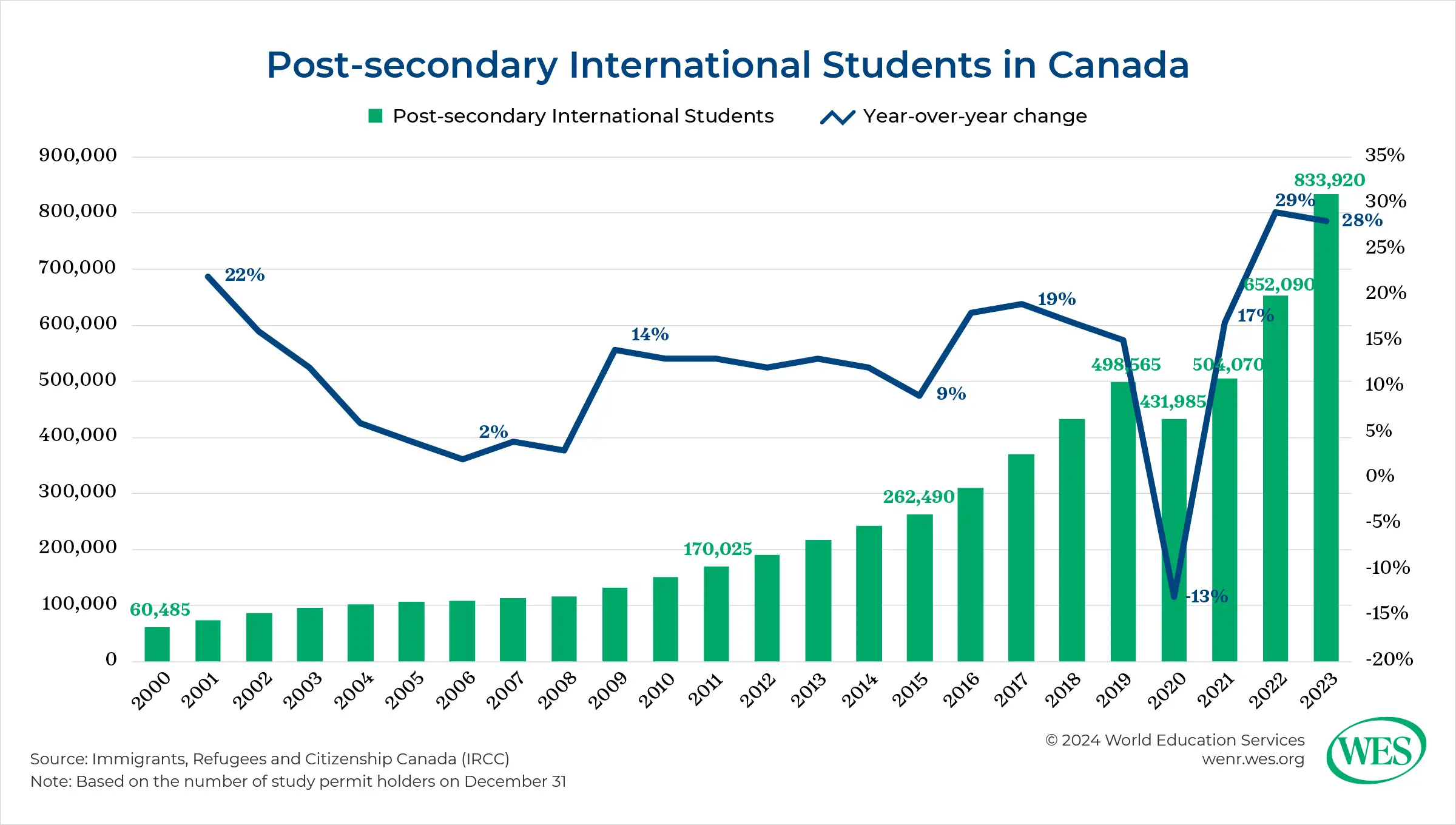
International students make up about 30% of Canada’s higher education population, meaning universities are well accustomed to supporting students from diverse backgrounds. Canada is also widely regarded as a safe and stable country, which remains an important consideration for families planning education abroad.
5. What to Consider Carefully
While Canada offers many advantages, it is not the right choice for everyone. Tuition and living costs can be high, particularly in major cities, competition for popular programs has increased, and climate can be an adjustment for some students. Understanding these factors early helps international students plan realistically and choose universities that align with both academic goals and practical considerations.
Canadian Universities for International Students: Examples
Canadian universities for international students span a wide range of academic fields, locations, and degree options. Below are examples of the universities where some of our students have pursued their studies.
- Universität von Toronto
- University of British Columbia
- McGill Universität
- University of Waterloo
- McMaster University
- Queen’s University
- Western University
- Simon Fraser University
- Dalhousie University
- Concordia University
This is not a complete list, and suitability depends on factors such as program choice, academic background, and long-term goals. For a broader overview of universities our students have attended, you can view our full university matriculation list.
How the Canadian University System Works
Understanding the Canadian university system can feel unfamiliar for international students, particularly because terminology and pathways differ from other education systems. The overview below explains how post-secondary education in Canada is structured and how universities in Canada are explained to students planning their studies from abroad.
| Category | Universitäten | Colleges |
|---|---|---|
| Schwerpunkt | Academic and research-oriented education | Applied, practical, and career-focused education |
| Qualifications Offered | Bachelor’s, Master’s, and PhD degrees | Diplomas, certificates, and sometimes applied bachelor’s degrees |
| Am besten für | Students aiming for advanced study, research, or careers requiring university degrees | Students seeking hands-on training and faster entry into industry |
| Learning Style | More theory-driven and academic | More skills-based and practical |
| Key Note | Often required for professional or research pathways | Not “lower quality”, designed for different career outcomes |
1. Universities vs Colleges in Canada for International Students
In Canada, universities and colleges serve different academic and career purposes, and they are designed for different types of educational outcomes.
Universitäten emphasize academic and research-oriented education. They award bachelor’s, master’s, and doctoral degrees and are typically chosen by students planning for advanced study, research, or professional careers that require a university degree.
Colleges focus on applied and practical education. They offer diplomas, certificates, and in some cases applied bachelor’s degrees, often with strong links to industry and hands-on training.
A common misconception is that colleges are of lower quality. This is not the case. Colleges and universities are designed for different outcomes, not different levels of ability. For many international students, colleges can be a strong fit depending on career goals, learning style, and budget.
2. Degree Types and Program Length in Canadian Universities
Canadian universities offer several degree types, each with different timelines and planning implications.
At the undergraduate level, Canadian universities often reflect elements of both American and British higher education traditions. Students typically have more flexibility to explore a range of subjects than in highly specialized UK programs, while following a more structured academic path than the broad, liberal arts-based American model. This approach allows students to build depth in their chosen field while still gaining exposure to related areas of study.
1. Bachelor’s Degrees
Most bachelor’s degrees take three to four years, depending on the program and course load. Longer programs generally mean higher total tuition and living costs, which should be factored into financial and visa planning.
2. Master’s Degrees
Master’s programs are typically one to two years.
- Course-based master’s focus on coursework and professional preparation.
- Research-based master’s include a thesis and are often chosen by students considering doctoral study.
Program length affects both total cost and eligibility timelines for post-study options, making it an important factor in planning.
3. PhD Programs
Doctoral programs usually take four to six years and are research-intensive. Admission is highly competitive and often tied to faculty supervision and funding availability. Longer programs increase overall cost but may offer greater academic depth and post-study planning flexibility.
Admission Requirements for International Students at Canadian Universities
Admission requirements for international students at Canadian universities are similar across many institutions, but they are always program-specific. In most cases, universities look for:
- Recognized secondary school credential (or prior degree for graduate entry).
- Prerequisite subjects for the program.
- Proof of English (or French) proficiency, and complete supporting documents.
Requirements can change from year to year, so confirm details directly on each university’s official admissions page before you apply.
1. Academic Requirements and Transcripts
Canadian universities typically evaluate your academic readiness using your official transcripts and completion certificates. Depending on your background, this may include national exam results, school-leaving certificates, or prior university coursework. Minimum GPA expectations vary widely by program, and competitive programs often require grades above the stated minimum.
If you are applying for 2026 entry, treat any third-party GPA conversions as approximate. Universities may review grades in context, including curriculum, course rigor, and subject prerequisites, so verify how your credential is assessed on the university website.
Common mistakes include:
- Submitting unofficial transcripts when official copies are required
- Missing prerequisite subjects (for example, required math or science courses)
- Using a generic GPA conversion that does not match the university’s method
- Late or incomplete document uploads, especially for competitive programs
2. Language Requirements (IELTS, TOEFL, and Alternatives)
The IELTS requirement that Canadian universities set varies by institution and by program. Many universities accept IELTS Academic, along with other tests such as TOEFL iBT, but minimum scores are often higher for competitive programs. As a general reference, many undergraduate and graduate programs require an overall IELTS score of around 6.5, with minimum band scores, though requirements can be higher depending on the field of study.
Some universities, including the University of Toronto, have advised applicants that TOEFL iBT scoring changes take effect from January 21, 2026, and that score requirements may be updated accordingly. At this time, applicants are generally advised to monitor official university admissions pages for updated guidance, rather than relying on fixed minimums published prior to the scoring change.
Some universities do not accept certain test formats, such as IELTS Indicator, and most require that language test results be recent, often taken within the last two years. Applicants should always confirm accepted tests, score thresholds, and validity periods on the university’s official website before registering for an exam.
English-language waivers may be available in limited circumstances, but the criteria are specific and vary by institution. In many cases, universities require documented proof of several years of full-time instruction in English, rather than informal or partial study. Waiver policies should be verified directly with the admissions office.
For programs taught in French, universities may require proof of French language proficiency. Accepted exams and minimum scores vary by institution and may include tests such as TEF, TCF, or DALF. Requirements are program-specific, and some universities offer bilingual programs where proficiency in one language is sufficient. As with English requirements, students should confirm accepted French tests, score thresholds, and any waiver policies directly on the university’s official admissions page before applying.
3. Additional Application Documents Universities Require
Beyond academics and language scores, many programs require additional documents that help universities assess fit and readiness. Common requirements include:
- Personal statement or statement of purpose (especially for graduate programs)
- Letters of recommendation (often required for master’s and PhD applications)
- Resume or CV (common for graduate programs)
- Portfolio or audition materials for select fields (for example, architecture, art, music)
Document-related mistakes are a frequent reason strong applicants underperform in review. Common issues include:
- Reusing a generic statement that does not match the program
- Submitting recommendations that are too short, vague, or not academic
- Uploading the wrong file version or missing required prompts
- Ignoring formatting rules, word limits, or document naming instructions
Academic requirements for admission are separate from study permit financial requirements. These are assessed during the visa application process and may involve higher proof-of-funds thresholds than in previous years.
Application Deadlines and Intakes for Canadian Universities
University intakes and application deadlines in Canada vary by institution and program. Many universities run multiple intake periods each year, but availability differs by faculty, degree level, and seat capacity. Because deadlines can shift for 2026 entry, confirm dates directly on each university’s official admissions site as early as possible.
Fall, Winter, and Summer Intakes Explained
Most Canadian universities offer a primary Fall intake (typically September), with a smaller Winter intake (typically January) for select programs. A Summer or Spring/Summer intake (often May) is less common at the university level and is usually limited to specific programs or continuing studies.
In general, Fall intake offers the widest program selection and the most structured first-year course sequencing, but it can also be the most competitive. Winter intake can be a practical option if you need more time for results, language testing, or documents, though program choice may be narrower. Summer intake should be treated as program-dependent and verified directly for 2026, since many universities do not offer full first-year entry in summer.
Study Permit Requirements for International Students in Canada (2026)
For international students, a Canadian study permit is closely tied to university choice, program length, and financial planning. While requirements are set at the federal level, how smoothly the process works often depends on decisions made well before the application is submitted.
Most international students applying to study in Canada will need to meet the following core requirements:
- An offer of admission from a Designated Learning Institution (DLI)
- Evidence of sufficient financial support for tuition and living costs
- Any required provincial or territorial documentation, such as a Provincial Attestation Letter (PAL)
- A completed study permit application and government fees
Requirements can change, and not all students follow the same path, so details should always be confirmed through official sources before applying.
1. Designated Learning Institutions (DLI) and Why They Matter
Only students accepted to a Designated Learning Institution are eligible to apply for a Canadian study permit. DLIs are schools approved by provincial or territorial governments to host international students.
Key points to understand:
- DLI status applies to the institution and campus, not just the school name
- DLI status can be verified through the federal government’s official list
- Enrolling in a non-DLI institution means you cannot receive a study permit
It is also important to note that while a school may be a DLI, not every program automatically leads to post-study work eligibility, which should be confirmed separately.
2. Provincial Attestation Letter (PAL) – What International Students Should Know
Die Provincial Attestation Letter (PAL) confirms that a student has been allocated a study space within a province’s international student limit.
What international students should know:
- Most new study permit applicants are required to include a PAL with their application
- PAL processes are managed at the provincial or territorial level, usually through the university
- Timing and availability vary by province and institution
As of 2026, some degree-granting graduate programs may be exempt from PAL requirements, depending on the institution and program type. Because these policies can evolve, students should confirm whether a PAL is required for their specific situation before applying.
3. Proof of Funds for a Canadian Study Permit
International students must show they can realistically cover tuition, living expenses, and travel costs during their studies.
Common forms of acceptable proof include:
- Proof of tuition payment
- Bank statements or financial records
- A Guaranteed Investment Certificate (GIC)
- Scholarship or funding letters
- Approved education loans
Minimum financial proof amounts are set by IRCC, and for applications outside Quebec, the current baseline listed by IRCC is CAD 22,895 per year, excluding tuition and travel costs. Because financial thresholds are reviewed regularly, students should treat published amounts as a minimum baseline, not a recommended budget.
Tuition Fees and Cost of Living for International Students in Canada (2026)
Tuition and living costs vary widely across Canada. Planning realistically means considering both program costs und where you will live, not just published tuition figures.
| Degree Level | Approximate Annual Tuition (CAD) | Notes |
|---|---|---|
| Undergraduate Programs | CAD 40,000+ per year | Costs vary by province, school, and field of study. |
| Graduate Programs | CAD 20,000–25,000 per year | Some programs may cost more depending on specialization. |
1. Tuition Fees by Degree Level and Program Type
The following figures reflect approximate national averages, which can vary significantly by province, institution, and field of study.
- Undergraduate programs: approximately CAD 40,000+ per year
- Graduate programs: approximately CAD 20,000–25,000 per year
Costs vary by field of study:
- Arts and social sciences are often lower
- Science programs fall in the middle range
- Engineering, business, and professional programs are typically higher
Because tuition is charged annually, longer programs increase total cost and should be considered as part of long-term planning.
2. Cost of Living in Major Canadian Student Cities
Living costs often have as much impact on total expenses as tuition, particularly housing.
General planning ranges:
- Smaller cities or towns: lower overall costs, especially with shared housing
- Mid-sized cities: moderate rent and daily expenses
- Toronto and Vancouver: higher housing costs and overall budgets
Housing, transportation, and daily expenses vary by city and lifestyle. Universities typically publish local cost estimates, which should be used as the most reliable reference when building a budget.
Working While Studying at a Canadian University
Many international students are interested in working during their studies, but it’s important to understand how work fits into the broader study plan.
1. Off-Campus Work Rules for International Students
Most international students with a valid study permit are allowed to work off campus during their studies, as long as they meet eligibility requirements. Work limits are set by federal policy and can change, so students should always confirm current rules before relying on employment income.
Eligibility is typically tied to full-time enrollment at a designated learning institution and compliance with study permit conditions. While part-time work can help offset everyday expenses, it should not be relied on to cover tuition or essential living costs, as hours and job availability can vary.
2. Co-op Programs and Internships in Canadian Universities
Some Canadian universities offer programs that include co-op or internship components, allowing students to gain practical work experience as part of their degree. These opportunities are structured and program-specific, and not all degrees include them.
Participation in co-op programs is not guaranteed and usually requires separate work authorization in addition to a study permit. The availability and quality of co-op placements vary by university, field of study, and local job market.
Post-Graduation Options After a Canadian University Degree
For many students, planning does not stop at graduation. Understanding post-study options early can help shape program and institution choices.
1. Post-Graduation Work Permit (PGWP) Overview
Eligible graduates of Canadian universities may apply for the Post-Graduation Work Permit, which allows them to work in Canada after completing their studies. Depending on program length and eligibility, the PGWP can be issued for up to three years. This period is often used to gain professional experience and assess next steps, but it is not automatic or guaranteed.
Eligibility depends on meeting specific criteria related to the institution and program, which should be confirmed before accepting an offer of admission.
2. Program and Field of Study Considerations for PGWP Eligibility
PGWP eligibility is influenced by factors such as program length, institution type, and compliance with federal requirements. In general, longer, degree-granting programs offer more flexibility for post-study planning, while some shorter or non-degree programs may not qualify.
Because eligibility rules can change, confirming PGWP eligibility before enrolling is an important part of reducing risk and aligning academic choices with post-study goals.
When International Students Should Speak With an Education Consultant
International educational consultants work with students who are navigating unfamiliar university systems and higher-stakes decisions. While many international students apply to Canadian universities independently, there are situations where additional guidance can be helpful.
Students may want to seek support when:
- Their academic background does not follow a standard curriculum or grading system
- They are applying to highly competitive programs with limited seats
- They are comparing Canada with other countries and weighing different admissions systems
- Their study plans involve visa complexity or concerns about eligibility and timing
In these cases, guidance can help students clarify options, understand trade-offs, and plan more confidently. Speaking with a consultant does not replace independent research, but it can provide structure and reassurance when decisions carry long-term consequences.
For international families who want a structured, personalized review of their plans, an initial consultation with McMillan Education International can help clarify next steps and priorities.
Häufig gestellte Fragen
1. What are the basic requirements to study at a university in Canada as an international student?
Most students need an offer from a Canadian university, academic transcripts, proof of English or French proficiency, and supporting documents. To study in Canada, students must also qualify for a study permit, which requires enrollment at a Designated Learning Institution and proof of sufficient financial support.
2. What is a Designated Learning Institution (DLI)?
A Designated Learning Institution (DLI) is a school approved by a provincial or territorial government to host international students in Canada. Only students accepted to a DLI are eligible to apply for a Canadian study permit. Applicants should always verify both the institution and the specific campus on the official DLI list before accepting an offer, as enrollment at a non-DLI school can affect study permit eligibility.
3. How much does it cost to study at a university in Canada for international students?
The cost of studying at a university in Canada for international students varies by program, institution, and location. On average, international undergraduate tuition ranges from CAD 30,000 to 45,000 per year, while graduate programs typically range from CAD 20,000 to 30,000 per year. In addition to tuition, students should budget CAD 12,000 to 25,000 per year for living expenses, depending largely on the city and housing choices. Total cost depends as much on where you study as on what you study.
4. Is studying in Canada cheaper than in the US or the UK?
In some cases, yes, but not always. It can be more affordable than studying in the US or the UK, particularly outside major cities and in certain degree programs. However, costs vary widely by university, location, and program length. Students should compare total expenses, including tuition, housing, and living costs, rather than assuming one country is consistently cheaper.
5. Can international students work while studying at a Canadian university?
Many international students are allowed to work part-time during their studies if they meet eligibility requirements. Work rules can change, and part-time employment should not be relied on to cover tuition or essential living costs.
6. Are co-op programs guaranteed for international students in Canada?
No. Co-op opportunities are program-specific and not guaranteed. Availability depends on the program structure, academic standing, and employer demand, and often requires separate work authorization.
7. What is the Post-Graduation Work Permit (PGWP) and is it guaranteed?
The PGWP allows eligible graduates to work in Canada after completing a qualifying program, for up to three years. It is not automatic or guaranteed and depends on program, institution, and compliance with current rules.
8. Does my choice of program affect post-study work opportunities in Canada?
Yes. Program length, credential type, and institution influence post-study options. Longer, degree-granting programs generally offer more flexibility than short or non-degree programs. Students should confirm eligibility before enrolling.