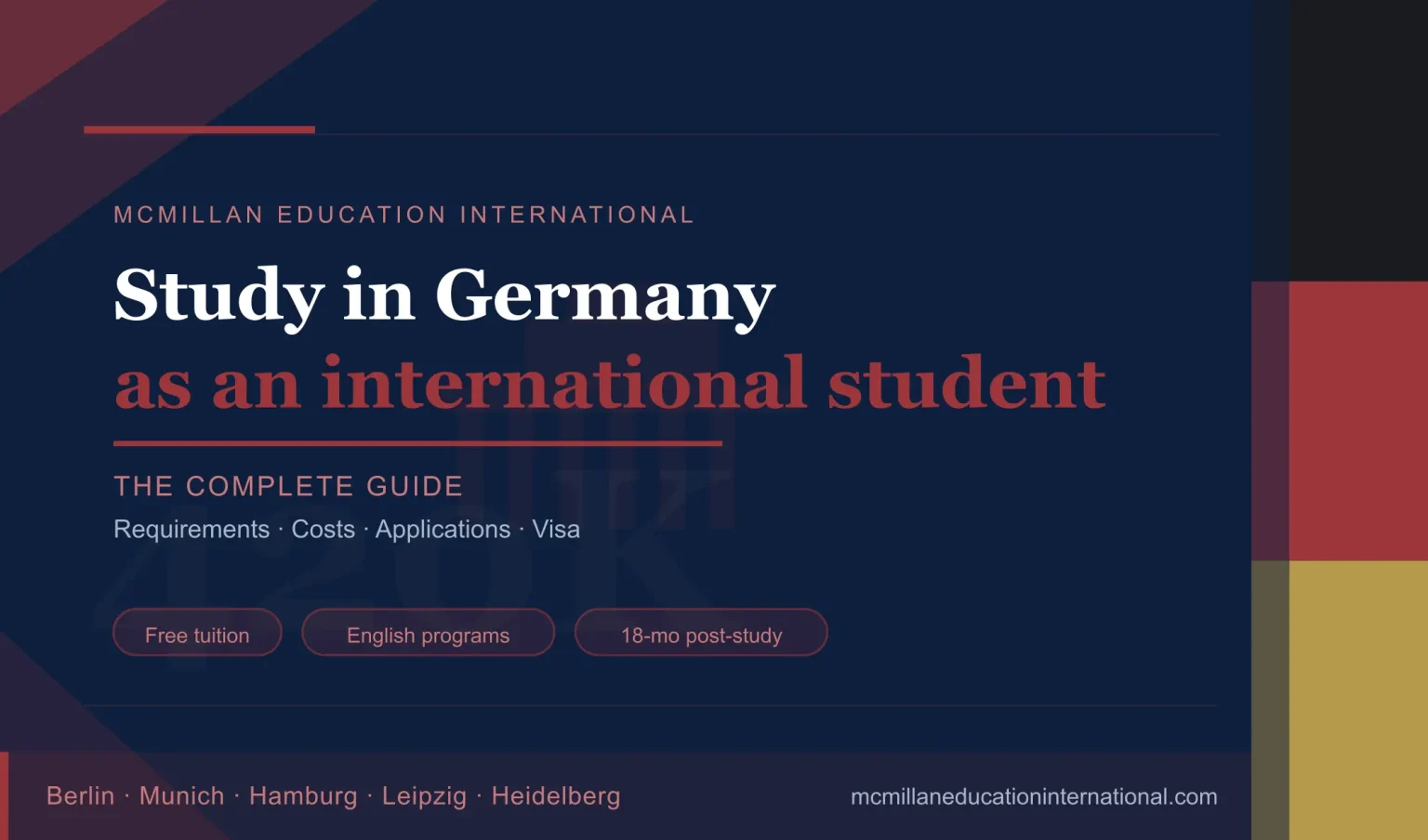
The number of international students studying in Germany has grown at approximately 4% year over year for more than a decade. In 2025/26, that trajectory reached 420,000 enrolled foreign students, making Germany one of the best study destinations for international students.
International students and families researching options to study in Germany arrive with reasonable questions about credential recognition, language requirements, and cost, and each of those areas follows defined institutional procedures with consistent application across institutions.
This article covers what it takes to study in Germany as an international student, from understanding the system to submitting an application.
In a separate article, we have covered English-taught programs in Germany at both undergraduate and postgraduate levels, for those already researching specific institutions.
The Higher Education System in Germany
Germany is home to several of the best universities in Europe, and its higher education system is organized around three institutional types, each with a distinct academic orientation:
- Universities (Universitäten) are research-focused institutions offering the full range of undergraduate, postgraduate, and doctoral programs.
- Universities of Applied Sciences (Fachhochschulen) place greater emphasis on professional and industry-oriented training, with programs structured around practical application rather than research output, and tend to attract students with a clear vocational or professional direction.
- Arts and music academies (Kunst- und Musikhochschulen) admit students through portfolio or audition-based processes rather than standard academic criteria.
1. Degree Structure
Degree structures follow the Bologna framework, which Germany adopted alongside most European systems. Undergraduate programs lead to a Bachelor’s degree, typically completed over three to four years, and postgraduate programs lead to a Master’s degree over an additional one to two years.
That alignment with European degree conventions means that qualifications from German universities are broadly recognized across the continent and, increasingly, beyond it, with credits documented through the European Credit Transfer System (ECTS).
2. Numerus Clausus
Admission to German universities for certain programs operates under a restricted entry mechanism known as Numerus Clausus (NC), in which eligibility is determined by academic grade thresholds rather than a holistic review process.
Families accustomed to US or UK admissions systems, where selectivity is expressed through acceptance rates and application review, will find NC operates on a different logic entirely. A student’s eligibility for a restricted program is assessed against a defined grade point, and applications that fall below that threshold are not advanced, regardless of other qualifications.
3. Academic Calendar
German higher education is administered at the state level rather than federally, which means that procedural requirements, including credential assessment and Studienkolleg placement, can vary by state and by institution.
The academic year runs across two semesters: the winter semester, which begins in October, and the summer semester, which begins in April. Most international applicants target the winter semester, as it represents the primary intake period for the majority of programs.
Requirements to Study in Germany for International Students
For international students planning to study in Germany, admission requirements are the starting point, the academic, linguistic, and, in some cases, program-specific criteria that must be met before an application can be submitted.
1. Academic Credential Recognition
The first question any international applicant planning to study in Germany needs to answer is whether their secondary qualification is recognized within the German system.
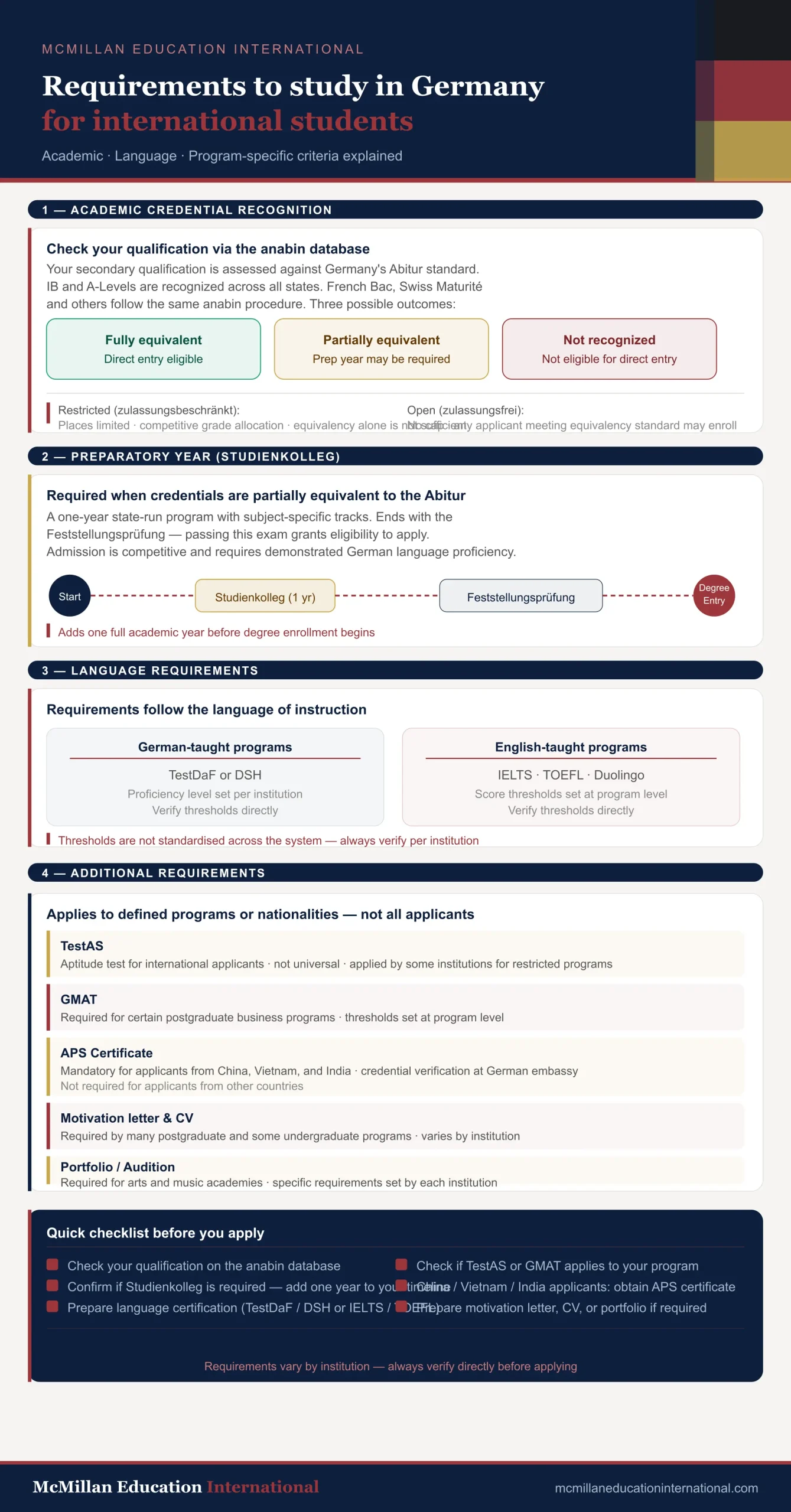
That determination is made through the anabin database, a federal reference tool that categorizes foreign credentials by country and institution against the Abitur, Germany’s standard upper secondary qualification. Checking anabin early in the research process establishes one of three outcomes:
- Fully equivalent to the Abitur
- Partially equivalent, which may require additional preparation
- Not recognized for direct entry
Recognition status alone does not determine eligibility. The grade standard an applicant must meet also depends on the type of program they are applying to:
- Restricted programs (zulassungsbeschränkt) – places are limited and allocated competitively by grade; meeting the recognition threshold is not sufficient on its own
- Open admission programs (zulassungsfrei) – places are not capped; any international applicant whose credentials meet the equivalency standard is eligible to enroll
In practice, most internationally recognized curricula are accepted within the German system, though the specific conditions depend on the curriculum, the state, and the program. Widely held qualifications such as the International Baccalaureate and A-Levels are recognized across all states, though grade thresholds and subject requirements vary by program. Other international curricula, such as the French Baccalauréat and Swiss Maturité, follow the same anabin assessment procedure.
2. Preparatory Year Requirements
International applicants from countries whose secondary systems are categorized in anabin as partially equivalent to the Abitur will routinely encounter this requirement when applying to German universities.
The Studienkolleg is a state-run preparatory program, typically one academic year in duration, structured around subject-specific tracks that correspond to the applicant’s intended field of study. It culminates in the Feststellungsprüfung, a university qualification exam that, if passed, grants eligibility to apply for university admission.
Admission to a Studienkolleg is competitive and requires demonstrated German language proficiency. International students planning to study in Germany should factor the preparatory year into application timelines, as it adds a full academic year before degree enrollment begins.
3. Language Requirements
Language requirements follow the language of instruction. German-taught programs require TestDaF or DSH certification, with proficiency levels set by each institution. English-taught programs require IELTS or TOEFL, or the Duolingo English Test, with score thresholds set at the program level.
Applicants should verify requirements directly with each institution, as thresholds are not standardized across the system.
4. Additional Requirements
Not all international applicants will encounter these requirements, but each applies to a defined subset of programs or nationalities:
- TestAS – an aptitude test designed for international applicants assessing cognitive and subject-specific competencies; not universally required but applied by some institutions for restricted programs
- GMAT – required for certain postgraduate business programs, with thresholds set at the program level
- APS Certificate – mandatory for applicants from China, Vietnam, and India; involves a credential verification process at the relevant German embassy; applicants from other countries are not subject to this requirement
- Motivation letter and CV – required by many postgraduate programs and some undergraduate programs; varies by institution
- Portfolio or audition – required for arts and music academies; specific requirements set by each institution
What Does It Cost to Study in Germany as an International Student?
Germany’s public universities operate largely without tuition fees, and for most international students, that holds at both undergraduate and postgraduate levels. However, the picture is not uniform.
Most public universities charge no tuition fees for undergraduate or postgraduate programs, regardless of nationality. Two exceptions apply: the state of Baden-Württemberg charges non-EU students approximately 1,500 euros per semester, and a small number of institutions charge program-level fees for specific postgraduate programs. Applicants should verify the fee structure at the program level before assuming public university study is cost-free.
Private institutions set their own fee structures, ranging from 5,000 to 20,000 euros per year at undergraduate level and 7,000 to 40,000 euros per year at postgraduate level, with MBA programs reaching considerably higher.
All students pay a semester contribution (Semesterbeitrag) of 150 to 350 euros per semester, which typically includes a public transport ticket for the region.
1. Estimated Cost Overview
| Cost Item | Estimated Range |
| Tuition: public universities | 0 euros (Baden-Württemberg: ~1,500/semester for non-EU) |
| Tuition: private institutions | 5,000 to 40,000+ euros per year |
| Semester contribution | 150 to 350 euros per semester |
| Health insurance | ~120 to 130 euros per month (statutory student rate, under 30) |
| Living costs | 800 to 1,200 euros per month |
| Blocked account (Sperrkonto) | 11,904 euros required upfront for visa purposes |
2. Health Insurance
Enrollment at a German institution requires proof of statutory health insurance before enrollment can be completed. The standard student rate for statutory health insurance is approximately 120 to 130 euros per month for students under 30. Private health insurance is accepted in some circumstances but statutory coverage is the standard requirement for most international students.
3. Living Costs
Living costs in Germany vary considerably by city. Munich and Hamburg represent the higher end of the range, while smaller university cities such as Leipzig or Münster are significantly more affordable. A realistic monthly budget for accommodation, food, transport, and personal expenses falls between 800 and 1,200 euros, though students in major cities should plan toward the higher end of that range.
4. The Blocked Account Requirement
Before a German student visa can be issued, applicants are required to demonstrate sufficient financial resources through a blocked account (Sperrkonto). The current required amount is 11,904 euros, deposited upfront and released in monthly installments of 992 euros after arrival. This is a visa requirement rather than a study cost and is addressed in full in the visa section of this article.
How to Apply to a German University from Abroad
Applying to a German university as an international student begins with identifying the correct application route, as the process differs by institution and program.
Step 1: Determine Your Application Route
Before preparing any documents, confirm how the institution accepts international applications. There are two routes:
- Uni-assist – most public universities require international applicants to submit through uni-assist, a centralized processing service that verifies credentials before forwarding applications to the institution. Applications are submitted through the uni-assist portal, and a processing fee applies per application.
- Direct application – some public universities and most private institutions accept applications directly through their own admissions portals.
The program page at each institution will specify which route applies. Applicants to restricted undergraduate programs at participating universities may also encounter Hochschule-Start, a separate platform that manages place allocation for high-demand programs. If a program uses it, the institution will indicate this.
Step 2: Prepare Application Documents
Authentication requirements, including certified translations, notarization, and in some cases apostille certification, vary by country and add significant time to the preparation process. Confirming what is required for a specific country of origin before starting is essential.
Standard documents required by most institutions:
- Secondary school leaving certificate and transcripts, with certified translations where required
- University transcripts (postgraduate applicants)
- Proof of language proficiency – TestDaF or DSH for German-taught programs, IELTS, TOEFL, or Duolingo English Test for English-taught programs
- Motivation letter and CV – required by most postgraduate programs
- APS Certificate – mandatory for applicants from China, Vietnam, and India
- Passport copy
Step 3: Submit Within Deadlines
German university application deadlines follow the semester structure. Most international applicants target the winter semester, which carries broader program availability.
- Winter semester (primary intake) – standard deadline July 15
- Summer semester – standard deadline January 15
Uni-assist closes its submission window before institutional deadlines, so applicants applying through uni-assist must submit earlier than the dates above. Individual programs frequently set their own earlier deadlines. Document authentication and translation should be factored into the timeline from the start.
International students and families working through this process with applications to multiple destinations, including Germany and other European systems, can work with McMillan’s international university admission consultants, who have placed students from more than 65 countries across these systems.
After the Acceptance Letter
Receiving an offer confirms eligibility but does not complete enrollment. Several steps must be completed before studies can begin, and some carry fixed deadlines.
Students from EU and EEA countries do not require a visa. All other international students planning to study in Germany must apply for a student visa at the German embassy or consulate in their country of residence before traveling. The application requires the university acceptance letter, proof of financial resources through the blocked account, and proof of health insurance. Processing times vary by country and embassy.
Housing in major university cities is in high demand and should be researched as early as possible after receiving an offer. All residents in Germany are required to register their address at the local registration office (Einwohnermeldeamt) within two weeks of arrival. This registration, the Anmeldung, is a prerequisite for opening a bank account and activating the blocked account.
Universities set a defined enrollment window after acceptance. Enrollment requires submission of the health insurance certificate, proof of address registration, and payment of the semester contribution. Missing the enrollment window forfeits the place.
Considering Studying in Germany?
Germany’s higher education system offers genuine accessibility for international applicants, tuition structures that remain among the most affordable in Europe, a defined admissions process, and a broad range of programs at both undergraduate and postgraduate levels.
For those considering Germany as a study destination, whether as a primary choice or alongside other options, McMillan’s international educational consultants have worked with families from around the world on university applications across multiple destinations.
If you would like to discuss your options with one of our consultants, we invite you to prendre rendez-vous pour une consultation gratuite.
Questions fréquemment posées
1. Can I study in Germany in English?
Yes. English-taught programs are available at German universities, though availability differs by level. Postgraduate programs offer a significantly broader range of English-language options than undergraduate programs.
2. Are German universities free for international students?
Most public universities charge no tuition fees, and this applies to international students as well as domestic students. Exceptions exist: the state of Baden-Württemberg charges non-EU students approximately 1,500 euros per semester, and a small number of institutions charge program-level fees for specific postgraduate programs. Private universities set their own fee structures. All students pay a semester contribution of 150 to 350 euros per semester, regardless of tuition status.
3. Can international students work while studying in Germany?
Non-EU international students may work up to 140 full days or 280 half-days per year, or up to 20 hours per week during the semester. Mandatory curriculum internships do not count toward this limit. EU students have the same working rights as German students.
4. Can I work in Germany after graduation?
Non-EU graduates of German universities are eligible for an 18-month residence permit for job seeking after completing their degree. During this period, any type of employment is permitted. EU graduates may work in Germany immediately after graduation without a separate permit.
5. When should I apply to a German university?
Most international applicants target the winter semester, with a standard application deadline of July 15. The summer semester deadline is generally January 15. Individual programs and uni-assist set their own earlier deadlines. Document authentication and translation add time to the preparation process and should be factored in from the start.
6. What documents do I need to apply to a German university?
Requirements vary by institution and program, but most applications require a secondary school leaving certificate and transcripts with certified translations, proof of language proficiency, a motivation letter and CV for postgraduate programs, and a passport copy. Applicants from China, Vietnam, and India must also provide an APS Certificate. Full details are covered in the application section of this article.