

Legal education in the UK is attracting more students than at any point on record. The latest UCAS admissions data shows 27,150 students secured places on law degree courses in a single cycle, a 10.4% increase on the previous year and one of the largest subject-specific surges recorded across all disciplines. The increase reflects demand from both local and international students, drawn in part by the quality of legal education that some of the best law schools in the UK consistently deliver.
In this article, we examine some of the best law schools across England, Wales, Scotland, and Northern Ireland, covering degree structure, entry requirements for international applicants, and what each institution offers academically.
At a Glance: 10 Law Schools in the UK
A quick overview of ten universities offering undergraduate law programs across the UK. The institutions below are not ranked or endorsed by McMillan Education, and the list is meant for educational purposes only.
- Cardiff University
- Swansea University
- Queen’s University Belfast
- University of Oxford
- University of Cambridge
- London School of Economics (LSE)
- University College London (UCL)
- SOAS University of London
- University of Bristol
- Durham University
For detailed profiles of each institution, see the full breakdown below.
What International Students Should Know Before Studying Law in the UK
The following covers the degree structure, entry requirements, and admissions process that international families should understand before evaluating undergraduate law programs in the UK.
1. The LLB vs the BA in Law
For international students unfamiliar with the UK education system, the distinction between an LLB and a BA in Law is a common source of confusion. Both lead to the same professional outcome; the difference is one of institutional tradition, not academic substance.
The LLB (Bachelor of Laws) is the standard undergraduate law degree awarded by the majority of UK universities. It is a three-year program covering the foundational subjects of English law and qualifies graduates to proceed directly to the professional stages of legal training as a solicitor or barrister in England and Wales.
The BA in Law follows the same academic structure and carries identical professional standing. The designation reflects a given institution’s historical degree conventions rather than any difference in curriculum or outcome. Both are recognized as qualifying law degrees by the Solicitors Regulation Authority and the Bar Standards Board.
2. Requirements to Study Law in the UK
Admission requirements to an undergraduate law program in the UK involve three components: academic qualifications, English language proficiency, and, at certain universities, an admissions test.
Academic qualifications. At A-level, offers typically range from AAB at less selective institutions to AAA at the most competitive. International Baccalaureate applicants should expect offers in the range of 38 to 43 points at the more selective institutions. Other international qualifications, including the US Advanced Placement system, le French Baccalauréat, and Indian board examinations, are assessed on a case-by-case basis; applicants should consult the admissions pages of individual universities for equivalent requirements.
English language proficiency. The majority of institutions in this guide accept IELTS Academic and TOEFL iBT as primary evidence of English language proficiency. Required scores range from IELTS 6.5 to 7.5 overall, depending on the university, with minimum component scores applying in each case. Some universities accept additional tests; applicants should verify accepted qualifications directly with their chosen institution.
The LNAT. The Law National Aptitude Test is a two-hour and fifteen-minute assessment required by a number of selective UK law schools. It tests reading comprehension, logical reasoning, and argumentative writing rather than prior legal knowledge, and is administered at registered test centers worldwide.
Law Schools in the UK by Region
The law schools below are not presented as a ranking or a definitive list. Many strong undergraduate law programs exist across the UK that are not featured here. The schools included are organized by region and are intended to give international families a structured overview of the landscape, not a comprehensive assessment of every available option.
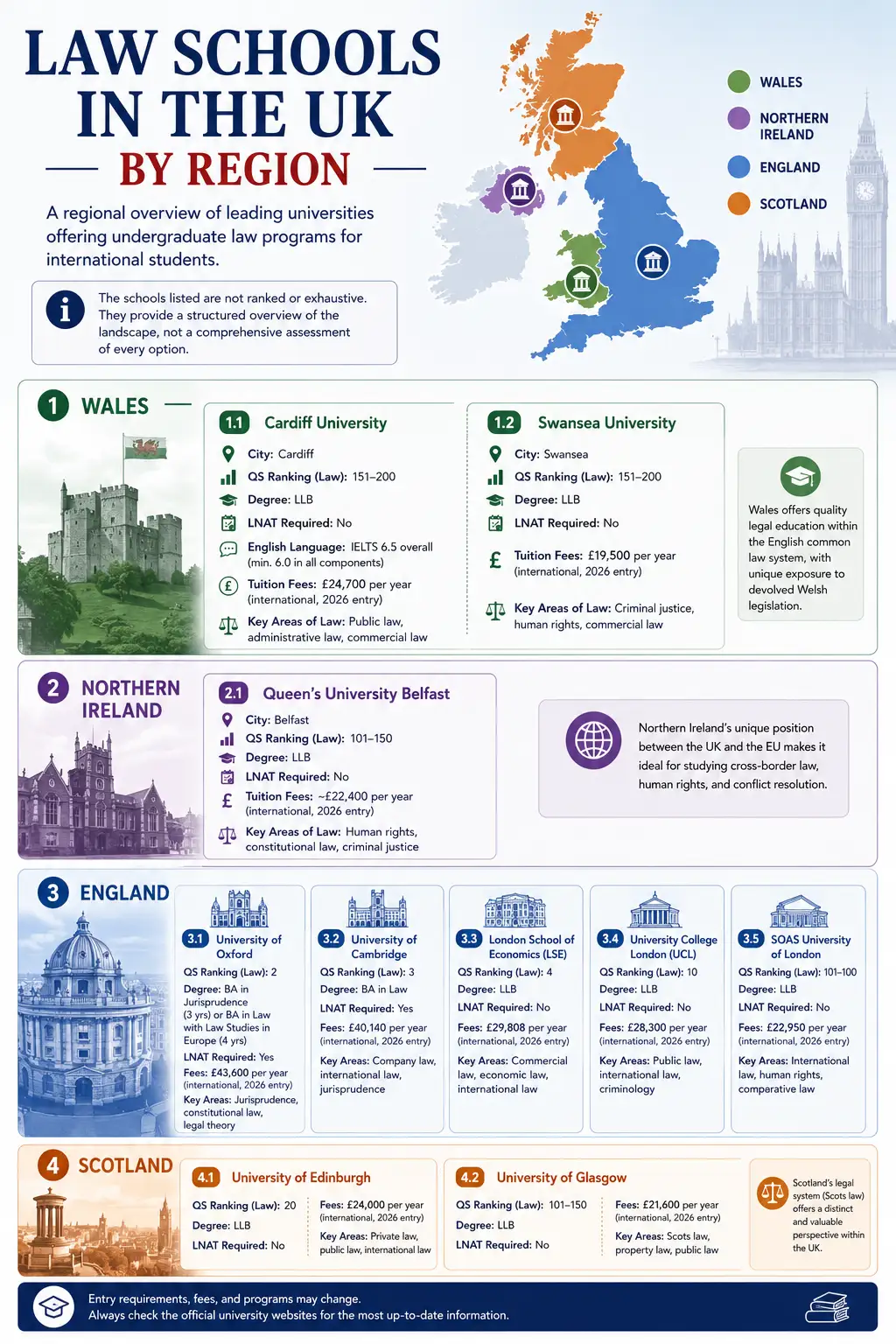
1. Law Schools in Wales
Wales offers undergraduate law programs grounded in the English common law framework, alongside exposure to devolved Welsh legislation that gives the curriculum a distinctive constitutional dimension. For international students, it represents a legitimate and academically serious entry point into UK legal education.
1.1 Cardiff University
Cardiff’s LLB feels like a classic full-spectrum UK qualifying law degree with a strong public-law backbone. It suits students who want a serious doctrinal education without the ultra-theoretical atmosphere of Oxford or Cambridge. The program is especially strong if you want exposure to constitutional, administrative, and devolved governance questions in a Welsh context. It strongly appeals to international students who want a friendly, accessible, and affordable British university experience while earning a globally recognized qualifying law degree.
- City: Cardiff
- QS Ranking (Law): 151-200
- Degree awarded: LLB
- LNAT required: No
- English language requirement: IELTS 6.5 overall (minimum 6.0 in all components)
- Tuition fees: £24,700 per year (international, 2026 entry)
- Key areas of law: Public law, administrative law, and commercial law
1.2 Swansea University
Swansea is a hidden gem for international students who want to specialize early, particularly those coming from maritime or heavily trade-reliant nations. It has a globally recognized niche in shipping, trade, and commercial maritime law. It is less about the abstract philosophy of law and more about equipping international graduates with highly employable, cross-border commercial skills in a safe, coastal campus environment.
- City: Swansea
- QS Ranking (Law): 151-200
- Degree awarded: LLB
- LNAT required: No
- Tuition fees: £19,500 per year (international, 2026 entry)
- Key areas of law: Criminal justice, human rights, commercial law
2. Law Schools in Northern Ireland
Northern Ireland’s legal education landscape is shaped by its distinct constitutional and institutional history. Undergraduate law programs here deliver traditional common law training within a jurisdiction where questions of human rights, constitutional transition, and public institutions carry particular historical and contemporary relevance.
2.1 Queen’s University Belfast
Queen’s is a fascinating choice for the globally-minded student. Because Northern Ireland shares a border with the EU (Republic of Ireland) but is part of the UK, it is arguably the best place in Europe to study post-Brexit cross-border law. It is internationally renowned for conflict resolution and transitional justice, making it the perfect fit for overseas students aiming for careers in the UN, international NGOs, or global human rights.
- City: Belfast
- QS Ranking (Law): 101-150
- Degree awarded: LLB
- LNAT required: No
- Tuition fees: ~£22,400 per year (international, 2026 entry)
- Key areas of law: Human rights, constitutional law, criminal justice
3. Law Schools in England
England is home to the largest concentration of globally ranked law schools in the UK, spanning institutions with distinct academic cultures, settings, and professional orientations. For international students, the range of programs available reflects the breadth of the English common law tradition itself, from analytically rigorous tutorial-based degrees to programs oriented toward policy, commerce, and international legal systems.
3.1 University of Oxford
Oxford’s BA in Jurisprudence is the standard 3-year undergraduate law degree, equivalent in professional standing to an LLB and recognized as a qualifying law degree for practice as a solicitor or barrister in England and Wales. A 4-year variant, the BA in Law with Law Studies in Europe, follows the same syllabus with the third year spent at partner universities in Europe, including France, Germany, Italy, Spain, or the Netherlands. The program is intensely analytical. Oxford treats law as a disciplined way of reasoning, and the tutorial model, weekly meetings between a tutor and two or three students, places argument, close reading, and conceptual precision at the center of the academic experience. Students are expected to develop views not simply about what the law is, but why it is so, whether it should be so, and how it might be different.
- City: Oxford (en anglais)
- QS Ranking (Law): 2
- Degree awarded: BA in Jurisprudence (3 years) or BA in Law with Law Studies in Europe (4 years)
- LNAT required: Yes
- Tuition fees: £43,600 per year (international, 2026 entry)
- Key areas of law: Jurisprudence, constitutional law, legal theory
3.2 University of Cambridge
Cambridge treats law as an academic discipline grounded in principle and technique, reasoning and explanation, with sustained attention to the historical development of law and its relationship to wider social context. Legal doctrine is placed in consistent conversation with philosophy, economics, ethics, criminology, and social policy, and students can specialize from the second year onward, including the option to study legal systems outside the UK. A four-year variant allows students to spend a third year at partner universities in Germany, France, the Netherlands, Spain, New Zealand, or Singapore before returning to complete the degree. The program is built around the supervision system, small group teaching that places analytical argument and independent reasoning at the center of the academic experience.
- City: Cambridge (en anglais)
- QS Ranking (Law): 3
- Degree awarded: BA in Law
- LNAT required: Yes
- Tuition fees: £29,052 per year (international, 2026 entry)
- Key areas of law: Legal history, jurisprudence, comparative law
3.3 London School of Economics (LSE)
LSE’s LLB approaches law from a social science perspective, examining its impact on society, politics, economics, and business. The program is doctrinally rigorous, but its identity is defined by proximity to political economy, public institutions, markets, and global regulatory systems. Legal analysis at LSE is consistently oriented toward policy, finance, and the structural forces that shape law in practice.
- City: London
- QS Ranking (Law): 9
- Degree awarded: LLB
- LNAT required: Yes
- Tuition fees: £34,000 per year (international, 2026 entry)
- Key areas of law: Commercial law, public law, international law
3.4 University College London (UCL)
UCL’s LLB is built around an explicitly international legal culture. The program places comparative and transnational law at the center of its identity, and its faculty’s research strengths in international and commercial law are structural to the curriculum rather than peripheral. Students can apply in later years to transfer to a joint LLB/JD with Columbia University, or to the Law with Another Legal System degree, with year three spent at partner Universités en Australie, Hong Kong, or Singapore. The program combines elite academic standing with a broad international outlook.
- City: London
- QS Ranking (Law): 13
- Degree awarded: LLB
- LNAT required: Yes
- Tuition fees: £35,400 per year (international, 2026 entry)
- Key areas of law: International law, commercial law, comparative law
3.5 SOAS University of London
SOAS is the most analytically distinct program on this list. The law degree places English law in direct conversation with colonial history, development economics, human rights, and non-Western legal systems. Global politics, postcolonial critique, and international justice are not elective dimensions of the curriculum; they are structural to how the degree is conceived and taught. For international students whose legal interests extend beyond English and European common law traditions, very few institutions offer comparable curricular depth in those areas.
- City: London
- QS Ranking (Law): 101-150
- Degree awarded: LLB (or BA in Law as a joint honors)
- LNAT required: No
- Tuition fees: £23,780 per year (international, 2026 entry)
- Key areas of law: Human rights, international law, law and development
3.6 University of Bristol
Bristol occupies a distinct position in the English law school landscape: a Russell Group institution with strong doctrinal foundations and well-established pathways into commercial legal practice, located outside London. The program delivers rigorous black-letter legal training while maintaining clear connections to corporate law careers, and its setting offers a more contained academic environment than the capital’s larger institutions.
- City: Bristol
- QS Ranking (Law): 54
- Degree awarded: LLB
- LNAT required: Yes
- Tuition fees: £25,500 per year (international, 2026 entry)
- Key areas of law: Commercial law, public law, international law
3.7 Durham University
Durham’s law degree is built around a strong collegiate structure and a serious commitment to black-letter legal method. The program delivers classic English doctrinal legal education within a focused academic environment, and its setting reinforces rather than competes with that character. For international students, Durham offers full immersion in a traditional English university environment where the collegiate system, the city, and the academic culture are inseparable from the degree itself.
- City: Durham
- QS Ranking (Law): 49
- Degree awarded: LLB
- LNAT required: Yes
- Tuition fees: ~£30,000 per year (international, 2026 entry)
- Key areas of law: Contract law, constitutional law, commercial law
4. Law Schools in Scotland
Scottish law degrees follow a distinct structure from those in England, Wales, and Northern Ireland. The undergraduate LLB in Scotland is typically a four-year program grounded in Scots law, a mixed legal system drawing on both common law and civil law traditions, with options to incorporate comparative and international subjects across the degree. For international students, this means a different curricular framework and a longer program than the standard three-year English LLB.
Our dedicated guide to law schools in Scotland covers three universities in depth:
- University of Edinburgh School of Law
- University of Glasgow School of Law
- University of Strathclyde Law School
For a full examination of undergraduate law study in Scotland, including what the Scots law curriculum means for international students and how these institutions compare, see our dedicated guide: Law Schools in Scotland.
How to Choose a Law School in the UK as an International Student
The instinct of most international families is to work from a ranking table downward, applying to the highest-ranked institution they believe they can access. That approach is not wrong, but it is incomplete. The more productive question is what kind of legal thinker the student already is, or wants to become. A student drawn to how law shapes markets and public institutions will find a different academic home than one drawn to how law has been used to govern, dispossess, or liberate. Rank does not resolve that question. Program character does.
The practical variables deserve equal weight. London carries higher living costs and a different professional atmosphere than cities further north or west, and for some students, that distinction matters as much as the degree itself. The LNAT is a further filter: it requires dedicated preparation and should be assessed honestly before a shortlist is built, not after.
Speak with a UK University Admissions Consultant
Families who find these decisions difficult to navigate without a clearer picture of a student’s profile and goals are welcome to speak with educational consultants specializing in UK university admissions.
Schedule a free consultation here.
Questions fréquemment posées
1. Can I study law in the UK as an international student?
Yes. UK universities actively recruit international students for undergraduate law programs. Admission is competitive and requires meeting academic entry requirements, English language proficiency standards, and, in some cases, the LNAT. There are no nationality-based restrictions on studying law in the UK, though international students will need a Student visa for programs longer than six months.
2. Is a UK law degree valid in my country?
A UK law degree is widely recognized internationally, particularly in common law jurisdictions including Australia, Canada, Singapore, Hong Kong, and many countries across Africa and the Caribbean. However, recognition does not automatically confer the right to practice. Most jurisdictions require additional local qualification steps after a UK LLB. Prospective students should consult the relevant legal regulatory body in their home country before drawing conclusions about transferability.
3. How long does it take to become a lawyer in the UK?
The undergraduate LLB takes three years in England, Wales, and Northern Ireland, and four years in Scotland. Graduates who wish to qualify as solicitors in England and Wales must then pass the Solicitors Qualifying Examination and complete two years of qualifying work experience. Those pursuing the bar must complete the Bar Practice Course. In total, the path from undergraduate entry to full qualification typically takes five to six years.
4. How much does it cost to study law in the UK?
Tuition fees for international students on undergraduate law programs at the institutions covered in this guide range from approximately £19,500 to £43,600 per year. Living costs vary considerably by location: London is significantly more expensive than cities such as Cardiff, Belfast, or Durham. Families should budget for accommodation, food, transport, and study materials in addition to tuition. Most universities publish estimated living costs figures on their admissions pages.
5. What is the difference between an LLB and a BA in Law?
Both are undergraduate law degrees that qualify graduates to proceed to professional legal training in England and Wales. The LLB is the standard designation used by the majority of UK universities. The BA in Law is awarded by a small number of institutions where the designation reflects historical degree conventions rather than any difference in academic content or professional standing. For a fuller explanation, see the section above.
6. Do I need the LNAT to study law in the UK?
Not at every institution. The LNAT is required by a number of selective UK law schools, but it is not a universal requirement. Of the institutions covered in this guide, Oxford, Cambridge, LSE, UCL, Bristol, and Durham require it. Cardiff, Swansea, Queen’s University Belfast, and SOAS do not. Applicants should verify requirements directly with each institution before registering, as policies can change between admissions cycles.