
Studying in the Netherlands provides access to one of the widest ranges of English-speaking universities in continental Europe, but its admission requirements and methods of evaluating applicants differ from those in the US or UK, systems familiar to many applicants.
For international students planning to study in the Netherlands, this article covers those nuances: the types of universities available, how qualifications from different countries are assessed, and the application steps most programs require.
Why Study in the Netherlands as an International Student?
Finding a program taught entirely in English is rarely the obstacle it is elsewhere in Europe. The Netherlands runs approximately 2,000 English-taught programs across its research universities and universities of applied sciences, the widest selection on the continent, so the search usually comes down to the right fit rather than whether an English option exists at all.
International students aren’t a small minority either. They made up 17% of the student population at publicly funded institutions in 2025-26, which means most programs are accustomed to non-Dutch applicants and the systems around admissions, housing, and academic support are built with that in mind. And the years after graduation hold up: five years out, 25.3% of international graduates are still living in the Netherlands, and 80% of them are working.
Types of Dutch Universities: Which Is Right for You?
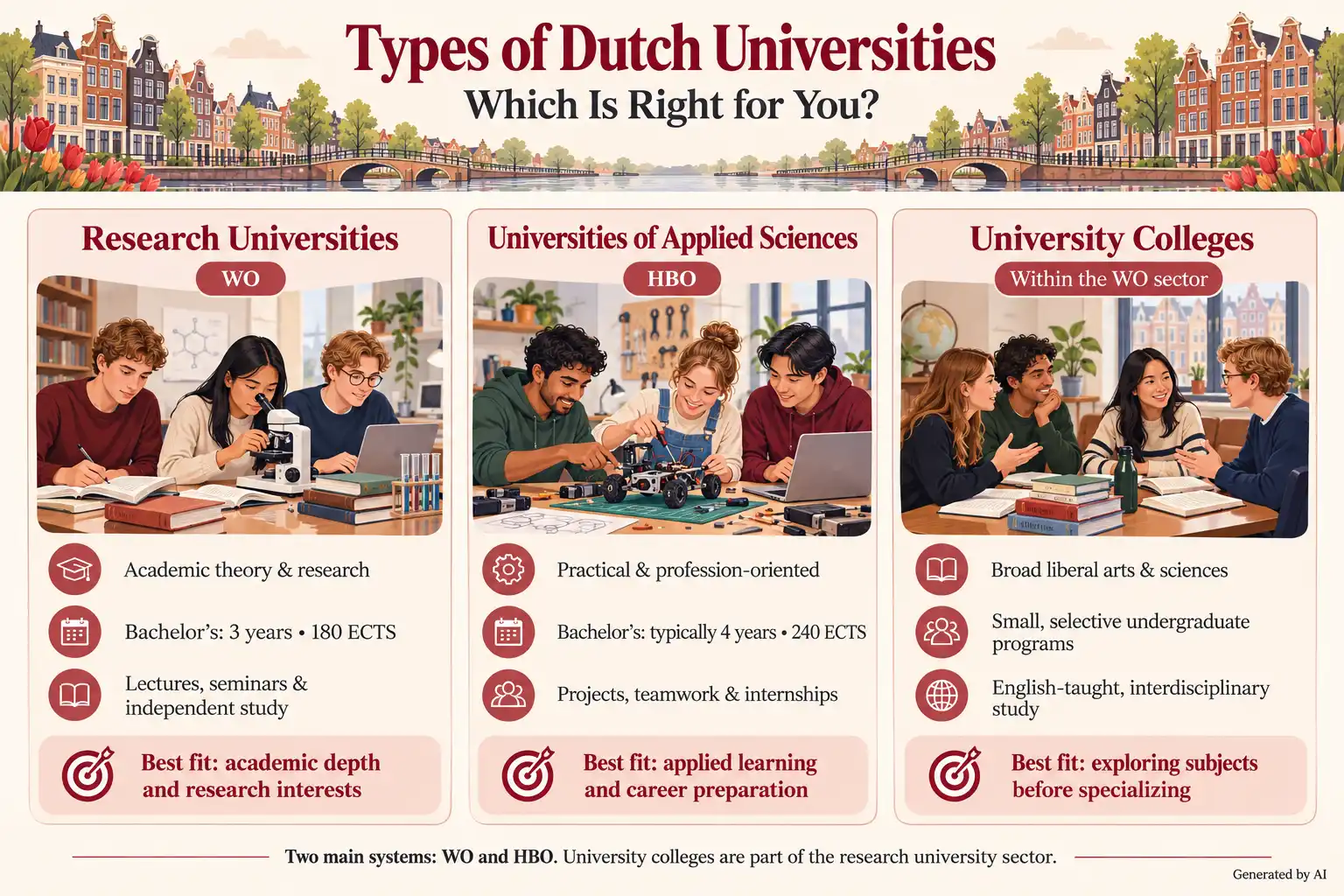
The Netherlands divides higher education into two main university systems: research universities and universities of applied sciences. Both award bachelor’s and master’s degrees, but they differ in teaching style, program length, and preparation for further study. A smaller third option, university colleges, offers selective undergraduate programs within the research university sector. Understanding which system you’re applying to is an important first step, because it shapes what you’ll study and what admissions will expect from you.
1. Research Universities
Research universities, known in Dutch as universiteiten or WO institutions, are one of the two main paths for studying in the Netherlands, built around academic theory and research. The teaching leans toward lectures, seminars, and independent study, and the focus is on the thinking behind a subject as much as its application. Bachelor’s degrees here run three years. This is the track most international students choose, and it shows in the numbers: more than a quarter of research university students come from outside the Netherlands. If you’re aiming for graduate study later or want a degree rooted in academic depth, this is usually the right fit. University colleges, covered below, sit inside this system as a distinct entry point.
- The bachelor’s carries 180 ECTS credits and usually includes research methods training and a thesis.
- A master’s degree afterward typically takes 1-3 years.
- Because the bachelor’s is shorter and research-focused, the specific courses you take can affect which master’s programs you’re eligible for later.
2. Universities of Applied Sciences
Universities of applied sciences, or hogescholen (HBO institutions), are the practical counterpart. The teaching is hands-on and profession-oriented, most programs include an internship year, and bachelor’s degrees run four years. Fields tend toward the vocational and applied: business, engineering, design, social work, and similar. One thing worth knowing is that the Dutch name, hogeschool, doesn’t translate to “high school,” and these are full degree-granting institutions on par with universities in status, just different in purpose. Families sometimes overlook them for that reason, which is a mistake if the student wants a career-focused route into a profession.
- The bachelor’s carries 240 ECTS credits, with internships, projects, and group assignments built into the coursework.
- Universities of applied sciences also offer their own master’s programs, many designed around professional experience.
3. University Colleges
University colleges are small, selective, English-taught programs housed within research universities, built on a liberal arts model that lets students study across disciplines before specializing. What makes them stand out is the admissions process: instead of the qualification-based check most Dutch programs run, university colleges look at essays, interviews, and the wider picture of who the applicant is. For students coming from the US or UK, this will feel closer to the admissions system they already know.
Admission Requirements for International Students
Every Dutch university checks admission requirements against its own entry standards, and the two reference points behind almost all of them are the Dutch VWO and HAVO diplomas. The institution makes the final call, and individual programs can add conditions on top of that baseline, so meeting the general level doesn’t guarantee you meet a program’s specific subject requirements too.
Since two applicants from the same country can hold very different diplomas, the Netherlands admission requirements below are organized by qualification rather than by country.
1. Diploma Equivalency: What Dutch Universities Look For
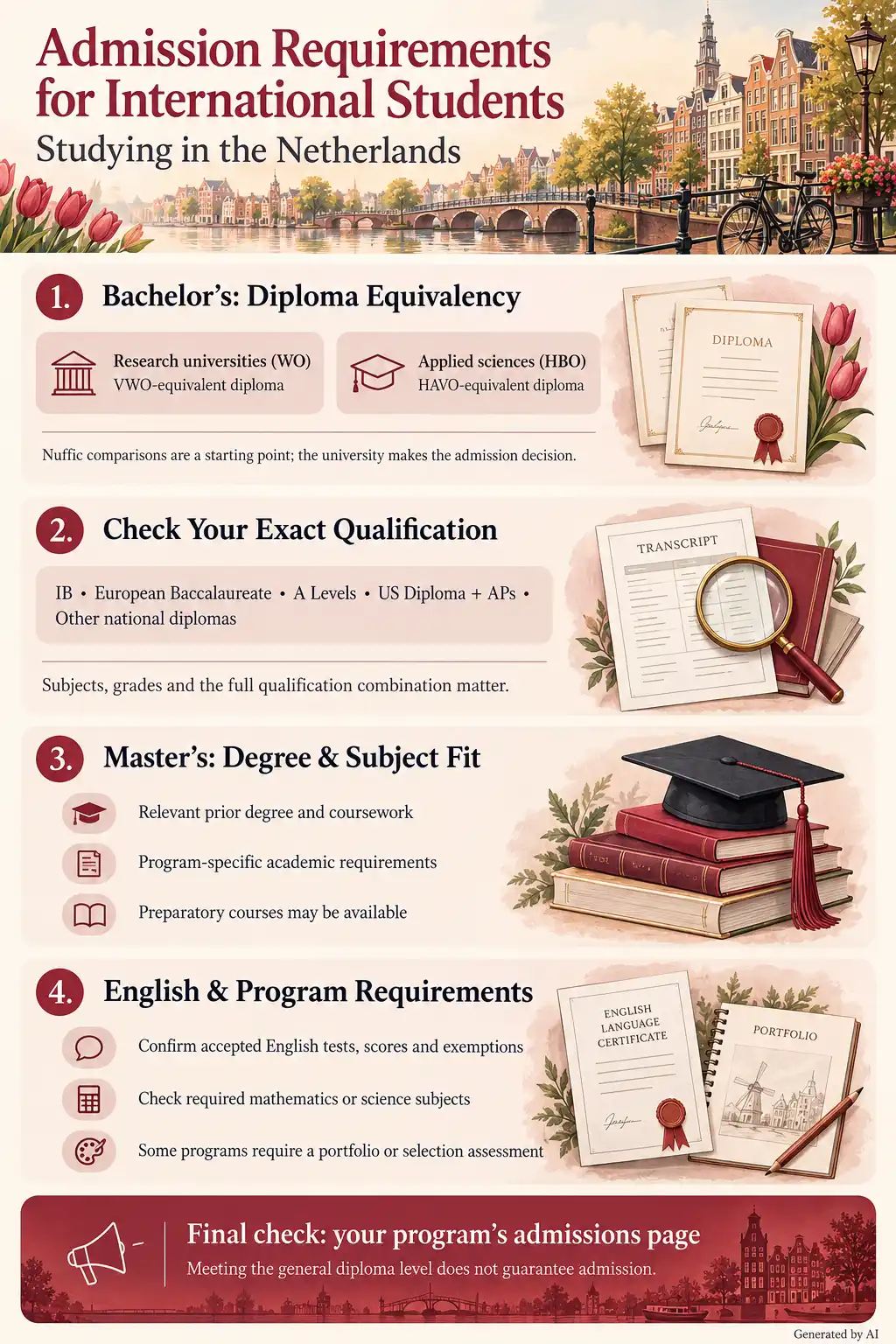
Nuffic, the Dutch organization for internationalization in education, compares foreign qualifications against VWO and HAVO. Its comparisons are the starting point for understanding admission in the Netherlands, but the exact credential, the subjects taken, and the grades earned all matter beyond the general comparison.
- Research university bachelor’s: VWO-equivalent diploma
- Applied sciences bachelor’s: HAVO-equivalent diploma
- General equivalency and program-specific subject requirements are checked separately
1.1 IB Diploma and European Baccalaureate
Nuffic compares the full IB Diploma and the European Baccalaureate Certificate to VWO. That addresses the general diploma requirement. A degree in engineering, economics, or another subject with specific prerequisites may still require particular mathematics or science courses. Individual IB course results without the full diploma are assessed differently.
1.2 A Levels and Other UK Qualifications
For applicants from England, Wales, or Northern Ireland, the standard comparison is three Livelli A at grades A* through C, combined with at least three GCSEs at grades 9 through 4 across six subjects total. That combination compares to VWO. Other combinations may land at HAVO instead. BTECs and Scottish qualifications are assessed on their own terms, so “UK qualifications” isn’t one single category when you apply to Dutch universities.
1.3 US High School Diploma and AP Courses
A US High School Diploma has no single Dutch equivalent, and on its own it typically compares to HAVO rather than VWO. The clearest route to VWO-level comparability is scoring 3 or higher on at least four official AP exams, and it has to be the exam result itself, not just the AP course listed on a transcript. Other routes exist too, based on the rigor of the overall curriculum and academic record, and this is one of the qualification checks American students studying in the Netherlands run into most often.
1.4 Canadian, Australian, and New Zealand School-Leaving Qualifications
- In Canada, requirements shift by province: Ontario and British Columbia school-leaving diplomas generally land at HAVO, while Quebec’s pre-university Diplôme d’Études Collégiales compares to VWO.
- For Australian applicants, the relevant figure is the ATAR, and a score of 86 or above generally reaches VWO level.
- In New Zealand, NCEA Level 3 with University Entrance and the required credits compares to VWO as well.
In every case, the program’s own entry requirements still apply on top of the general comparison, whichever country you’re applying from to study in the Netherlands.
2. Master’s Admission: Prior Degree and Subject Requirements
Master’s admission in the Netherlands works differently from bachelor’s admission. Instead of a general diploma comparison, the university checks whether your specific prior degree and coursework line up with the program itself.
- Research university master’s: generally requires a bachelor’s degree comparable to a Dutch academic bachelor’s, with substantial coursework already completed in the relevant field
- A related bachelor’s degree: may be sufficient for one program and leave real gaps for another, even within the same broad subject area
- Preparatory courses: some universities offer one to close specific gaps, others don’t, so this needs checking program by program
- Application sequence: many applications for studying in the Netherlands at the master’s level still start in Studielink before moving to the institution’s own portal for transcripts and documents, but the actual academic review is done by the university, not Studielink
Because the outcome depends so heavily on your specific degree, this is one of the Netherlands’ admission requirements worth confirming directly with the program.
3. English Proficiency and Program-Specific Requirements
For anyone who wants to study in the Netherlands as an international student, English-taught programs set their own language standards, and the good news is these are broadly consistent whether you’re applying to a bachelor’s or a master’s program, though some competitive master’s programs set a higher bar than the standard undergraduate threshold.
- Recognized tests: IELTS, TOEFL iBT, Cambridge English, Pearson PTE, or LanguageCert are the most commonly accepted
- Some programs accept other tests, including Duolingo, but acceptance must be confirmed on the specific program’s admissions page before taking the test
- Required scores and exemptions: vary by institution and program, so there’s no single number that applies everywhere
- Additional conditions some programs add: mathematics or science preparation, a portfolio, or a selection assessment
The program’s own admissions page is the final check for the requirements to study in the Netherlands at that specific degree level.
University College Admissions: Essays, Interviews, and Fit
University colleges run the one admissions process in the Netherlands that will feel familiar to families who have applied in the US or UK. They read the whole application and make a judgment about the person behind it, rather than checking a diploma against a fixed standard and moving on.
A typical Dutch university college application asks for:
- A motivation essay, which carries real weight. Admissions teams want to understand why a student is drawn to a broad liberal arts education and to their college specifically, and a generic answer stands out for the wrong reasons.
- A CV.
- An interview, where they test that motivation in person, virtually in most cases.
- Sometimes a written assignment or questions about specific coursework.
What they’re assessing is fit in the genuine sense: whether the student will do well in a small, discussion-based, interdisciplinary environment where they design much of their own path. That model doesn’t suit everyone, and university colleges would rather admit students who will thrive in it than fill every seat. Places are limited, and the process is more involved than standard Dutch admission, so anyone considering this route should start planning early.
Numerus Fixus: How Selective Programs in the Netherlands Work
Most Dutch programs admit every applicant who meets the requirements. A minority work differently. These are numerus fixus programs, where the number of places is capped and demand usually outstrips supply, so meeting the requirements gets you into the selection but doesn’t guarantee a seat.
When a numerus fixus program receives more qualified applicants than it has places, it runs a selection procedure and assigns each applicant a ranking number. Whether you’re admitted depends on where you land in that ranking against the number of available places. The application deadline for these programs is fixed and earlier than the general one: January 15 at 23:59 CET, with no extensions. If you’re close to the cutoff but not admitted, you may still get a place when higher-ranked applicants turn theirs down.
One thing to keep clear: numerus fixus applies to specific programs, not to whole universities.
- The same institution can run open-admission and capped programs side by side.
- Popular fields like medicine, psychology, and some international programs are the ones most likely to be capped.
- Check your program’s own page to confirm which category it falls into, since it changes both your deadline and your odds.
How to Apply to Universities in the Netherlands
Applying to university in the Netherlands usually happens in two stages. The first stage registers your intent through a national system. The second is the university’s own application, where the real assessment happens.
1. Register on Studielink
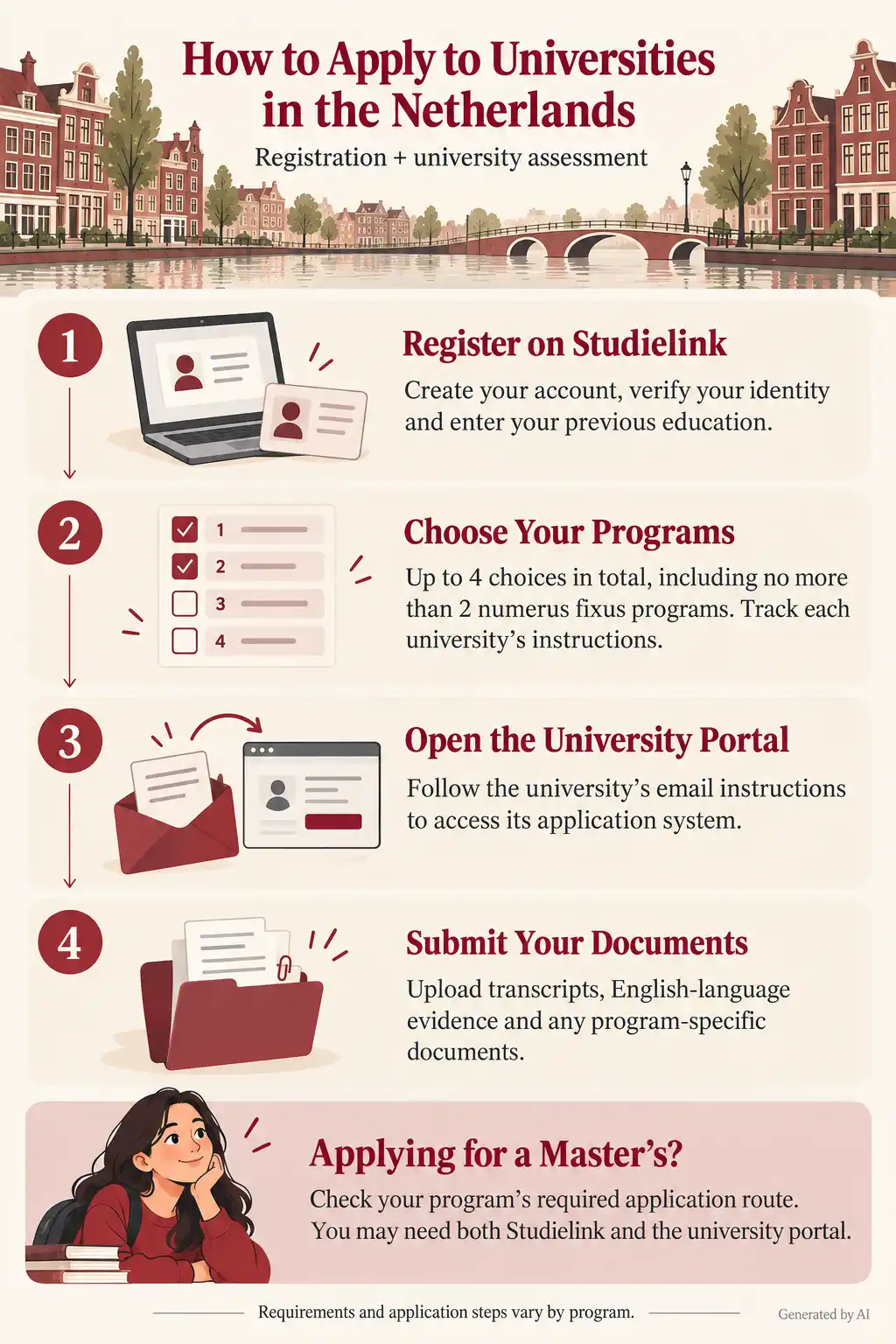
Studielink is the national registration system for Dutch higher education and the starting point for most undergraduate applications. You’ll create an account, verify your identity using a valid ID, and enter the details of your previous education. This is also where you select the programs you want to apply to.
2. Choose Your Programs
You can list up to four program choices in total, with no more than two being numerus fixus programs. Add them one at a time rather than all at once. Each program triggers its own stream of emails from the university, and adding several simultaneously tends to bury instructions that actually matter for next steps.
3. Move to Each University’s Portal
Studielink registers your intent; the application itself happens elsewhere. Once you’ve registered for a program, the university sends you access to its own application portal. These portals differ from one institution to the next, so don’t assume the process is identical across your choices.
4. Submit Your Documents
The university portal is where the actual assessment begins. You’ll upload your transcripts, proof of English proficiency, and anything else the program requires. Check each program’s page for its specific document list, since requirements vary and missing one can delay your application.
5. What Changes for Master’s Applicants
Applying to a Dutch university at the master’s level works differently. Most master’s programs skip Studielink entirely and take applications directly through the institution’s own portal. Requirements, documents, and timelines vary widely between programs, more so than at the undergraduate level, so there’s no single route to describe. Your program’s admissions page is the place to start and the source to trust.
If you’re working through this process and want guidance from an educational consultant with cross-system experience, speak with one of McMillan Education International’s consultants.
University Application Deadlines in the Netherlands
Deadlines in the Netherlands vary by program, by institution, and sometimes by where you’re applying from, so treat the dates below as general guidance and confirm the exact one on your program’s page. Non-EU applicants in particular often face earlier deadlines because of the time visa and residence processing takes.
1. Bachelor’s Application Deadlines
- Numerus fixus programs: January 15, with no extensions.
- General programs: usually 1 May, though plenty of programs and institutions set earlier dates, especially for international applicants.
- Housing is a practical reason to apply well before any official cutoff. Housing in Dutch student cities is in short supply, and the earlier you’re admitted, the earlier you can start looking.
2. Master’s Application Deadlines
Master’s deadlines don’t follow a single calendar. They range from late in the preceding year through the summer, depending on the program, and some run rolling admissions that close once places fill. Non-EU applicants should build in extra time for visa processing. As with everything at the master’s level, the program page is the only reliable source for the real date.
Apply to Dutch Universities With McMillan Education International
McMillan Education International has placed students across 15 countries and secured admission at 450+ universities worldwide. Whether a student is applying only to the Netherlands or building a list that spans the US, UK, Canada, and Europe at once, and whether the goal is undergraduate or graduate admission, our consulenti didattici know how these admissions systems work and how they interact.
To plan your Netherlands application with an educational consultant who works across systems, fissare una consulenza gratuita.
Domande frequenti
1. Can I study in the Netherlands without speaking Dutch?
For most international students, yes. The Netherlands runs around 2,000 English-taught programs, the widest selection in continental Europe, and English is spoken widely in daily life. You’ll need to prove your English with a recognized test for an English-taught program, but you won’t need Dutch to study. Some students pick up Dutch anyway, since it opens up more part-time work and everyday interactions, and many universities offer language courses for that.
2. Do international students need a visa or residence permit?
It depends on nationality. EU, EEA, and Swiss students don’t need a visa or residence permit to study in the Netherlands. Non-EU students staying longer than 90 days generally need a residence permit for study purposes, and depending on nationality, an entry visa (MVV) as well. One detail worth knowing: you don’t apply for the student residence permit yourself. Your university acts as your official sponsor and submits the application to the Dutch immigration authority (IND) on your behalf after you’re admitted.
3. Is student housing guaranteed in the Netherlands?
No, and this is one of the most important things to plan for early on in your process. Housing in Dutch student cities is in short supply, and most universities don’t guarantee accommodation. Some offer limited housing or help connect students with providers, but many international students arrange their own. Start looking as soon as you’re admitted, since the earlier you begin, the better your options.
4. What is binding study advice, and could it affect my degree?
Binding study advice (BSA) is a progression rule Dutch universities apply at the end of the first year. Each institution sets its own threshold, usually requiring students to pass a set proportion of their first-year credits. A student who falls below it can receive a negative BSA, which allows the institution to end their enrollment in that program.
5. Can international students work while studying in the Netherlands?
Yes, though the rules depend on nationality. EU, EEA, and Swiss students can work without restrictions. Non-EU students on a study residence permit can work a maximum of 16 hours per week during the academic year, or full-time during the summer months, but not both in the same year, and the employer has to arrange a work permit. Working beyond the limit puts your residence permit at risk, so it’s worth understanding the rules before taking a job.
6. Can I defer my admission to a Dutch university?
Usually not in the way US or UK universities allow. Dutch institutions generally don’t hold a place for a later year, so a student wanting a gap year typically reapplies the following cycle. For non-numerus fixus programs, meeting the requirements again the next year is normally straightforward. If deferral matters to you, confirm the specific institution’s policy, since a few handle it case-by-case.
7. Can a Dutch bachelor’s degree lead to graduate study in the US or UK?
Yes. A Dutch research university bachelor’s is a recognized academic degree that can lead to master’s study in the Netherlands or abroad, including the US and UK. The point worth planning around is that a Dutch research bachelor’s runs three years, one less than a standard US degree, so if graduate study elsewhere is the goal, it’s worth mapping out early how the degree and its coursework line up with the programs you’re aiming for. This is exactly the kind of international cross-system admissions planning worth sorting before applications go in.