

How different, in practice, are the American and European education systems? What does each system offer that the other does not? Which credentials carry more weight, and for whom? Where do the costs and tradeoffs land for a student with specific academic goals?
Answers to these questions vary by student, country, context, and individual circumstance. Drawing on decades of international education planning, this article addresses the differences between American and European education systems in depth
The United Kingdom follows an educational model distinct from continental Europe’s, and you can read a full comparison of the American and UK education systems here.
American vs. European School Systems
Both the American and European education systems move students through primary and secondary stages before university, with compulsory schooling beginning around age five or six. However, the two systems differ in how students progress, what they study, and when they are asked to choose a direction.
1. American Schools
The American school system follows three stages: elementary school (roughly ages 5-11), middle school (ages 11-14), and high school (ages 14-18). Students graduate after grade 12. Both public and private institutions, including boarding schools in the United States, operate within this same framework.
Students move between classrooms for different subjects throughout the day, building individual schedules and mixing with different peers across courses. Sports, theater, and clubs are run directly by the school and are central to school life. Requirements vary by state and district, but the overall progression is consistent nationwide.
2. European Schools
European school systems vary significantly by country; there is no single European system in the way there is a recognizable American framework. That said, most follow three broad stages: primary school, lower secondary, and upper secondary, covering roughly the same age range as in the American system.
However, private education operates differently. While fully independent tuition-based schools are rare, state-subsidized private schools are common across much of Europe, particularly in Western Europe, where they educate a substantial share of the student population.
Students typically move through school as a fixed cohort, staying in the same classroom while teachers rotate between them. Extracurricular life is largely decentralized: competitive sports, music, and other activities are organized through independent community clubs rather than through the school itself. Many European systems also ask students to choose an academic or vocational direction during secondary school, earlier than the American system requires.
Curriculum and Qualifications in the US and Europe
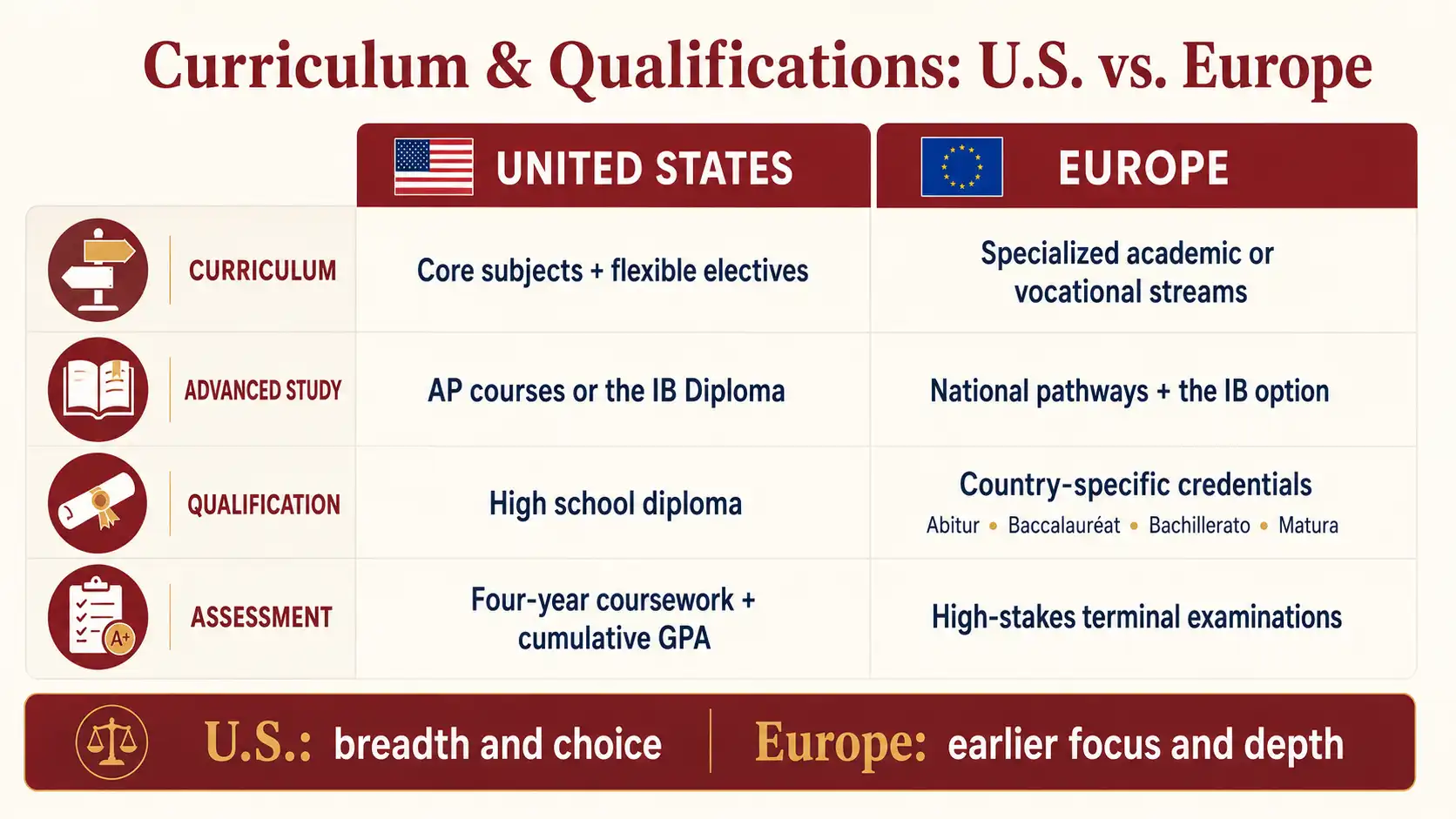
Both systems cover core academic subjects through secondary school. Where they differ is in how long that breadth is maintained, how much choice students have within their schedule, and what credential they hold when they leave.
1. American Curriculum
Here is how the American model works in practice.
1.1 Core Subjects and Electives
American high school students follow a required core curriculum: typically English, mathematics, science, social studies, and a world language, across all four years. Within that framework, the elective system is highly flexible. A student can take AP Calculus alongside drama, ceramics, and a second world language.
There is no nationwide subject track; students build individual schedules and can move between academic areas with relatively few restrictions, though some states define graduation pathways or endorsement tracks.
1.2 Advanced Coursework
For students seeking more rigorous preparation, two main pathways exist within the standard high school framework. Advanced Placement courses offer college-level content in individual subjects, assessed through a standardized exam at the end of the year. The International Baccalaureate Diploma provides a more comprehensive, internationally recognized credential, requiring students to study across six subject groups alongside a core that includes an extended essay and a theory of knowledge component. Both are widely recognized by American and international universities. While not all schools adopt the AP or IB framework for advanced rigor, these two frameworks are by far the most utilized.
You can read a full comparison of AP and IB here.
1.3 Qualifications and Assessment
American students graduate with a high school diploma. What distinguishes their university application is not the diploma itself but the academic record behind it: a cumulative GPA built across all four years, reflecting continuous performance rather than a single terminal examination. Because the system maintains breadth through graduation, students can enter university without having declared a field of study, choosing a major as late as the second year of undergraduate education.
2. European Curriculum
This is how the European approach differs at each level.
2.1 Streams and Subject Tracks
At upper secondary level, most European education systems ask students to choose a stream or academic profile, and the schedule that follows is largely determined by that choice. A student who selects a scientific stream studies a pre-set combination of mathematics and sciences; a student in a humanities stream follows a different pre-set combination. The freedom to mix subjects across areas, common in the American system, is limited once a stream is chosen. This reflects a different assumption about what secondary school is for: not broad exposure but progressive depth in a defined direction. As a consequence, students applying to European universities generally apply directly to a specific field of study rather than entering undeclared.
2.2 National Qualifications
There is no single European qualification. Each country issues its own terminal credential at the end of upper secondary school: Germany has the Abitur, France the Baccalauréat, Spain the Bachillerato, Switzerland the Matura, and several other countries have their own equivalents, each with distinct subject requirements and examination structure. The International Baccalaureate Diploma is also offered across many European schools and is increasingly used as a pathway to both European and American universities.
2.3 Assessment
Where the American system accumulates performance across four years into a GPA, European systems typically assess students through high-stakes terminal examinations at the end of upper secondary school. The score on that examination is the primary academic record a student carries into university admissions. The implications for preparation, for pressure, and for what counts as evidence of academic ability are significant. How European universities use those scores in admissions decisions is covered in the next section.
Grading Systems Compared: GPA, Letter Grades, and European Scales
Grading works differently on each side of the Atlantic, in scale, in structure, and in what a high score actually means. Here is how the two grading systems compare.
1. How US Grading Works
The American grading system is built around continuous accumulation, every course, every year, contributing to a single running record.
1.1 Letter Grades and GPA
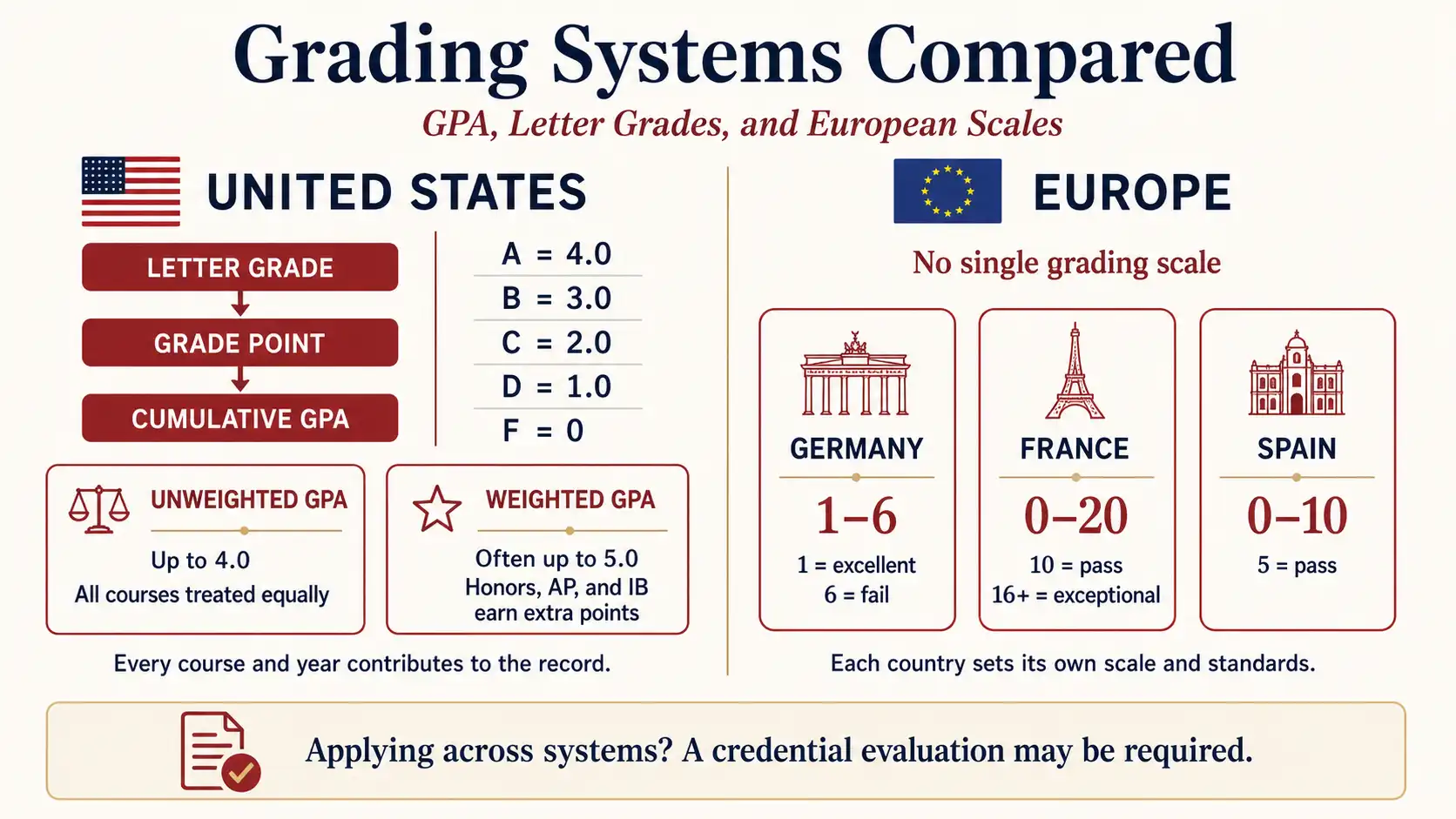
American students are assessed using a letter grade scale running from A through F, which most frequently maps onto a numerical Grade Point Average on a 4.0 scale. An A is broadly understood to carry 4.0 points, a B carries 3.0, a C carries 2.0, and so on. GPA is calculated as a credit-weighted average across all courses taken, meaning classes with more credit hours impact the final score more heavily. Some variation exists regarding whether elective coursework beyond the five academic core subjects is included.
1.2 Weighted vs Unweighted GPA
Two versions of GPA exist in the American system. An unweighted GPA treats all courses equally on the standard 4.0 scale regardless of difficulty. A weighted GPA assigns additional points to honors, AP, or IB courses, often raising the maximum possible score to 5.0. A student with a 3.8 weighted GPA and a student with a 3.8 unweighted GPA are not presenting equivalent records, and universities read them accordingly.
2. How European Grading Works
European grading is nationally standardized within each country but varies significantly across them, in scale, direction, and in what a high score actually represents.
2.1 No Single European Scale
There is no unified grading scale across European education systems. Each country uses its own system, and the scales differ not only in range but in direction and in what a high score actually represents in practice.
2.2 Country-Level Examples
Germany uses a 1 to 6 scale, inverted relative to what most non-German families expect: 1 is the highest possible grade, equivalent to excellent, while 6 represents failure.
France uses a 0 to 20 scale, with 10 as the passing threshold; scores above 16 are considered exceptional and relatively rare.
Spain operates on a 0 to 10 scale, with 5 as the minimum pass mark. These are among the most commonly encountered, but the variation across the continent is wider still.
2.3 What This Means for Cross-System Applicants
When a European student wants to apply to US university, usually, their transcript does not arrive in a format admissions offices automatically recognize or convert. Credential evaluation services assess foreign transcripts and produce a foreign degree equivalent in the US that universities can read alongside domestic applications.
University Admissions in the US vs. Europe
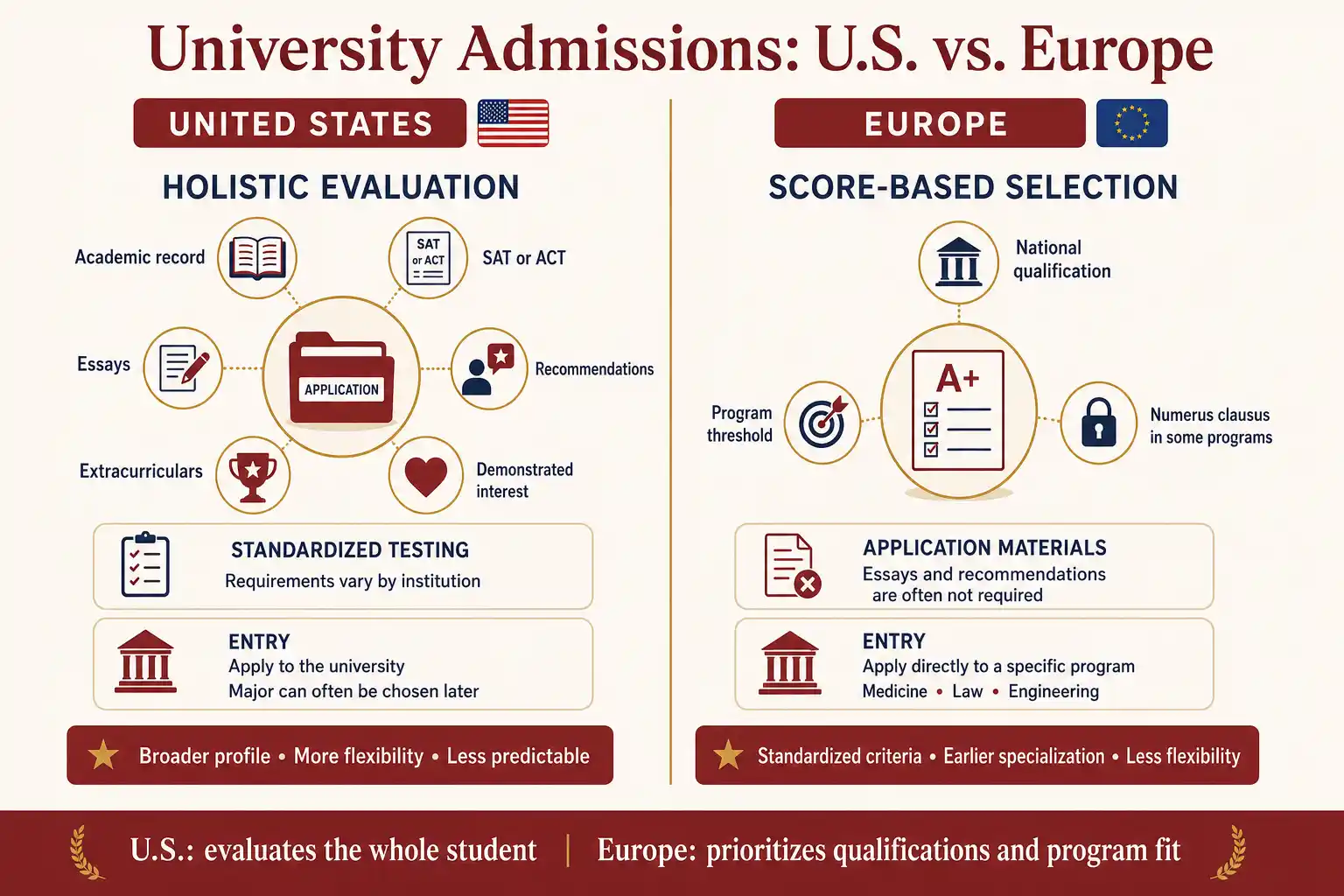
The selection logic in American and European university admissions reflects the same philosophical difference that runs through their school systems: one evaluates the whole student, the other evaluates the score.
1. Admissions in the US
Here is how American colleges and universities select their students, and what that process is designed to measure.
1.1 Holistic Evaluation
American college admissions do not reduce a candidate to a single number. Because GPA varies so significantly across high schools, admissions offices evaluate a broader picture: academic record in context, standardized test scores, essays, letters of recommendation, extracurricular activities, and demonstrated interest in the institution. A student from a less resourced school district with a strong upward trajectory and testing that’s high relative to their cohort can be a competitive candidate alongside a student from a selective prep school with a higher GPA.
The process is covered fully in this guide on how to apply to US universities.
1.2 Standardized Testing
Les SAT and ACT serve as a common measuring stick across an otherwise unstandardized system. For much of the past decade, the role of these tests has been in flux: many American universities moved to test-optional policies during and after the pandemic, though a number of selective institutions have since reinstated testing requirements. The tests remain a significant factor at many universities, but they sit within the broader holistic evaluation rather than determining the outcome on their own.
1.3 What the System Produces
American admissions produces an incoming class of students who are broadly formed, often undeclared, and selected on a range of criteria beyond academic scores alone. The tradeoff is predictability: because the process weighs so many variables, two students with nearly identical academic records can receive different outcomes at the same institution.
For international students applying to American universities, that complexity is part of what makes working through each stage of the process significant. Families who prefer to navigate the process independently can start with college admissions courses; those who want personalized guidance can speak with educational consultants who have been doing this for over 70 years.
2. Admissions in Europe
Here is how European universities select their students, and what that approach reflects about the systems behind it.
2.1 Score-Based Selection
In most European education systems, university admission is driven primarily by the score on the terminal national qualification. A student’s Abitur grade, Baccalauréat score, or equivalent determines whether they meet the threshold for a given program. In some countries and for some programs, this operates through a formal numerus clausus system, a fixed admissions ceiling where only students above a certain score are admitted.
In most cases, there are no essays, no letters of recommendation, and no evaluation of extracurricular involvement. Some competitive programs require interviews or motivation letters, but the terminal qualification score remains the primary determinant.
2.2 Direct Program Entry
Because European students specialize before they leave secondary school, they apply directly to a specific field of study from the outset. A student applies to study medicine, law, or engineering, not to a university in the general sense.
In most European education systems, there is no undeclared pathway, and opportunities to explore disciplines before committing to a field are limited. This means the decision about academic direction, made during secondary school when stream selection occurs, carries consequences that extend well beyond the school years.
2.3 What the System Produces
European admissions produces incoming cohorts of students who are academically specialized from day one, selected on a nationally standardized metric, and already oriented toward a professional or academic field. The tradeoff is flexibility: a student who changes direction after arrival faces structural barriers that an American student switching majors would not encounter in the same way.
For international students considering admissions in European universities, understanding how each country’s system handles cross-border applicants is a separate and necessary step. If you are navigating that process, you can speak with international admissions consultants who have guided families through European university admissions for decades.
Higher Education in Europe vs. the USA
The differences between American and European education systems do not end at admissions. The university experience itself – how long it lasts, what it costs, how it is structured, and what students do outside the classroom – differs fundamentally between the two systems.
1. American College Education
Here is what the American university experience looks like from the inside.
1.1 Degree Structure
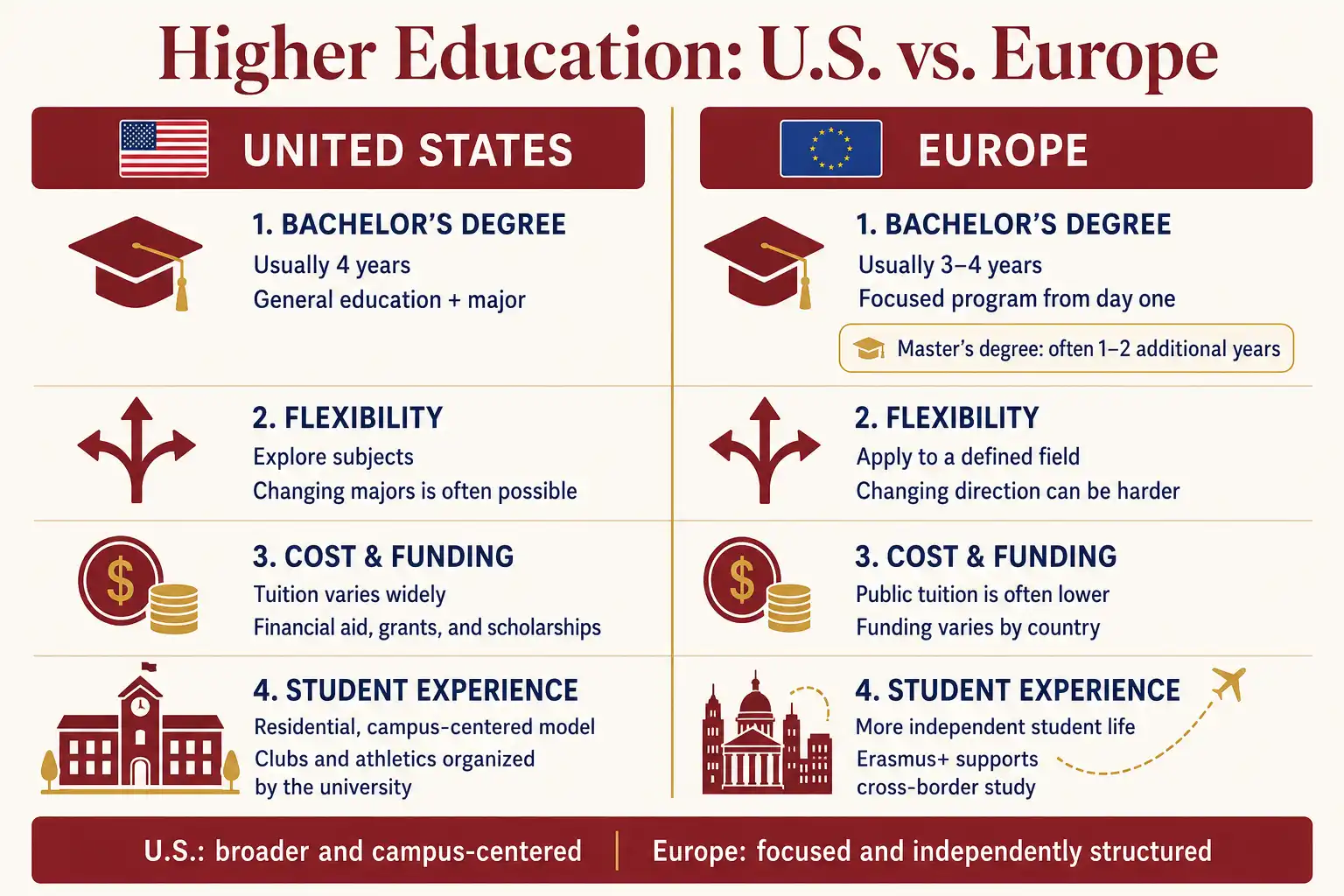
The standard American bachelor’s degree takes four years, but the experience varies significantly by institution type. Research universities offer large-scale programs across dozens of disciplines. Liberal arts colleges emphasize broad intellectual exposure across the humanities, sciences, and social sciences. Community colleges provide two-year associate degrees, often serving as a transfer pathway to a four-year institution.
Professional programs in fields like engineering, business, and nursing are more structured from the outset, though they still typically include general education requirements. Across most of these, students can and frequently do change majors during the early years.
A fuller breakdown of types of colleges in the US covers what each type offers. The bachelor’s degree also serves as the primary gateway to graduate programs: master’s and doctoral degrees are pursued as separate stages after completion.
1.2 Cost and Funding
Tuition at four-year American institutions ranges widely, from state universities charging lower rates for in-state residents to private universities. Financial aid, merit scholarships, need-based grants, and (more rarely) athletic scholarships offset these figures for many families, but the sticker price remains a defining feature of the American system. International students are often eligible for merit-based aid at private institutions, though need-based aid for international applicants is available at a smaller number of schools.
1.3 Campus Life and Experience
American colleges, particularly four-year residential institutions, operate on a campus-centered model. Many students live on campus in dormitories, especially during the first year. Extracurricular life, athletics, student organizations, and social activities are run by the university and are central to the student experience. At these institutions, the campus functions as a self-contained community.
Not all American universities follow this model; commuter campuses and community colleges operate very differently, but the residential experience remains one of the defining features of American higher education.
2. European University Education
Here is how the European model compares to American in practice.
2.1 Degree Structure
The standard European bachelor’s degree takes three to four years under the Bologna framework adopted across most of the continent, depending on the country, institution, and field of study.
Unlike the American model, there is no general education phase. Students enter a focused program from day one and study within that discipline for the duration. European higher education also distinguishes between research universities and applied or vocational universities, which offer practice-oriented degrees in fields like engineering, business, and healthcare.
A master’s degree, typically one to two additional years, is far more common in Europe than in the United States and in many fields is considered the standard professional qualification.
A small but growing number of liberal arts and sciences universities in Europe offer a broader curriculum model closer to the American approach.
2.2 Cost and Funding
Tuition at public universities in many European countries is lower. Germany charges no tuition for domestic or international students at most public universities. France, Spain, and Italy charge modest annual fees.
Public universities in the Netherlands and Switzerland charge higher fees than much of the continent but generally remain below American levels for comparable programs.
However, private universities and specialized schools across Europe, particularly international business schools and some English-taught programs, can charge tuition comparable to American levels. The range is wide, and the cost calculation depends heavily on the country, institution, and program type.
Scholarships exist but operate differently: government-funded programs and some institutional awards are available to international students, but the large-scale need-based and athletic scholarship systems common in the United States do not have a direct European equivalent.
Families exploring this option can compare the top destinations for international students for country-level details.
2.3 Campus Life and Experience
European universities generally do not operate on the American residential campus model. Student housing and halls of residence exist, particularly for first-year and international students, but living on campus is not the default expectation it is at many American institutions. Extracurricular life, athletics, and student organizations exist but are less central to the university experience and less institutionally organized. The university is primarily an academic institution; social life is built more independently around it.
One notable feature is the Erasmus+ program, which enables students to study at a partner university in another European country for one or two semesters as part of their degree, making cross-border mobility a standard part of the European university experience.
Plan Your Next Step
Choosing between American and European education systems is not a question with one right answer. It depends on the student, the academic goal, and the destination. McMillan Education’s international educational consultants have guided families from over 65 countries through every level of this decision, from school selection to university admissions, across both systems.
Planifier une consultation gratuite to get started.
Questions fréquemment posées
1. Is education better in Europe or the US?
Neither system is objectively better. The American education system offers breadth, flexibility, and a holistic university admissions process. European education systems offer earlier specialization, nationally standardized qualifications, and in many countries significantly lower tuition costs. Which system serves a student better depends on their academic goals, preferred learning style, and long-term plans.
2. How are European schools different from American schools?
European school systems generally use a fixed cohort model where students stay in one classroom and teachers rotate, while American students build individual schedules and move between classrooms. Extracurricular activities in Europe are typically organized through independent community clubs rather than through the school. Many European systems also introduce academic or vocational tracking during secondary school, earlier than the American system requires.
3. Is a 3-year European degree accepted in US graduate schools?
In most cases, yes, provided the institution and program are accredited within the Bologna framework. However, some American graduate programs evaluate three-year degrees on a case-by-case basis. Credential evaluation services can clarify equivalency and produce a US-equivalent summary for admissions offices.
4.Can international students study for free in Europe?
At public universities in several European countries, tuition is free or very low for both domestic and international students. However, not all European countries or institutions follow this model. Private universities, business schools, and some English-taught programs can charge significant tuition. Living costs, visa requirements, and program-specific fees also factor into the total cost.
5. Which education system is right for your student?
The answer depends on what the student is trying to achieve. Students who value broad exploration, flexible major selection, and a campus-centered experience may be better served by the American system. Students who already have a clear academic direction, prefer earlier specialization, and want to minimize tuition costs may find European universities a stronger option. In many cases, the decision is not about which system is better but which one aligns with the student’s goals and circumstances.
6. Do European universities teach in English?
A growing number do, particularly in the Netherlands, Scandinavia, and Germany. However, many programs across France, Spain, Italy, and other countries are taught entirely in the local language. Availability of English-taught programs varies by country, institution, and field of study.
7. Is a US degree recognized in Europe?
Yes. American bachelor’s and master’s degrees are widely recognized across Europe, particularly within countries that follow the Bologna framework. Some professional fields may require additional credential evaluation or local certification, but for most academic and career purposes, a US degree is accepted without issue.